Best 48-Inch Press Brake Options for Professional Sheet Metal Work
Looking for a reliable 48-inch press brake to handle 16–20 gauge, mild steel, or aluminum? This guide highlights five top 48″ sheet metal brakes, with practical insights on who each tool suits best and why. Each option balances bending capacity, die configuration, and overall versatility for workshops and production runs. The following summary helps compare features at a glance.
| Product | Capacity | Best For |
|---|---|---|
| VEVOR Box and Pan Brake, 48 in, 0-135° | 0–135°, up to 20 Gauge Steel / 14 Gauge Aluminum | Small to mid-size shops needing versatile angle bending |
| VEVOR Box and Pan Brake, 48 in, 16-Gauge | 0–135°, up to 16 Gauge Mild Steel | Medium-duty fabrication with modular finger dies |
| VEVOR Box and Pan Brake, 48 in, 12-Gauge | 0–135°, up to 12 Gauge Mild Steel | Heavier-duty panels and enclosures |
| KAKA INDUSTRIAL EB-4816M | 6-Ton Magnetic Clamping, 16-Gauge | Open-ended, ductwork, and complex shapes |
| Baileigh HB-4816 | 16-Gauge Mild Steel, 135° | Production runs with repeatable bends |
VEVOR Box and Pan Brake 48-Inch, 0-135 Degrees

This 48-inch brake handles 20-gauge low carbon steel and 14-gauge aluminum, with a 0.31″ thick blade and reinforced rib design for sturdy bending. The integrated press plate secures sheet metal without external clamps, and two handles simplify operation. Best for small manufacturers and DIYers needing solid all-around performance. Limitations include a fixed 0–135° range and the need for proper setup to maximize precision.
VEVOR Box and Pan Brake, 48 in, 16-Gauge

This model focuses on 16-gauge mild steel, offering 0–135° bending with 48-inch capacity. It includes 16 fingers (2″ and 3″ segments, 4″ sections) for customizable, modular bends. Best for mid-sized shops working with varied enclosure or housing panels. A potential limitation is its reliance on finger configuration for complex contours, requiring planning for repeatable results.
VEVOR Box and Pan Brake, 48 in, 12-Gauge

Designed for heavier-duty work, this brake handles up to 12-gauge mild steel with 0–135° adjustment and an 8-finger setup for precise, segmented bending. It’s well-suited for fabricating electrical enclosures or HVAC components. A caution is that 12-gauge bending can require more robust clamping and careful alignment to prevent drift during longer runs.
KAKA INDUSTRIAL EB-4816M Magnetic Box Brake
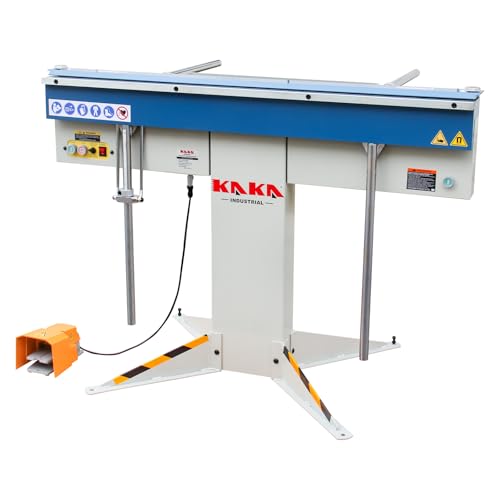
Open-ended design with 6-ton magnetic clamping delivers consistent bends, even at the center, for complex ducts and boxes. It includes multiple clamp bars for straight and segmented bends. Best for open-ended projects requiring high clamping force and flexible configuration. Limitation: magnetic clamping can add setup time and may require close surface contact for best results.
KAKA INDUSTRIAL EB-4816B Magnetic Box Brake

This magnetic 48-inch brake offers 6-ton clamping and open-ended versatility with multiple clamp bars for varied bends. It is well-suited for fabrication that benefits from magnetic holding and simple setup. A potential drawback is magnetic clamping that may not always align perfectly on uneven or dirty surfaces.
Baileigh 48-Inch Manual Sheet Metal Brake

Baileigh’s HB-4816 handles 16-gauge mild steel and offers 135-degree bends along the entire 48-inch length. Stop rod enables repeatable bends for production runs, and components are machined to exact tolerances. This model is ideal for shops prioritizing repeatability, durability, and precision. A note: heavier setups may require space and robust bench preparation.
40s 48″ Sheet Metal Brake Bender Tool (DBMIMPORTERS)

Designed for 20 gauge mild steel and 14 gauge aluminum, this brake can produce up to 90-degree bends across 48 inches. It is a practical choice for HVAC ductwork and roofing components where moderate accuracy and speed are needed. Limitation: fewer advanced features beyond basic bending may require supplementary tools for high-precision tasks.
Prolinemax 48″ Sheet Metal Brake

Pro 48″ brake accommodates up to 20-gauge mild steel and 14-gauge aluminum with 0–90 degree or 45-degree bend angles. It is positioned as a reliable option for HVAC and duct manufacturing with straightforward operation. A caution is that some setups may require careful alignment to ensure clean, consistent bends across long panels.
Buying Guide: Key Purchase Considerations
- Material compatibility: Match the brake capacity to the sheets you most often bend (mild steel, aluminum, stainless steel) and gauge range (12–20 gauge).
- Bend range and precision: Look for models offering 0–135° or 0–90° ranges and features like stop rods or segmented dies for repeatability and accuracy.
- Die and finger configuration: Modular fingers or multiple clamp bars enable complex bends and custom profiles. Consider future project needs.
- Clamping method: Magnetic versus mechanical clamping affects setup speed, surface compatibility, and ease of use on varied surfaces.
- Workpiece length and capacity: A full 48″ bend length suits large panels, while lighter-duty units may be easier to maneuver in small shops.
- Repeatability for production: For production runs, prioritize machines with repeatable bends, sturdy pivots, and robust construction.
Frequently Asked Questions
- What gauge materials can a 48-inch brake handle efficiently?
Answer varies by model; many 48″ brakes handle up to 16–20 gauge mild steel and 14–16 gauge aluminum, with some models handling heavier gauges. - Is magnetic clamping better than mechanical clamping?
Magnetic clamping offers quick setup and flexibility, but requires clean, flat surfaces for best results; mechanical clamps can provide more consistent clamping force on uneven surfaces. - Do I need modular dies or fixed dies?
Modular dies increase versatility for complex shapes and custom profiles; fixed dies are simpler and often sufficient for straightforward bends. - How important is a stop rod for production runs?
Stop rods enable repeatable bends, which is crucial for consistency in production and multiple identical parts. - What maintenance is needed for these brakes?
Regularly inspect clamps and pivots, keep moving parts clean, and ensure alignment of fingers and dies to prevent drift during bends. - Can these brakes bend stainless steel?
Some models claim stainless steel compatibility; verify the specific gauge and material recommendations for each unit to ensure safe operation.