Best 5th Axis Self-Centering Vises for Precise Multi-Axis Machining
Answering the need for stable, accurate, and flexible workholding in five-axis CNC setups, this guide highlights top 5th axis self-centering vises. These fixtures are best for shops requiring quick, repeatable clamping on complex parts, such as aerospace components, mold tooling, and precision mechanical parts. The listed models cover a range from compact portable units to larger, high-capacity vises compatible with 52-point quick-change plates. Use this overview to compare clamping ranges, jaw configurations, and compatibility with multi-axis workflows.
| Product | Best For | Jaw Range / Opening | Notable Limitation |
|---|---|---|---|
| RATTMMOTOR ZF-70-100 | Small to mid-size parts, precise repeatability | 6–80 mm clamping range | May require proper jaw orientation for negative jaw clamping |
| XinDianPAF H77-120 | Compact, portable setups with easy jaw changes | 0–4.7 inch opening | Jaw replacement may affect setup time |
| KSSCV-M90210 (MGMYVDDGVW) 8 Inch | Heavy-duty, quick clamping on round workpieces | Not specified in spec list | Primarily clamping for round materials |
| HHIP 3900-2239 | Five-axis self-centering with zero-point capabilities | 75 mm jaws; 96 mm pin space | Higher complexity; may require system matching |
| RATTMMOTOR ZF-90-150GJ | Large workpieces; strong, stable hold | 0–143 mm total clamping | Requires larger spindle/tool clearance |
RATTMMOTOR CNC 5-Axis Self-Centering Vise ZF-70-100
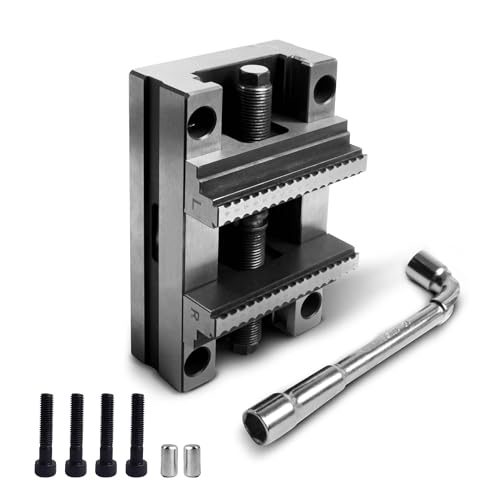
Model: ZF-70-100; Total clamping range: 6–80 mm; Positive jaw clamping: 28–80 mm; Reverse jaw clamping: 6–54 mm. Weight: 1.86 kg. This self-centering vise supports precise, repeatable clamping with a detachable jaw design, enabling quick transfer between positive and negative jaw configurations. Best for CNC three-, four-, and five-axis machines that require fast jaw changes and stable alignment. Limitations include jaw orientation sensitivity for certain workpiece geometries.
Best for: small to mid-size parts where fast jaw changes and repeatable positioning are critical. The detachable jaws make it easier to adapt to different workpiece profiles without swapping the entire vise.
XinDianPAF 5.1 Inch H77-120 Self Centering Vise

Spec highlights include a 0–4.7 inch opening and a 5.1 inch approach size. The jaws are disassemblable and replaceable, offering high hardness and wear resistance suitable for electrode processing and mechanical parts work. Best for: compact, portable setups where jaw changes are frequently required and workpieces vary in contour. Caution: ensure compatibility with your machine’s mounting pattern and table space.
Self-Centering Vise KSSCV-M90210 8 Inch 5 Axis

Brand: MGMYVDDGVW. Features include enhanced grip for clamping and suitability for quick tightening after sanding. This 8-inch self-centering model is designed to fit CNC machine tables and is aimed at five-axis operations requiring stable clamping with straightforward mounting. Best for: workshops needing an 8-inch vise with improved clamping feel for round or irregular workpieces. Limitation: explicit jaw range and compatibility details are not listed in some product pages.
Self-Center Vise KSSCV-M90210 8 Inch 5 Axis Rotary Table Vise
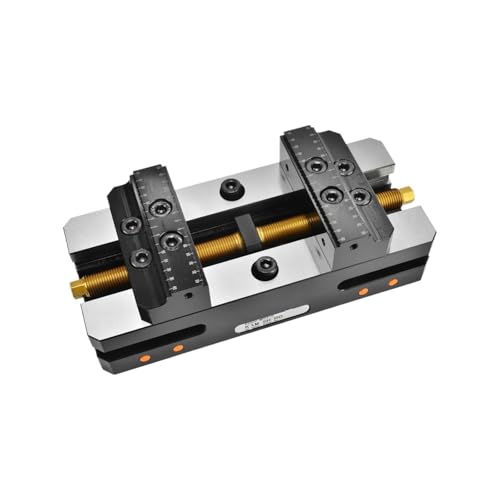
Same MGMYVDDGVW offering as the previous entry, this model emphasizes convenience for clamping round materials and quick adjustments on a workbench or rotary table. Best for: five-axis workflows where repetitive clamping of round parts is common. Caution: check the exact mounting pattern and table compatibility for your CNC setup.
HHIP 3900-2239 5-Axis Self-Center CNC Vise

Made in Taiwan, this vise features quick reversible jaw changes and a patented swing of 1.50 degrees on one side for better grip when a workpiece isn’t parallel. It supports zero-point clamping and is compatible with 96-mm pin spacing, enabling self-centering operations for five-axis machines. Best for: shops adopting a zero-point system or needing reliable five-axis clamping with robust jaw design. Limitation: might require matching with compatible zero-point equipment and spare parts.
RATTMMOTOR Self-Centering Vise 90–150GJ
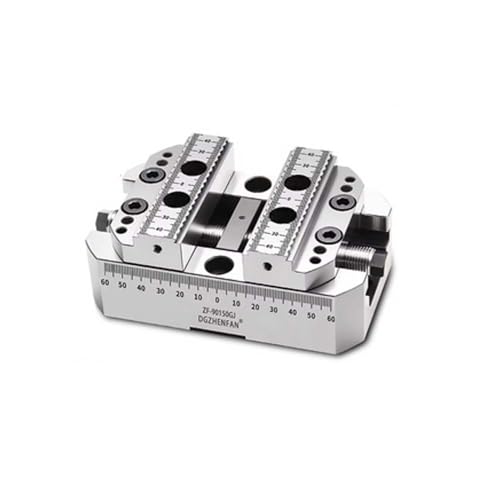
Clamping range: forward 0–97 mm, reverse 41–143 mm, total 0–143 mm. This model offers greater clamping capacity than shorter models and is suitable for larger workpieces. Maximum recommended torque: 60 Nm, aiding rigid clamping while protecting the lead screw and vise body. Best for: five-axis machines handling larger parts or deeper pockets. Caution: ensure sufficient space on your machine table for the extended stroke.
Buying Guide
Key purchase considerations help identify the right five-axis self-centering vise for your shop:
- Clamping range: Match the expected part sizes with the vise’s forward, reverse, and total clamping capabilities to avoid under- or over-clamping.
- Jaw design and adjustability: Detachable or replaceable jaws enable faster adaptation to different contours and surfaces without swapping the entire vise.
- Jaw opening and reach: For tight pockets or tall features, consider larger opening and extended stroke options.
- Mounting compatibility: Check plate compatibility (e.g., 52-point quick-change plates or zero-point systems) and ensure your CNC table can accommodate it.
- Material and wear: High-hardness jaws and wear-resistant screws improve longevity in repeated cycles and heavy use.
- Five-axis workflow fit: Look for self-centering designs that support both positive and negative jaw configurations to maximize versatility on five-axis setups.
- Space and clearance: Larger vises require sufficient machine table space and tool clearance to avoid interference during multi-surface milling.
FAQ
- What is a self-centering vise? A vise that maintains alignment of both jaws around a workpiece, enabling consistent clamping in multi-axis setups.
- Why choose a detachable jaw design? It allows quick adaptation to different workpiece shapes without replacing the entire vise, improving throughput.
- Can these vises work with zero-point systems? Some models are designed for zero-point or 52-point quick-change plates, which can speed changeovers in five-axis machining.
- What should I consider for large workpieces? Choose a model with a higher total clamping range and extended stroke to handle bigger parts safely.
- Are there cautions about five-axis use? Ensure proper mounting, avoid interferences with tool paths, and verify that the vise can handle the required torque without deformation.
- Do these vises require special tooling? Some models may integrate with specific jaws or bases; verify compatibility with your existing fixtures and tooling ecosystem.