Best Box Label Applicator Machines for Fast, Precise Labeling
Answering the need for efficient labeling, these box label applicator machines offer portable, semi-automatic, or manual options ideal for small-batch packaging, warehouse labeling, or DIY labeling setups. The top picks here are best for small businesses, home labeling projects, or shops that need quick, reliable label placement on round or flat surfaces. The following summary compares five relevant models to help buyers choose the right tool for their labeling tasks.
| Product | Best For | Notes | |
|---|---|---|---|
| Spolehli Label Applicator | Small-batch labeling on various shapes | 0.8–1.8 in × 0.8–3.0 in | Portable, comfortable grip; may require multiple presses for long labels |
| VEVOR Manual Round Labeling Machine | Simple rounds, quick setup | 0.78–4.72 in | Good balance of speed and control; manual operation |
| Hanchen Label Applicator | Durable, portable handheld labeling | 0.8–1.8 in × 0.8–3.0 in | Comfortable, durable design; similar specs to Spolehli |
| Hanchen Semi-Automatic Round Bottle Labeling Machine | Higher efficiency for round bottles | Φ0.6–4.7 in | Automatic optical alignment; higher labeling efficiency |
| Sumeve Manual Round Labeling Machine | Versatile round bottle labeling | 0.6–4 in diameter | Simple manual operation; broad bottle range |
Spolehli Label Applicator

Best for: Small businesses or hobby labeling tasks that require a portable handheld tool. This model supports label sizes from 0.8 to 1.8 inches in length and 0.8 to 3.0 inches in width, with a label roll inner diameter over 0.8 inches. The design emphasizes a comfortable grip and non-slip handling, with a lanyard for easy storage. It is particularly suitable for quick, on-the-spot labeling on varied surfaces. Limitation: If a label is longer than 1.8 inches, you may need to press multiple times to complete the labeling process.
VEVOR Manual Round Labeling Machine

Best for: Facilities needing fast manual round labeling with a simple workflow. It claims labeling 15–20 bottles per minute, aided by a round bottle press bar and rubber roller to minimize bubbles. The universal fit accommodates bottles from 0.78 to 4.72 inches in diameter and supports various label widths and lengths. Caution: Not suitable for some transparent label papers; verify label type fits the machine and your production needs.
Hanchen Label Applicator
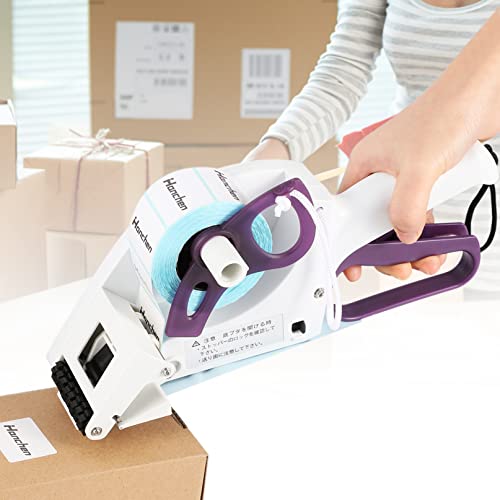
Best for: Users who want a durable, portable handheld applicator with reliable labeling on 0.8–1.8 inch length labels and 0.8–3.0 inch widths. The Hanchen model features a similar ergonomic and durable design to the Spolehli, with a focus on a smooth rotation and easy hanging for storage. Limitation: If long labels exceed 1.8 inches, multiple passes may be necessary to finish a full label application.
Hanchen Semi-Automatic Round Bottle Labeling Machine

Best for: Businesses seeking higher efficiency than a manual gun, with automatic optical fiber positioning to improve labeling accuracy on cylindrical products. It supports bottles with diameters from 0.6 to 4.7 inches and uses a robust aluminum alloy body for durability. Caution: The semi-automatic operation requires setup and alignment, which adds a learning curve compared to fully manual devices.
Sumeve Manual Round Labeling Machine (White)

Best for: Round bottle labeling on a budget with broad compatibility for diameters 0.6–4 inches. This model emphasizes a manual approach, providing a straightforward mechanism for small batches and quick adjustments. Limitation: Its design is best suited for round or cylindrical items; not ideal for oddly shaped bottles or flat surfaces.
Buying Guide
- Label type and size compatibility: Check label width, length, and inner/outer roll diameters. Some devices handle 0.8–3.0 inch widths, while others accommodate longer labels; ensure your label stock fits the machine’s supported range.
- Bottle or surface shape: For round bottles, consider devices with a round bottle press bar or optical alignment features. For flat or irregular shapes, a handheld manual applicator with a stable grip may perform better.
- Speed and production needs: Manual devices are simple and cost-effective but slower; semi-automatic models improve labeling speed and consistency and may reduce waste due to precise sensing.
- Durability and material quality: Look for metal or high-strength polymer bodies, rust-resistant components, and ergonomic handles for extended use without fatigue.
- Maintenance and availability: Consider tools with straightforward parts replacement and readily available support or replacement components.
How to choose by use case:
– Home or craft labeling: prioritize portability and ease of use (Spolehli, Hanchen).
– Small business labeling: balance speed and accuracy with semi-automatic options (Hanchen Semi-Automatic, VEVOR Semi-Automatic).
– Budget labeling or quick experiments: consider basic manual models (Sumeve, Generic).
FAQ
- What is the main difference between manual and semi-automatic label applicators? Manual devices require full operator input for each label, while semi-automatic models automate certain steps (sensing, positioning) to improve speed and accuracy.
- Are these devices suitable for all bottle shapes? Most are optimized for round bottles or flat surfaces. Oddly shaped items may require specialized tooling or a different approach.
- Can these labelers handle different label sizes? Yes, each device lists its compatible label dimensions; verify both width and length ranges before purchase.
- Do these tools work with transparent labels? Some models note limitations with transparent label papers. Check product specifics to ensure compatibility with your stock.
- Is a mounting or alignment setup required? Some semi-automatic models require alignment or calibration before use; manual models typically need minimal setup.
- What maintenance is recommended? Regularly clean rollers and contact surfaces, check for wear on the pressing bar, and replace worn parts as needed.