Best Ceramic Gauge Block Sets for Precision and Stability
Answering the need for durable, thermally stable measurement references, ceramic gauge block sets offer high dimensional stability and wear resistance. This guide highlights top ceramic options suitable for workshops, metrology laboratories, and precision machining. Best for environments where temperature fluctuations and corrosion are concerns, these sets help maintain accurate reference dimensions. The selections below emphasize clarity, stability, and practical use for different budgets and applications.
| Product | Material | Best For | Notes |
|---|---|---|---|
| CME 81 pc Ceramic Gauge Block Set | Ceramic | High-precision labs and calibration rooms | Grade 1; includes deviation certificates |
| Mitutoyo Ceramic Square Gage Block Set | Ceramic | Dimensionally stable wringing and reference work | AS-2 quality; includes inspection certificate |
| INSIZE 4005-136 Ceramic Gage Block Set | Ceramic | General purpose high stability in production | AS-1 grade; manufacturer certificate |
| MeterTo Ceramic Gage Blocks, 32 Pieces | Ceramic | Non-magnetic, non-conductive environments | Grade 0; JIS B 7506 compliant |
| 81 PCS Ceramic Gage Block Set Grade 1 | Ceramic | NIST-traceable references for calibration | NIST Equivalent Certificate |
CME 81 pc Ceramic Gauge Block Set, Grade 1

The CME 81 pc Ceramic Gauge Block Set provides Grade 1 accuracy with 81 blocks. Manufactured under controlled conditions, each gauge block is calibrated at 68°F and tested for accuracy. A certificate lists the deviation for each block, aligning with ASME B89.1.9-2002 Federal Standards. Best for laboratories and calibration labs needing comprehensive ceramic reference sets, this option emphasizes traceability and documentation. A potential limitation is the need to maintain a stable environment to preserve ceramic accuracy over time.
Mitutoyo Ceramic Square Gage Block Set, ASME Grade AS-2

This Mitutoyo set uses ceramic blocks for dimensional stability and thermal resistance, with a square base to enhance wringing accuracy and a dedicated inspection jig. Grade AS-2 blocks come with a certificate of inspection confirming ASME B89.1.9 compliance. It suits users who want reliable, stable references for inspection work and calibration stacks. A limitation is that AS-2 blocks may be more expensive than other grades, reflecting higher stability requirements.
Accusize Industrial Tools Precision 81-Piece Steel Gauge Block Set

Although primarily steel rather than ceramic, this 81-piece set is included for comparison where mixed material references are used. It comes with a certificate and is calibrated to 68°F (20°C). Best for users seeking a broad range of sizes with traceable certificates; however, it is not ceramic, so it may exhibit higher thermal sensitivity than ceramic options. Choose this if you need a large steel set for general calibration in varied environments.
81 PCS Ceramic Gage Block Set Grade 1, NIST Certificate

This CME set emphasizes a Grade 1 ceramic reference with a NIST-equivalent certificate (#702-CC01). It is well-suited for labs needing thorough documentation and traceability for high-precision calibration tasks. The ceramic material offers lower thermal expansion than metals, reducing drift in controlled environments. A possible constraint is the higher initial cost compared to basic grade sets.
INSIZE 4005-136 Ceramic Gage Block Set, AS-1

INSIZE’s 4005-136 is a Grade AS-1 ceramic set noted for wear resistance and excellent dimension stability. Supplied with a manufacturer inspection certificate, this set is ideal for shops prioritizing stable measurements in environments with potential chemical exposure or humidity. It’s best for users who require strong corrosion resistance and reliable base measurements, with a caution that AS-1 may not reach the absolute lowest tolerances some AS-2 sets offer.
MeterTo Ceramic Gage Blocks, 32 Pieces
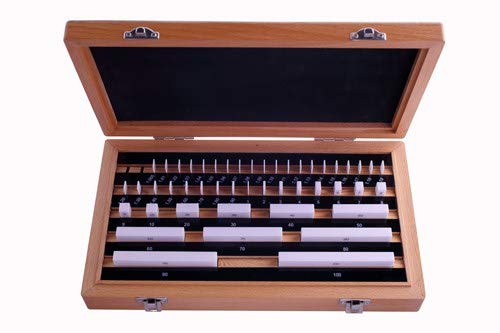
MeterTo’s 32-piece set provides a compact, non-magnetic, non-conductive option for environments with sensitive electronics or magnetic interference. The blocks offer high dimensional stability and are designed to prevent plastic deformation, making them suitable for short-run calibration tasks. A limitation is the smaller block count, which may require additional sets for broader measurement ranges.
Buying Guide
Key considerations to choose the right ceramic gage block set:
- Material and grade: Ceramic blocks come in AS-1, AS-2, or Grade 0/1 equivalents. Higher grades generally offer better stability and tighter tolerances but at higher cost.
- Calibration and certificates: Decide whether you need a set with a formal inspection certificate or NIST/ASME traceability for regulatory or quality systems.
- Environmental conditions: For environments with temperature fluctuations, ceramic blocks minimize thermal drift compared to steel blocks.
- Block count and size range: Ensure the set covers the measurement range you frequently use. Larger sets enable more calibration steps without swapping blocks.
- Wringing surfaces: Ceramic often has favorable wringing properties, but verify if a dedicated inspection jig or base is included or recommended by the manufacturer.
- Durability and use-case: Ceramic offers corrosion resistance and wear resistance, making it suitable for labs and production lines that handle frequent use.
- Documentation needs: If you require strict traceability, prefer sets with explicit certificate numbers and serial tracking.
Which set is best for you?
- Choose this if you need comprehensive grain-to-grain stability and full certification: CME 81 pc Ceramic Gauge Block Set (Grade 1), or the 81 PCS Grade 1 with NIST certificate.
- Choose this if you require a balance of price, stability, and ASME compliance: Mitutoyo Ceramic Square Gage Block Set (AS-2).
- Choose this if you want a compact, highly stable option for non-magnetic environments: MeterTo Ceramic Gage Blocks (32 pieces).
- Choose this if you require AS-1 stability with an inspection certificate from the manufacturer: INSIZE 4005-136 Ceramic Gage Block Set (AS-1).
Maintenance and care tips
- Store blocks in a clean, dry case to limit moisture exposure and corrosion risk, especially for the few steel blocks in mixed sets.
- Handle blocks with care to avoid chipping or surface damage that can affect wringing and measurements.
- Calibrate and re-certify periodically according to internal quality policies and external standards.
- Use proper cleaning methods as specified by manufacturers to preserve surface conditions and accuracy.
FAQ
- What is the main benefit of ceramic gauge blocks?
Ceramic blocks offer superior dimensional stability and corrosion resistance, reducing drift in fluctuating temperatures and humid environments.
- Do all ceramic gauge blocks come with certificates?
No, certificates vary by model. Some sets include a certificate of inspection, while others may have a NIST-equivalent certificate or certificate from the manufacturer.
- Which grade should I choose for high-precision calibration?
Grade AS-2 or Grade 1 (AS-1) are common for high-precision tasks; AS-2 is a typical balance of accuracy and cost, while Grade 1 offers tighter tolerances.
- Is a larger block count always better?
A larger set provides more calibration points and range, but consider your typical measurement needs and workspace storage constraints.
- Can ceramic blocks replace steel blocks entirely?
Ceramic blocks are preferred where thermal stability matters, but steel blocks may still be useful for certain mechanical testing or rough calibrations in stable environments.
- What is wringing and why does it matter?
Wringing is the process by which gage blocks adhere together to form a stable stack; good wringing surfaces improve alignment and reduce measurement errors in stacks.