Best CNC 4th Axis Rotary Table for Precision Engraving and Milling
From precise 4th-axis rotation to reliable tailstock support, a high-quality rotary table can elevate CNC engraving, milling, and carving projects. This guide highlights top 5 4th-axis rotary tables designed for versatility, strong holding power, and smooth operation. Each option supports common CNC routers and milling machines, with various jaw configurations, reduction ratios, and shaft through-holes. Read on to compare key specs, potential applications, and what to consider before buying.
| Product | Key Feature | Typical Use |
|---|---|---|
| CNCTOPBAOS K12-100mm | 6:1 reduction, MT2 tailstock | Engraving cylinders and rounded workpieces |
| CNCTOPBAOS K11-65mm | 4:1 ratio, 63mm chuck | Compact routing and light-duty turning |
| CNCTOPBAOS K11-100mm Hollow Shaft | 6:1 ratio, hollow shaft | Longer workpiece access |
| FoxAlien 4th Axis | 30:1 harmonic reducer, 0.1° resolution | High-precision engraving and curved surfaces |
| RATTMMOTOR K11-130mm | 4:1 belt deceleration, Nema34 motor | Heavy-duty routing and metalworking |
CNCTOPBAOS K12-100mm CNC 4th Axis Rotary Table

The K12-100mm model integrates a 4th-axis rotating head with a 6:1 reduction ratio, housed in an aluminum alloy base. The MT2 tailstock uses a Morse taper 2 live center for stable alignment. A Nema23 hybrid stepper motor provides precise control with a 1.8° step angle and about 1.8 Nm of holding torque. The through-hole shaft diameter is 22 mm, and the output shaft measures 30 mm, enabling steady rotation and robust clamping. This setup supports 3D engraving, cylindrical profiles, and round parts on compatible CNC machines.
Key features include a compact footprint (210 x 168 x 115 mm) and a weight around 7.9 kg, balancing rigidity with machinability. The system is designed for repeatable positioning and smooth operation under typical hobbyist to small-shop workloads. Suitable software integration depends on your controller and firmware, so verify compatibility with your setup before mounting. The included tailstock adds axial support for longer or cantilevered workpieces.
CNCTOPBAOS K11-65mm CNC 4th Axis with Three-Jaw Chuck

The K11-65mm configuration features a 3-jaw chuck with a belt-driven 4:1 reduction system. With a center height of 54 mm and an overall height of 85 mm, this unit is compact and approachable for smaller projects. The chuck accepts a clamping range from about 1 to 50 mm, while the centering precision is stated at 0.05 mm, supporting accurate rotational positioning for engraving, drilling, and milling tasks. The tailstock has a 54 mm center height and provides a 30 mm telescopic stroke, enabling flexible setups for short‑ to mid-length parts.
Build quality emphasizes durability and stable performance in routine machining. The MT2 tailstock is included with a locking wrench, aiding quick tool changes and adjustments. While the belt-driven reduction can help simplify tension management, users should verify belt wear and alignment during maintenance. This model suits users seeking a smaller, cost-effective rotary axis without sacrificing essential 4th-axis capabilities.
CNCTOPBAOS K11-100mm Hollow Shaft Rotary Axis
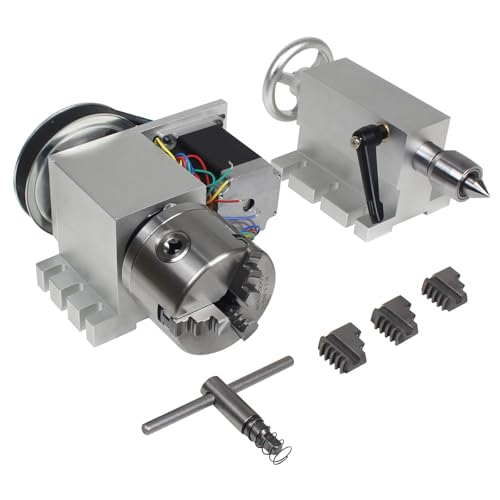
This 100 mm hollow shaft rotary axis is designed for longer workpieces, featuring a 6:1 reduction ratio and a hollow shaft diameter of 16 mm. The 65 mm MT2 tailstock height provides compatibility with a variety of backing devices and support fixtures. The system uses a Nema23 hybrid stepper motor with a 1.8° step angle, delivering 270 oz-in (about 1.8 Nm) of holding torque. The overall dimensions are 210 x 168 x 115 mm, and the unit weighs around 6.3–7.7 kg depending on configuration.
With a sturdy aluminum alloy base and precise machining, this model supports cylindrical, curved, and asymmetric shapes. The hollow shaft enables passing bars or longer stock through the center, expanding the range of possible projects. It’s a versatile choice for shops needing extended reach without sacrificing the reliability of a dedicated 4th axis. Applications include round engraving, screw-threading demonstrations, and multi-axis alignment experiments.
RATTMMOTOR K11-130mm CNC Rotary Axis with 3-Jaw Chuck

The K11-130mm rotary axis from RATTMMOTOR uses a three-jaw chuck and a 4:1 belt deceleration to achieve strong clamping and steady rotation. The center height is 100 mm with a total height of 165 mm and a through-hole diameter of 30 mm, enabling longer stock to pass through the axis for uninterrupted machining. The motor is a two-phase, four-wire Nema34 driver with a holding torque of around 4.5 N·m, paired with a synchronous belt 5M-450, 15 mm wide, to deliver controlled motion.
The device supports heavy-duty milling and engraving tasks, offering robust performance for more demanding workflows. Its larger chuck opening (up to 130 mm) accommodates bigger parts, while the Nema34 motor provides meaningful torque for challenging operations. Precision is aided by a 0.45 degree per step angle and reliable mechanical design, making it a strong option for users needing higher-duty-cycle 4th-axis rotations on capable CNC systems.
Buying Guide: Key Considerations When Choosing a CNC 4th Axis
Purpose and compatibility: Identify whether you primarily engrave, mill, or shape cylindrical parts. Check compatibility with your CNC router or milling machine, including mount type, mounting spacing, and required tailstock support. Ensure the rotary axis can be integrated with your control system and software (GRBL, Mach3/4, LinuxCNC, etc.).
Reduction ratio and torque: Higher reduction ratios can improve resolution and torque, but may reduce speed. Assess the need for fine positioning versus rapid rotation. Consider motor type (Nema23 vs Nema34) and the corresponding torque and current requirements to meet your workload.
Jaw chuck configuration: A three-jaw chuck is easier for round parts, while a four-jaw or hollow-shaft design expands clamping options and long-stock compatibility. Ensure clamping range covers your typical stock diameter, and verify centering accuracy and repeatability specifications.
Tailstock features: A dependable MT2 or alternative tailstock helps support axial loads and longer workpieces. Look for a tailstock with adjustable or locking features, stroke length, and ease of alignment to maintain concentricity during rotation.
Construction and longevity: Aluminum alloy bases reduce weight while preserving rigidity. Assess the overall dimensions to fit your workspace and the device’s weight for handling and mounting. Durable bearings, precise machining, and protective coatings contribute to long-term reliability.
Maintenance and accessories: Check for available spare jaws, replacement belts, and service support. Consider whether the manufacturer provides documentation and setup guides, which can shorten the learning curve and improve performance.
Budget and scale: For hobbyists, a compact 4th axis with reliable performance may suffice. For small workshops or professional use, prioritize higher torque, longer stock-through capability, and robust control options. Balance upfront cost with anticipated throughput and accuracy needs.
Safety and setup: Ensure safe mounting, proper shielding of moving parts, and secure electrical connections. Follow manufacturer instructions for wiring, alignment, and initial calibration to achieve repeatable results and minimize damage to tooling or workpieces.