Best Commercial Air Compressor Dryers for Industrial Use
That is, high-demand environments need reliable, energy-efficient refrigerated air dryers to deliver consistently dry compressed air. This guide focuses on five top options suited for 15–30+ HP industrial compressors, highlighting who benefits most from each model and where to choose one over another. The selections emphasize robust moisture removal, straightforward control, and durable construction for workshops, assembly lines, automotive shops, and manufacturing facilities. Use the comparison table below to quickly assess key specs and decide which dryer aligns with your equipment and workflow.
Product Comparison Snapshot
| Product | Flow (CFM) | Refrigerant | Best For | Notable Point |
|---|---|---|---|---|
| VEVOR Compressed Air Dryer 85 CFM | 85 | R134a | Mid-sized industrial setups; 15–20 HP compressors | Color screen control panel; automatic drainage |
| VEVOR Compressed Air Dryer 125 CFM | 125 | R410a | Higher-demand plants; 20–30 HP systems | Higher throughput; large evaporator |
| HPDAVV 35 CFM Refrigerated Dryer | 35 | R134a | Workshops, garages, smaller shops | Compact, cost-effective option |
| SCHULZ 75 CFM Refrigerated Dryer | 75 | Not specified | Industrial setups with pre-filters | Includes water separator and coalescing filter |
| 3/4″ NPT Industrial Air Dryer (CAtArt) | Varies by setup | Not specified | Versatile filtration for plasma cutters and paint spray | Four-stage filtration; automatic drain |
VEVOR Compressed Air Dryer 85 CFM

Best for: Medium-sized industrial facilities with 15–20 HP compressors. This model handles up to 85 CFM, delivering moisture and impurity removal for cleaner air. It uses R134a refrigerant and supports a wide working pressure range (87–232 PSI). The color touch panel simplifies monitoring and adjustments, while automatic drainage reduces maintenance needs. Limitation: Dew point ranges from 35.6–50°F, which may be less aggressive in extremely hot environments.
VEVOR Compressed Air Dryer 125 CFM
Best for: Larger industrial lines with 20–30 HP compressors. This unit provides 125 CFM of dry air with efficient moisture removal and a robust evaporator for fast condensation. It uses R410a refrigerant and accommodates a broad inlet temperature range. Advantage: Higher throughput supports more aggressive production schedules. Caution: The higher flow requires sufficient space and proper air piping layout to avoid pressure losses.
HPDAVV Refrigerated Dryer, 35 CFM
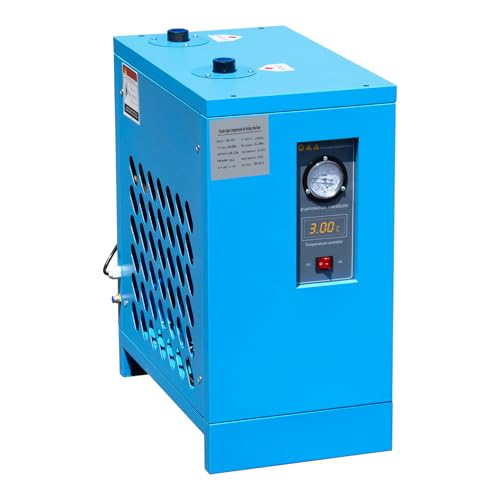
Best for: Workshops, garages, and light industrial uses requiring dry air for pneumatic tools and spray painting. The 0.58 kW R134a cooling system maintains stable temperatures for moisture control at 35 CFM. Advantage: Compact footprint and straightforward installation. Limitation: Lower flow means not ideal for high-demand lines without parallel dryers or staged capacity.
SCHULZ 75 CFM Refrigerated Dryer

Best for: Industrial setups requiring a complete kit with moisture and oil removal. This non-cycling dryer includes an industrial water separator and a coalescing filter, supporting ultra-dry air at 100 PSI. Choose this if you need an all-in-one kit with pre-filter readiness. Caution: Ensure the compressor output does not exceed 175 PSI to protect the stage 1 and 2 filters.
3/4″ NPT Industrial Air Dryer (CAtArt)

Best for: Multi-stage filtration needs in plasma cutting or paint spraying workflows. This 3/4″ NPT system offers a four-stage filtration with automatic drainage and a 0.01-micron coalescing filter for high-efficiency removal of oil and moisture. Advantage: High filtration performance supports ultra-dry air. Limitation: Installation and maintenance may be more complex due to multiple stages and component checks.
Buying Guide
What to consider when choosing a refrigerated air dryer
- Flow capacity vs. compressor horsepower: Match the CFM rating to your system’s demand to avoid undersizing or over-sizing the dryer.
- Refrigerant type and efficiency: R134a and R410a are common; newer models may offer more efficient cooling and faster moisture removal.
- Moisture removal specs: Look for dew point data and evaporator size to ensure adequate dryness for your tools and processes.
- Control and maintenance: Color touch panels and automatic drainage reduce operational overhead.
- Pre-treatment needs: Some models assume pre-filters; others come as complete kits with water separators and coalescing filters. Plan piping layout accordingly.
- Space and installation: Higher-flow units require more room and proper air piping to maintain performance; consider future expansion.
- System compatibility: Verify inlet/outlet connections (NPT sizes) and working pressure ranges to ensure seamless integration with existing compressors.
Which dryer should you choose?
- For budgets and smaller spaces: HPDAVV 35 CFM offers a compact, cost-conscious option suitable for garages and light industrial use.
- For mid-range industrial lines: SCHULZ 75 CFM provides an all-in-one kit with pre-filters and a robust moisture/oil removal path.
- For higher demand: VEVOR 85 CFM and VEVOR 125 CFM models deliver stronger throughput, with the 125 CFM ideal for 20–30 HP systems.
- For versatile filtration needs: The 3/4″ NPT CAtArt setup is a multi-stage solution suited for plasma cutting and paint spray workflows requiring high contamination control.
Maintenance and safety tips
- Schedule regular drain checks to prevent condensate buildup in lines.
- Inspect filters and replace as needed to maintain optimal dryness.
- Ensure electrical connections and refrigerant lines are inspected by qualified technicians.
Frequently Asked Questions
- What is the main purpose of a refrigerated air dryer?
To remove moisture from compressed air, preventing rust and corrosion in downstream tools and equipment. - How do I know if I need a 85 CFM vs 125 CFM dryer?
Compare your peak air demand (CFM) with the dryer’s capacity to avoid bottlenecks or wasted energy. - Can these dryers handle oil removal as well?
Many units are designed to reduce oil aerosols via coalescing filters or integrated oil removal stages; refer to each model’s filtration setup. - What maintenance is required after installation?
Regular drain checks, filter replacements, and periodic inspections of the refrigeration components are advised. - Are pre-filters always necessary?
Some configurations require pre-filters to protect the dryer stages and maintain performance, especially in dirty or oily air streams.