Best Dissolved Oxygen Data Logger Options for Accurate Water Monitoring
For researchers, aquaculture professionals, and water-quality technicians, a reliable dissolved oxygen data logger is essential. This guide highlights five top options, explaining who each is best for and why they stand out. Each product is evaluated on DO range, temperature handling, data storage, and ease of transfer to a PC. The result is a practical, comparison-friendly overview that helps buyers pick the right logger for their environment.
Summary table of selected products
| Product | Best For | Key Benefit | Data Storage |
|---|---|---|---|
| Extech SDL150 | General lab and field testing | Direct SD card data export to Excel | SD card with Excel format |
| INSTRUKART DO-5512SD | Harsh environments, field labs | Real-time datalogger with handheld usability | RS232/USB interface |
| HOBO U26-001 | Long-term monitoring, low maintenance | Optical DO sensor for less drift | Software-assisted data handling |
| PCE-WO2 10 | Aquaculture and QA | ATC, salinity correction, backlit display | Data logger included |
| NANBEI Portable DO Meter (GLP) | GLP-compliant labs, field experiments | USB or RS-232, 500 data points | GLP-compliant data storage |
Extech SDL150 Dissolved Oxygen Meter SD Logger

The Extech SDL150 is designed for general lab and field use with a broad DO measurement range. It supports dissolved oxygen from 0 to 20.0 mg/L and 0 to 100.0% saturation, plus a temperature range of 32 to 122°F (0 to 50°C). The meter logs data with timestamps and stores readings on an SD card in Excel format for straightforward transfer to a PC. This makes it a solid choice for buyers who need a simple, dependable data logger that works with standard software. Best for: technicians and field staff needing quick, portable DO logging with easy data export. Caution: ensure the SD card is properly inserted to avoid missing data during long sessions.
INSTRUKART DO 5512SD Real-Time Datalogger
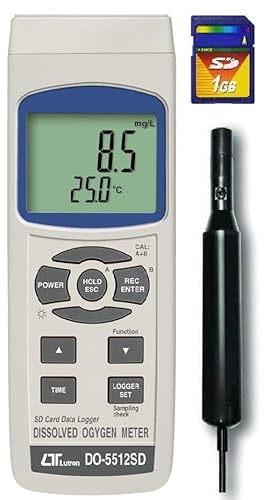
The INSTRUKART DO 5512SD is built for real-time datalogging in demanding environments. It uses a polar graphic oxygen probe with an integrated temperature sensor, enabling precise DO and temperature readings (0 to 20.0 mg/L DO; 0 to 100% O2). It supports a heavy-duty probe head that can connect with BOD bottles, facilitating diverse measurement setups. It offers RS232/USB PC interfacing for data transfer. Best for: operations needing a rugged, real-time logging DO meter with flexible probe options. Caution: setup and data extraction may require compatible software or drivers for full functionality.
HOBO U26-001 – Dissolved Oxygen Logger

The HOBO U26-001 offers a balance between cost and capability, featuring optical DO sensor technology that reduces calibration drift and maintenance. It is designed for long-term monitoring, with software support (HOBOware Pro) to correct for fouling and adjust for salinity in DO calculations. This logger is well-suited for researchers and facilities that need reliable, lower-maintenance DO data logging over extended periods. Best for: long-term monitoring with less calibration effort. Caution: ensure compatible software is used to apply drift corrections and salinity adjustments.
PCE Instruments PCE-WO2 10

The PCE-WO2 10 is designed for aquaculture and water QA workloads, offering DO measurement from 0 to 20 mg/L and 0 to 200% saturation, along with a 0 to 50°C temperature range. It features automatic temperature compensation, salinity correction, and a backlit LCD display for field use. Data logging is included, enabling straightforward record keeping. Best for: mobile testing in water quality programs and aquaculture environments. Caution: robust use may require periodic recalibration to maintain accuracy across changing salinities.
NANBEI Portable Dissolved Oxygen Meter (GLP-Compliant)

The NANBEI GLP-compliant DO meter emphasizes data integrity, offering data storage for up to 500 sets and USB or RS-232 communication. It features an IP65 waterproof, spill-proof, and dust-proof design, a 3.5-inch LCD, and a multi-reading function for auto-read, timed-read, and continuous-read modes. Best for: field or lab work requiring robust data logging with GLP-friendly records. Caution: its higher data storage in this model is beneficial, but ensure you have compatible software for GLP reporting.
Buying Guide
What should you consider when choosing a dissolved oxygen data logger?
- Measurement range and accuracy: Ensure the DO range (0–20 mg/L is common) and accuracy meet your project’s requirements. Consider percentage saturation if relevant to your applications.
- Temperature handling: Look for sensors with a broad temperature range and temperature compensation options to maintain accuracy across environments.
- Data storage and transfer: Decide between SD card storage, internal memory, or cloud-enabled options. Check data formats (CSV/Excel) and whether USB/RS232 interfaces are supported for easy transfer.
- Probe durability and attachment: If field work is needed, choose robust probes that withstand water conditions and can connect to other measurement heads as needed.
- Software compatibility: Some models pair with vendor software for drift correction, salinity adjustment, or GLP reporting. Confirm compatibility with your existing systems.
- Maintenance and calibration: Consider devices with longer calibration intervals or drift-correction features to reduce maintenance time.
FAQ
- What is a dissolved oxygen data logger used for?
A dissolved oxygen data logger records DO and often temperature over time, enabling trend analysis and quality control in water environments such as aquaculture, laboratories, and field studies.
- Do these loggers support salinity adjustments?
Many models offer salinity correction options or software tools to adjust DO readings for salinity, improving accuracy in brackish or marine waters.
- Which logger is best for long-term monitoring?
Loggers with robust probes and drift-resistant sensors, such as optical DO sensors, are generally better suited for long-term monitoring with less maintenance.
- Is data export complicated with these devices?
Most options provide straightforward data export to Excel/CSV via SD cards or USB/RS232 interfaces, simplifying PC transfer and analysis.
- What should I avoid when selecting a logger?
Avoid models with narrow temperature ranges if your environment fluctuates. Also avoid devices lacking reliable data export options or clear calibration guidelines.
- Do these loggers require frequent calibration?
Calibration needs vary by model; optical sensors typically require less frequent recalibration, while electrochemical sensors may require periodic checks to maintain accuracy.