Best Ground Mount Solar System for Off-Grid Power and Large Installations
Finding a reliable ground mount solar system is essential for optimizing energy production on farms, cabins, sheds, and remote sites. This guide highlights five top-rated ground-mount bracket kits designed for flexibility, stability, and easy setup. Each product is evaluated on adaptability, durability, and tilt options to maximize sun exposure across seasons. Read on to compare features and decide which system best fits your open-space solar project.
Summary of selected products:
- ECO-WORTHY Solar Ground Mount Adjustable Brackets System — 5 panels (400W each) compatibility
- ECO-WORTHY Upgraded Ground Mount Adjustable Multi-Pieces Brackets Kit — versatile multi-panel configurations
- ECO-WORTHY 4 Sets 45inch Adjustable Tilt Mount Brackets — foldable tilt legs, roof, RV, and ground use
- Rvpozwer Upgraded 47in Adjustable Tilt Mount Brackets — robust, tool-free assembly
- Solar Panel Mount Brackets by GLIESE POWER — 2 sets of 45 inch rails, versatile mounting
ECO-WORTHY Ground Mount Bracket For Large Solar Installations
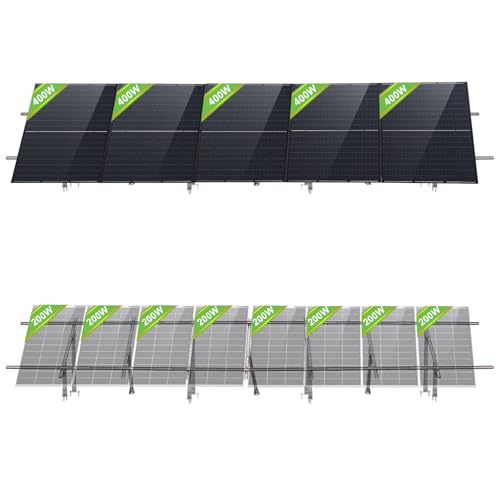
The ECO-WORTHY ground mount system features a substantial 236 inches by 39 inches frame with front and rear pillars positioned to optimize support for 5 × 400W solar panels. Designed for larger installations on farms, sheds, or off-grid sites, the brackets use a robust triangular framework to improve stability and load-bearing capacity. The system is rated to support up to 330 pounds without sagging, providing dependable performance in varied weather conditions. Seven adjustable angles from 30° to 60° help maximize sun capture through the seasons.
ECO-WORTHY Upgraded Ground Mount Kit For Large Panels

This upgraded multi-pieces bracket system expands flexibility for various configurations, supporting 4 × 200W, 3 × 300W, or 2 × 400W panels. The frame dimensions and pillar heights (front 13.78 in, rear 28.53 in) enable stable mounting on open land or cabin sites. A central support rod is recommended to prevent mid-span sag, and spacing should be kept at 59 inches between vertical columns. Users benefit from easy height adjustments and angle settings, designed to improve long-term durability and panel alignment for efficient energy collection.
ECO-WORTHY 4 Sets 45″ Adjustable Tilt Mount Brackets

The 45-inch tilt mount brackets increase panel efficiency by enabling tilt adjustments to optimize sun exposure, potentially boosting output by up to 25%. Designed for 100W–400W panels, the kit is suitable for roof, RV, boat, shed, and ground installations. The foldable tilt legs enhance portability and ease of setup, making it a versatile choice for off-grid enthusiasts who need a scalable mounting solution for 4 to 8 panels.
Rvpozwer 4-Pack 45″ Heavy-Duty Tilt Mount Brackets

These four heavy-duty, weatherproof tilt brackets are designed for 100–400W panels and offer a tool-free assembly process. Built with an anodized finish to resist rust and UV damage, they are suitable for RV roofs, boat decks, or ground mounts. The tilt range from 0–90 degrees supports dynamic sun tracking, while the sturdy construction supports stable solar arrays in harsh environments and variable wind loads.
GLIESE POWER 2 Sets 45″ Tilt Mount Brackets

GLIESE POWER’s 2-pack 45-inch rails provide solid mounting support for 2–4 panels, emphasizing torsion resistance and corrosion resistance. The adjustable tilt (0–90°) without tools offers a versatile setup for ground or rooftop installations. The rails are compatible with panels up to roughly 115 cm wide and 100–800 watts, with the option to mount panels horizontally or vertically for optimized space use.
Buying Guide
Key considerations for choosing a ground mount system
- Panel compatibility: Confirm wattage range and dimensions of your solar modules to ensure the brackets fit securely without overhang or gaps.
- Strength and durability: Look for anodized or powder-coated frames, corrosion resistance, and load-bearing capacity to withstand wind, snow, and UV exposure.
- Adjustability: Tilt range (0–60° or 0–90°) helps maximize annual solar exposure; consider systems with preset angles for convenience.
- Installation environment: Ground installations require stable bases and, if possible, anchor blocks or concrete for added stability; consider the impact of soil conditions and frost heave.
- Ease of assembly: Tool-free or minimal-tool setup reduces installation time and labor costs; modular kits support scalable configurations.
- Maintenance: Choose modular designs that allow easy panel access for cleaning and inspection; consider hardware corrosion resistance for coastal or humid areas.
Multiple perspectives
- Cost and scalability: For large installations, modular multi-piece kits offer scalable solutions, enabling gradual expansion as energy needs grow.
- Performance vs. footprint: Tilt and alignment significantly impact energy capture, but larger, heavier mounts require stronger foundations and careful terrain assessment.
- Durability under weather: In coastal or desert environments, selecting corrosion-resistant materials and robust fasteners reduces maintenance and replacement frequency.
- DIY vs professional installation: While many kits advertise quick assembly, a professional assessment ensures correct anchoring, electrical safety, and optimal tilt settings for local sun paths.
When selecting a ground mount system, prioritize compatibility with your panel wattage, climate suitability, and the ease of future expansion. A well-chosen mounting system helps maximize energy production, minimize maintenance, and support reliable off-grid power for years to come.