Best Hand Held Pallet Jack for Efficient Material Handling
Answering the question: which hand held pallet jack best fits your needs depends on space, load, and environment. This guide highlights five top manual and electric options ideal for warehouses, workshops, and retail settings. It helps choose between narrow-aisle jacks, high-capacity units, and powered models. The selections favor compact design, ergonomic operation, and durable construction to reduce fatigue and improve efficiency for everyday pallet movement.
| Product | Capacity | Fork Size | |
|---|---|---|---|
| NORTHSKY Standard Manual Pallet Jack | 5,500 lbs | 48″ x 27″ | Warehouse and tight spaces; heavy loads |
| T Tory Carrier Pallet Jack Truck | 5,500 lbs | 48″ x 21″ | Narrow aisles; durable steel design |
| Global Industrial High Capacity Pallet Jack | 6,600 lbs | 27″ x 48″ | Higher throughput and heavy pallets |
| EZMHBRO Leak-Proof Pallet Jack (First) | 5,500 lbs | 48″ x 27″ | Stable lifting and reliable performance |
| APOLLOLIFT Electric Pallet Jack | 3,300 lbs | 48″ x 27″ | Narrow spaces; powered lifting for repetitive tasks |
NORTHSKY Standard Manual Pallet Jack
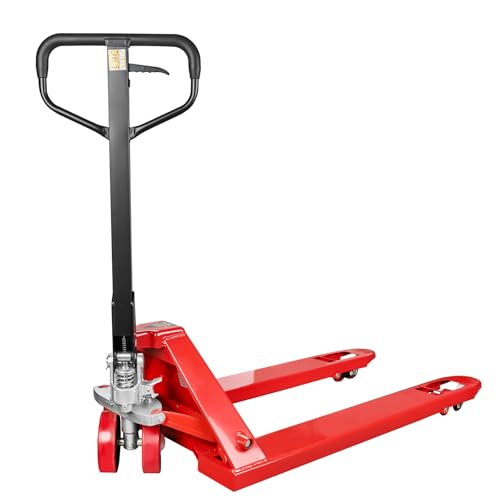
The NORTHSKY pallet jack uses a narrow 48″ x 27″ fork footprint with a 5,500 lb capacity, making it suitable for warehouse docks and retail floors with tight aisles. The ergonomic loop-style handle has three positions—Lower, Neutral, and Lift—allowing precise manual control and reduced operator fatigue during long shifts. The integrated hydraulic system includes an overload relief valve to prevent over-pressurization, contributing to safer operation and longer equipment life. Best for: facilities needing reliable power for heavy loads in constrained spaces. Caution: verify fork width suits your pallets to avoid entry issues in very narrow pallets.
T Tory Carrier Pallet Jack Truck

The Tory Carrier model offers 5,500 lbs capacity with 48″ x 21″ forks and a maximum lift height of 7.3 inches. It uses a hydraulic pump for lifting and features a controllable fork lowering speed for gentle placement of loads. Integrated lead rollers help pallets enter smoothly, and the unit uses a leak-proof hydraulic pump with a steel frame for durability. Best for: environments requiring smooth pallet entry and robust construction in narrow aisles. Caution: narrower fork width may be less compatible with wider pallet sizes.
Global Industrial High Capacity Pallet Jack

This model delivers a higher capacity of 6,600 lbs and features a manual duty design with a 3-stage lift, neutral, and lower operation. The loop handle is spring-loaded to return upright, supporting safer, fatigue-reducing use. Its 3″ load wheels and 7″ steer wheels provide a smooth 200-degree steering arc for easier maneuvering in larger facilities. Best for: facilities handling heavier pallets and requiring a more robust build. Caution: higher capacity can translate to stiffer steering in very tight spaces; take care in narrow aisles.
EZMHBRO Leak-Proof Pallet Jack

The EZMHBRO pallet jack combines a 5,500 lb capacity with 48″ x 27″ forks and a 7.1 inch lift height. Its 7-inch dual wheels enable a 180° turning radius, supporting agile movement in aisles and tight spaces. The third-generation hydraulic pump emphasizes stability during lifting and transport. Best for: busy warehouses needing steady lifts and efficient maneuverability. Caution: ensure maintenance access for the hydraulic system to sustain performance over time.
APOLLOLIFT Electric Pallet Jack

The APOLLOLIFT Electric Pallet Jack provides 3,300 lbs capacity with 48″ x 27″ forks and a lifting height of 7.3 inches. It features a 57.1″ turning radius and an upright handle for slow-speed operation, making it well-suited for narrow spaces such as truck beds and containers. The multi-function control handle includes travel, lift, horn, emergency reverse, and a turtle speed option for precise movement. Best for: tasks that benefit from powered assistance and tighter navigation. Caution: electric models may require charging and maintenance cycles to maintain optimal performance.
Buying Guide: Key Purchase Considerations
- Capacity vs. load type: Choose a higher-capacity jack for heavy, dense pallets or frequent bulk movement. Consider lower capacities if pallets are consistently light.
- Fork size and pallet compatibility: Ensure fork dimensions (length and width) match the standard pallets used in your operation to avoid entry issues or tipping.
- Turning radius and aisle width: Narrow-aisle or tight-spaces operations benefit from smaller turning radii and lighter steering effort; measure your aisles before purchase.
- Manual vs. electric: Manual jacks are simple and robust, ideal for low-frequency use. Electric models reduce operator fatigue for repetitive tasks but require charging and maintenance.
- Ergonomics and controls: Look for ergonomic handles, smooth lift/lower action, and adjustable controls to minimize fatigue during long shifts.
- Durability and maintenance: Steel frames, reliable pumps, and protective finishes extend life in harsh environments. Consider spare parts availability and service options.
- Safety features: Overload relief, stable base design, and secure load handling help prevent accidents during lifting and transport.
FAQ: Quick Answers For Buyers
- What is the typical pallet jack capacity? Most manual jacks range from 5,000 to 6,600 lbs; choose based on your heaviest pallets.
- Are electric pallet jacks worth it for small warehouses? Yes, for repetitive tasks or longer shifts, electric units reduce operator fatigue and increase throughput.
- Why consider a narrow-aisle pallet jack? Narrow-aisle models improve maneuverability in tight spaces and help maximize storage density.
- What should I inspect before buying a pallet jack? Check fork dimensions, lifting height, wheel type, pump reliability, and handle ergonomics.
- How important is wheel material? Polyurethane wheels offer smooth movement on concrete and reduce floor damage; consider steel wheels for heavy, rough loads.
- Does maintenance affect performance? Regular lubrication, inspection of hydraulics, and checking for hydraulic leaks maintain performance and safety.