Best Heavy Duty 3D Printers for Industrial-Grade Prototyping and Large Parts
When choosing a heavy‑duty 3D printer, look for robust build quality, large build volumes, fast but reliable speeds, and material versatility. The following five models are among the most capable options for professional makers, engineers, and small-batch manufacturers who need durable performance, multi-material capability, and dependable auto-leveling capabilities. This guide highlights who each printer is best for and why it stands out, with clear, data‑driven reasons to aid quick decisions.
Comparison At A Glance
| Printer | Key Strength | Largest Build Volume | Best For |
|---|---|---|---|
| QIDI Max4 Combo | Ultra-large volume, high-speed, multi-material | 390×390×340 mm | Large industrial parts, molds, multi‑color prototypes |
| Creality K2 Pro Combo | Multicolor, high-speed, auto leveling | 300×300×300 mm | Colorful prototypes, multi-material projects |
| FLASHFORGE Adventurer 5M Pro | Fast, auto bed leveling, versatile nozzle options | 220×220×220 mm | Rapid iteration, compact high-speed parts |
| FLASHFORGE AD5X | Multi-color, 1‑click auto level, high speed | 220×220×220 mm | Colorful, precise small parts and rapid prototyping |
| Creality K2 Plus Combo | Very large build volume, multi-color, auto leveling | 350×350×350 mm | Large multi-color prints and batch production |
QIDI Max4 Combo 3D Printer
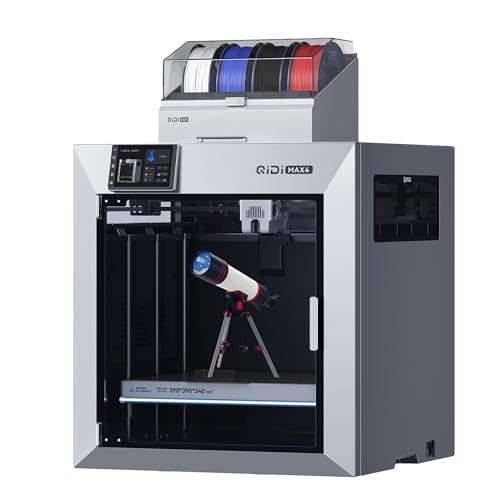
Best for users who need an ultra‑large print area and reliable high‑temperature material support. The Max4 Combo delivers a 390×390×340 mm build volume, which is 55% larger than its predecessor, enabling single‑print fabrication of large industrial parts, complex molds, and custom prototypes without splitting. A full-surface silicone heated bed provides even temperature distribution and strong first‑layer adhesion to reduce warping. The 65℃ active heated chamber and Polar Cooler system support high‑temperature materials like ABS‑CF and PC, expanding material options beyond standard PLA/ABS.
Best for: engineering teams, product developers, and creators who routinely print large parts or need multi‑material capabilities with a heated chamber. You can print big prototypes in one go and experiment with advanced materials. Cautions: the larger footprint needs ample space and careful containment of power requirements; advanced users should verify enclosure compatibility in tight work environments.
Creality K2 Combo (A) 3D Printer

Best for multi-color, high-speed production with out‑of‑the‑box convenience. The K2 Combo pairs a 260×260×260 mm build volume with multi-color capabilities via CFS (Color Filament System) that supports up to 16 colors when combined with extra CFS units. It features out‑of‑the‑box pre-assembly and an auto‑leveling bed for reliable first layers. The direct drive extruder supports flexible materials and faster retractions.
Best for: designers and small teams who want fast color changes and easy setup for multi‑material prints. Limitations: the standard build area is smaller than some competitors, which may constrain very large parts or batch production without modular expansion.
FLASHFORGE AD5X Multi-Color 3D Printer

Best for multi-color printing with high-speed performance and streamlined workflow. The AD5X supports up to four CFS units for flexible multi‑color projects and offers 1‑Click Auto Leveling for consistent first layers. With speeds up to 600 mm/s and 20,000 mm/s² acceleration, it blends rapid prototyping with dependable quality. The 220×220×220 mm build volume suits small‑to‑mid‑size parts and rapid iterations.
Best for: teams needing vibrant color experiments, quick turnarounds, and reliable automation. Caution: the smaller build volume may require batching for larger assemblies, and matierals beyond PLA/PETG/ABS may demand testing for performance.
Creality K2 Plus Combo 3D Printer

Best for large-scale multi-color projects and batch production. The K2 Plus Combo expands to a 350×350×350 mm build volume and supports up to 16 colors using multiple CFS units. Auto leveling, a dual AI camera option, and the new Direct Drive Extruder enable smooth multi‑material workflows and reliable filament handling. The robust aluminum frame and fast 600 mm/s printing speed with 20,000 mm/s² acceleration support ambitious prototypes while maintaining accuracy and stability.
Best for: advanced makers and startups that need a larger format and versatile color/material capabilities. Limitation: the expanded features require more space and a more complex setup, which may involve a learning curve for new users.
Buying Guide: How To Choose A Heavy Duty 3D Printer
What build volume do you need? Larger volumes enable single-print parts that would otherwise require assemblies or segmentation, reducing print joins and post-processing time.
How important is multi-color or multi-material capability? If you frequently need color parts or different materials in one build, prioritize printers with CFS, auto filament identification, and reliable auto levelers.
What materials will you print with? If you plan to use high‑temperature materials like ABS‑CF, PC, or PPS‑CF, ensure a heated chamber and appropriate hotend design, as well as chamber temperature stability.
Speed versus quality: high speeds are beneficial for rapid iteration, but ensure the printer maintains layer adhesion and fine detail at your chosen materials and nozzle sizes.
Ease of setup and ongoing maintenance: models with pre-assembly, auto leveling, and robust frame structures reduce setup time and improve uptime in busy workflows.
Support and ecosystem: consider available service options, software compatibility, and the ability to expand capabilities with additional CFS units or options like dual cameras.
FAQ
- What heavy‑duty 3D printer should I choose for large parts? Look for printers with build volumes of at least 300×300×300 mm, a heated chamber for high‑temperature materials, and a rigid frame for stability at high speeds.
- Are multi-color printers worth it for professional use? Yes, when color differentiation is essential for prototypes, branding, or assembly demonstrations, and you need to model different components in one print job.
- Do all heavy‑duty printers require assembly? Not necessarily. Some models come pre-assembled or partially assembled for plug‑and‑play use, which saves setup time.
- What materials can be printed reliably in a heated chamber? Materials such as ABS, ABS‑CF, PC, and other high‑temperature filaments typically require a heated chamber to minimize warping and improve layer adhesion.
- Is faster printing always better? Faster speeds reduce production time but may trade off surface finish and dimensional accuracy if the machine is pushed beyond its optimal parameters.
- What maintenance is common for multi-color printers? Regularly check filament spools, ensure clean filament paths, and verify auto-leveling sensors for consistent first layers.