Best Industrial Hood Ventilation System Options for Kitchens and Labs
Answering the demand for reliable, durable ventilation, this guide highlights top industrial hood ventilation systems suited for food trucks, commercial kitchens, and lab environments. The selections emphasize high airflow, corrosion resistance, and easy installation. Best for mobile kitchens, small restaurants, and compact labs, these options balance performance with maintenance needs. Below is a quick summary to help buyers compare before diving into detailed reviews.
| Product | Best For | Key Advantage |
|---|---|---|
| HYITCL 4FT Commercial Hood System | Food trucks, small commercial kitchens | Stainless steel, 4-foot smoke capture |
| FICBXRA 5FT Stainless Hood System | Restaurants, larger concession setups | Wide 5-foot capture area, high-velocity exhaust |
| HOODMART 6′ Concession Hood System | Food trucks, concession trailers | Low-profile design, install kit included |
| HOODMART UL/NSF 5′ Hood System | Commercial kitchens with safety standards | Fire suppression included option |
| VEVOR 1136 CFM Canopy Fan | Outdoor or warehouse kitchens | High airflow, weatherproof design |
HYITCL 4FT Commercial Hood System

The HYITCL 4FT hood system uses heavy-duty stainless steel to provide rigidity, fire resistance, and corrosion protection. Its 4-foot smoke capture area focuses on confining grease and odors from high-heat cooking. The included high-speed direct drive centrifugal upblast exhaust fan is designed for industrial, institutional, and commercial kitchens. Best for compact food trucks and small kitchens that need efficient smoke control without sacrificing space. A potential limitation is the absence of ductwork or curb details in the product listing, which buyers should confirm before purchase.
FICBXRA 5FT Stainless Hood System

The 5-foot stainless steel hood provides broad coverage for multiple stoves and a robust exhaust fan with a grease-rated design. It’s suited for restaurants or larger concession setups seeking strong air movement and quick odor removal. Note that ductwork and a roof curb are not included and must be purchased separately. Best for operations needing wider smoke capture with straightforward installation, but verify compatibility with existing ducting.
HOODMART 6′ Concession Hood System
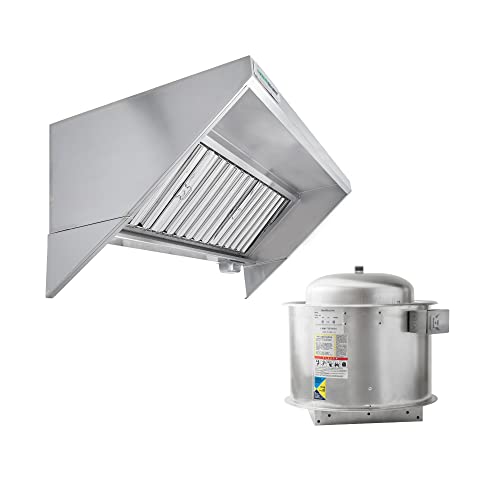
The HOODMART 6’ hood system is designed for food trucks and concession trailers, offering a low-profile mount that maximizes cooking clearance. It includes a direct drive exhaust fan, an install kit, mounting curb, variable speed control, lights, grease filters, and other accessories. This setup is well-suited for mobile kitchens requiring compact, proven components with a complete kit. Buyers should confirm curb height and fitment for their trailer’s layout to avoid clearance issues.
HOODMART UL/NSF 5′ Hood System
This 5-foot hood is built to meet safety and quality standards with NSF and UL approvals. It includes a pre-piped fire suppression option for added safety in areas with heavy cooking loads. Best for operations prioritizing safety compliance and a structured installation, though buyers should confirm suppression kit compatibility with their fire system preferences.
VEVOR 1136 CFM Canopy Exhaust Fan

The VEVOR canopy fan delivers 1136 CFM with a 250W direct-drive motor, designed for outdoor or warehouse kitchens. It provides strong air movement with a relatively quiet operation (≤75 dB). Best for settings needing high airflow in open outdoor conditions. A possible limitation is the product’s emphasis on rugged outdoor use, which may be more than what some indoor kitchens require.
Buying Guide
What should you consider when choosing an industrial hood system?
Airflow capacity (CFM) should match the kitchen size and cooking load. Larger spaces or multiple burners require higher CFM. Look for direct-drive fans for lower maintenance and steadier performance. Materials matter—stainless steel resists corrosion and is easier to clean. Check for safety features like fire suppression options and compliance with NSF/UL standards when applicable.
What installation factors matter?
Ensure the hood width aligns with the cooking area and that ductwork or roof curbs are available or purchasable separately if not included. Consider whether the system is designed for mobile setups (low-profile) or stationary kitchens (broader hood). Confirm install kits and mounting hardware are included or compatible with your trailer or building structure.
Maintenance and durability considerations
Choose systems with accessible grease filters and easy cleaning paths. Stainless steel surfaces minimize corrosion from cooking oils and humidity. If you operate in a high-heat environment, verify that the hood and fan remain stable and don’t deform under heat exposure.
Safety and compliance questions
Are you required to have a fire suppression system installed? Look for options that include or are compatible with fire suppression kits. Confirm NSF/UL certifications if you handle regulated cooking processes or must meet certain health and safety standards.
FAQ
- What is the most important feature in an industrial hood system? Airflow capacity and reliable filtration are essential for removing grease, smoke, and odors efficiently.
- Do I need a fire suppression system with a hood? It depends on local code and the type of cooking equipment; some systems offer pre-piped suppression options.
- Is a low-profile hood better for food trucks? Yes, low-profile designs maximize cooking clearance and fit within trailer constraints.
- Should I buy a complete kit or assemble components separately? Complete install kits simplify setup and reduce compatibility issues, especially for mobile setups.
- Can outdoor hoods be used indoors? Outdoor-rated elements may be overkill for indoor kitchens; verify suitability and noise levels for indoor use.
- What maintenance is required for commercial hoods? Regularly clean grease filters, inspect duct connections, and check for any corrosion or wear on fans and motors.