Best Industrial Vegetable Drying Machine for Bulk Dehydration and Professional Kitchens
When choosing an industrial vegetable drying machine, buyers look for high capacity, reliable performance, and ease of cleaning. This guide highlights five commercial dehydrators that suit bulk production, catering to restaurants, small manufacturers, farm shops, and large home-based operations. Each option is described with who it’s best for and why it stands out, plus a practical caveat to consider before you buy.
| Product | Best For | Key Benefit |
|---|---|---|
| Septree Commercial Food Dehydrator, 18 Trays | Large batches, 24/7 operation | Huge 34.42 ft² drying space with 18 trays |
| Cercker 22-Tray Commercial Dehydrator | Small businesses needing dual volt options | High capacity with 2500W and dual-plug setup |
| 60 Layers Commercial Drying Machine | Industrial-scale facilities | Very high capacity with 60 layers and 3KW motor |
| PSIIDAN 8-Tray Dehydrator | Batch processing with safety focus | Adjustable time/temperature and inside light |
| 48 Layers Commercial Dehydrator | Versatile production lines | Large observation window and high airflow |
Septree 18-Tray Industrial Dehydrator
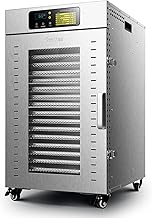
Best for high-volume operations that require a large drying footprint. This model features 18 trays (each 15.67 by 15.67 inches) and a usable area of 34.42 square feet. It includes four fruit roll trays, hanging racks for jerky, and 20 hooks, enabling dehydration of vegetables, fruits, meats, and more with minimal handling. The digital control offers temperature presets from 70ºF to 190ºF and a 0.5–24 hour timer, with auto shutoff and overheat protection. Food-grade stainless steel ensures easy cleaning and durability. The glass front door helps monitor progress without opening the unit. Best for businesses or large households handling continuous batches. Limitation: bulk unit requires substantial space and electricity supply; plan installation accordingly.
Cercker 22-Tray Commercial Dehydrator

Best for operators needing flexibility in voltage. This dehydrator offers 22 dishwasher-safe trays and a 121 L drying space, driven by 2500W power. It includes a dual-plug design allowing 110V or 220V operation, handy for venues with varying electrical setups. The model emphasizes a thickened viewing window for monitoring. Choose this if your operation sometimes runs on different power configurations. Caution: avoid plugging two cords into a single outlet to prevent overload; ensure compatible electrical infrastructure.
60 Layers Industrial Fruit & Vegetable Dryer

Best for large-scale facilities needing extensive capacity. This unit features 60 drying layers and a 30°C–90°C (approx. 86°F–194°F) temperature range powered by 3 kW. It uses high-quality fans and a uniform air distribution system to achieve even drying. The 304 stainless steel construction and a sizable observation window facilitate monitoring and maintenance. It is well-suited for jerky, herbs, and bulk produce. Consider space and energy use when planning deployment. Limitation: higher electricity consumption due to large footprint and horsepower.
PSIIDAN 8-Tray Stainless Dehydrator

Best for compact batches with safe home-ready features. This 8-tray unit offers 650W power, with adjustable temperature up to 167°F and adjustable timing from 30 minutes to 48 hours. An interior light aids status checks, and dual-layer insulation keeps exterior cool, supporting safer operation in kitchens or small production spaces. It’s a solid pick for smaller operations or test runs before scaling. Caution: limited capacity means more batches for larger demands; plan production schedules accordingly.
48 Layers Commercial Dehydrator

Best for versatile production lines and high airflow requirements. With 48 layers and a broad 4 kW motor, this model uses 360° hot air circulation and a ring-shaped intake to ensure even drying and accelerated processing. A large observation window allows continuous monitoring during operation. It suits operations desiring flexible output for beef, jerky, fruits, and vegetables. Limitation: bulkier footprint and higher energy use; assess space and power availability before purchase.
Buying Guide: Key Considerations For Industrial Vegetable Dryers
- Capacity and footprint: Match tray count and usable area to your daily output and available space. Higher tray counts typically mean larger footprints and greater energy needs.
- Power and voltage: Check available electrical infrastructure. Some units offer dual-plug configurations for 110V/220V operation; plan for consistent power supply and safety.
- Temperature range: A wide range enables handling delicate produce as well as tougher meats. Look for precise digital controls and stable temperatures.
- Uniform drying: Look for features that promote even airflow, such as annulus air paths, 360° circulation, and front door monitoring windows.
- Materials and cleaning: Stainless steel construction and dishwasher-safe trays simplify sanitation and maintenance in commercial environments.
- Monitoring and safety: Glass doors, viewing windows, and auto shutoff with overheat protection help maintain quality and reduce risk.
- Durability and warranty: Commercial-grade equipment should withstand long run times. Consider units with robust warranties and reputable after-sales support.
- Mobility and setup: Some units include wheels or compact dimensions for flexible placement. Factor in weight and maneuverability for installation.
Frequently Asked Questions
- What makes an industrial dehydrator suitable for vegetable drying?
- Is a higher wattage always better?
- Can these units be used for jerky and meat as well as vegetables?
- What maintenance is required for industrial dehydrators?
- How should I choose between 18-tray and 60-tray models?
- Do these units come with a warranty?
Look for large capacity, uniform airflow, easy cleaning, and durable, food-grade materials designed for continuous operation.
Not always. Higher wattage can speed up drying but increases energy use. Choose a model with appropriate heat distribution and efficient airflow for your batch sizes.
Yes. Many models are designed for multi-item drying, with adjustable temperatures suitable for meats, fruits, and vegetables.
Regular cleaning of trays and housing, inspecting seals, checking airflow, and ensuring safety features function correctly are recommended practices.
Consider annual output, batch size, space, and power availability. Higher-capacity models suit continuous production; smaller units fit limited spaces or pilot runs.
Warranty terms vary by model and seller. Review the product listing for coverage details and after-sales support before purchase.