Best Industrial Wireless Temperature Sensor Solutions for Remote Monitoring
Industrial environments demand reliable, long-range temperature and humidity monitoring without overloading networks. The following hand-picked wireless sensors deliver LoRa or robust WiFi connectivity, wide temperature ranges, and alerting options that cover fridges, greenhouses, greenhouses, cold storage, and industrial spaces. This guide compares five top devices, highlighting suitability for harsh or remote settings and thoughtful troubleshooting tips for deployment.
Summary of Selected Products
| Product | Brand | Connectivity | Range | Key Strengths |
|---|---|---|---|---|
| YoLink Smart Wireless Temperature & Humidity Sensor (3-Pack) | YoLink | LoRa-based | Long-range (outdoors and multi-floor) | No WiFi crowding, wide deployment, hub-enabled |
| MOCREO WiFi Remote Thermometer Freezer Alarm | MOCREO | WiFi | Up to 0.25 miles open air indicated | IP66 waterproof, data export to CSV, app & alert options |
| YoLink Smart Freezer Thermometer (3-Pack) | YoLink | LoRa-based | Up to 0.25 miles open air | Hub included, app & SMS alerts, long battery life |
| Indoor Outdoor Thermometer Wireless (Unni, 4.5 inch) | U UNNI | Wireless proprietary | 330 ft radius | Dual-channel readings, indoor/outdoor trend, alerts |
| SafeSense TempTouch WiFi Thermocouple Sensor | SAFESENSE | WiFi | Standard home/industrial range | Multiple thermocouple compatibility, real-time alerts |
This article focuses on sensors suitable for professional environments, with emphasis on reliability, long-range operation, alerting flexibility, and data accessibility. Each product section below includes a concise overview, key features, and deployment considerations.
YoLink Smart Wireless Temperature & Humidity Sensor (3-Pack)

Overview: This YoLink kit leverages LoRa-based wireless technology, avoiding WiFi congestion while delivering broad coverage for challenging sites such as basements, multi-story facilities, and outdoor enclosures. The 3-pack design makes it practical for large rooms or multiple zones. The system emphasizes long-range transmission, low power consumption, and a hub-based architecture to centralize alerts and data.
Key features and considerations: The LoRa protocol enables long-range communications without relying on your home WiFi network. Ideal for places where WiFi is unreliable or unavailable, such as outdoor facilities, barns, or gun safes. The sensors monitor temperature and humidity, enabling comprehensive climate control. A hub is required to collect alerts and route information to a chosen notification method (app, email, or text). For deployments, assess the LoRa gateway layout, potential interference from large metal structures, and the availability of a weatherproof variant for outdoor use.
Deployment tips: Position sensors away from thick metal enclosures, ensure line-of-sight where possible, and consider pairing with other YoLink devices to create a robust multi-sensor network. Use the weatherproof option in harsher environments to extend lifespan. Regular battery checks help maintain continuous monitoring, especially in remote locations.
MOCREO WiFi Remote Thermometer Freezer Alarm

Overview: The MOCREO system delivers IP66-rated water resistance and a user-friendly app with email alerts. It includes two smart wireless temperature sensors designed for refrigerator, RV, greenhouse, and other cold-chain or climate-controlled environments. The device emphasizes data fidelity, with an industrial-grade temperature chip that supports charting and CSV export for long-term analysis.
Key features and considerations: Thermal measurements span a wide range with decent accuracy suitable for industrial monitoring. The device supports remote monitoring via a central hub and app, and it doesn’t require ongoing subscriptions to access historical data. Alarm customization is a focal point, with alerts delivered via app and emails. When deploying, ensure proper ventilation for sensors, avoid placing sensors inside sealed metal containers where signal could be blocked, and verify compatibility with existing WiFi networks and hubs.
Deployment tips: Use the CSV export for regulatory or QA reports. For perishable inventory or equipment with critical temperature thresholds, set multiple alert levels and test alert delivery routes (SMS, email, push) to confirm reliability in your environment.
YoLink Smart Freezer Thermometer (3-Pack)

Overview: This YoLink triple-pack focuses on freezer and cold-storage environments, delivering LoRa-based, long-range wireless monitoring and alerting. The kit includes a hub and supports app-based and SMS notifications, making it suitable for facilities where real-time temperature awareness is critical and network bandwidth is a concern.
Key features and considerations: The LoRa technology provides far-ranging coverage beyond typical WiFi, useful for walk-in coolers, cold rooms, or remote outbuildings. Battery life is a key strength, allowing extended periods between replacements. Alerts can be configured through the YoLink app, and SMS allowances are included with hub-plus-sensors configurations. Deployment should consider hub placement to optimize coverage across multiple zones and power considerations for remote locations.
Deployment tips: Create a network map to identify optimal hub locations. For freezer environments, protect sensors from condensation and ensure shielding from direct exposure to water spray where applicable. Pair additional YoLink devices to capture door status, leakage, or power-fail events for a comprehensive monitoring system.
Indoor Outdoor Thermometer Wireless (Unni)
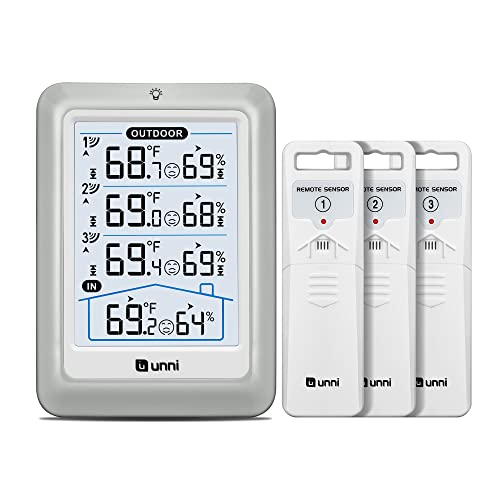
Overview: The Unni wireless thermometer offers a 4.5-inch display with indoor and outdoor readings. It provides data transmission up to 330 feet and supports dual sensors for separate indoor and outdoor monitoring. This model emphasizes real-time trend data, comfort indicators, and alerts, making it useful for greenhouses, barns, clinics, or large residential properties requiring precise environmental awareness.
Key features and considerations: The device supports switchable Celsius/Fahrenheit, daily max/min data, and low-battery indicators. It’s designed for wide-ranging applications from HVAC setups to outdoor kiosks. As a potential limitation, it uses a proprietary wireless protocol rather than standard WiFi or LoRa, so ensure compatibility with existing systems if you plan to integrate with central dashboards or automation platforms.
Deployment tips: Mount the sensor away from direct sunlight and source of heat to avoid skewed readings. Use the backlight feature for low-light visibility and calibrate thresholds to match specific crops, livestock, or equipment storage requirements. Consider using multiple units across a campus or farm to build a network with better spatial coverage.
YoLink Temperature Sensor With Hubs And Alerts

Overview: This YoLink product emphasizes a broad temperature and humidity range with LoRa-based connectivity—ideal for outbuildings, equipment rooms, and other locations where standard WiFi is not reliable. The system highlights app and SMS alerts, enabling rapid responses to threshold breaches and environmental changes.
Key features and considerations: Long-range capability reduces the need for multiple gateways. Battery life is prioritized for long-term deployments. It’s important to manage hub placement for maximum redundancy and ensure a stable power source for the hub, especially in remote sites where maintenance may be infrequent.
Deployment tips: Combine this sensor with other YoLink devices to build a scalable monitoring network. For critical environments like cold storage or server rooms, configure emergency alerts and test response workflows with your on-call personnel or facilities team.
Buying Guide: Key Considerations For Industrial Wireless Temperature Sensors
- Connectivity type: LoRa-based sensors avoid congesting WiFi but require gateways; WiFi sensors are easier to deploy where existing networks are robust. Consider future scale and network management needs.
- Range and coverage: Evaluate whether the environment is open-air or cluttered by metal structures. Long-range capabilities matter in barns, warehouses, or multi-floor facilities.
- Sensor accuracy and ranges: Check measurement ranges for temperature and humidity; ensure accuracy matches your monitoring requirements and regulatory standards.
- Power and battery life: Consider expected maintenance intervals. Long battery life reduces downtime but may require battery procurement planning.
- Alerts and notifications: Review alert modalities (app, email, SMS, push). Ensure the platform supports the required notification channels and escalation rules.
- Data history and export: For compliance or QA, access to historical data and export options (CSV, charts) is valuable.
- Environmental robustness: For outdoor or wet environments, IP ratings (IP66, IP65) and weatherproof housings are critical.
- Hub and ecosystem compatibility: Confirm hub compatibility with existing systems and automation platforms (IFTTT, Alexa, etc.).
- Installation considerations: Placement away from direct heat sources, direct sunlight, or metal enclosures to avoid skewed readings or signal interference.
In summary, for remote or harsh industrial settings, LoRa-based YoLink sensors offer strong long-range capabilities, low power consumption, and flexible alerting with hub support. For environments where WiFi is stable and a high data history is required, MOCREO and SafeSense provide robust options with data export features and versatile installation scenarios. The Unni models present dual-sensor convenience for indoor-outdoor monitoring, while the TempStick provides subscription-free cloud logging with real-time alerts for broader home-to-facility use. When selecting, weigh range, reliability, maintenance demands, and how you intend to scale the network over time.