Best Inert Gas Flow Meter for MIG/TIG Welding
Looking for an inert gas flow meter that suits MIG and TIG welding workflows? This guide identifies five reliable options and explains who each is best for, helping you choose a model that minimizes gas waste while delivering stable shielding. Suitable buyers include hobby welders, professional shops, and electronics or chemical processing environments where precise gas delivery matters.
| Product | Best For | Key Benefit |
|---|---|---|
| YESWELDER Welding Gas Regulator Flow Meter | MIG/TIG welding beginners and pros needing wide gas compatibility | Leak-proof, wide interface options |
| RX WELD Argon Flowmeter | Argon/Helium setups with CGA-580 | Simple 10–60 CFH range with sturdy brass build |
| BETOOLL Argon/CO2 Flow Meter | Budget-minded users needing accuracy | Flow meters are more accurate than basic gauges |
| Sxstar Argon Co2 Professional Gas Flow Meter | Professional testers and torch flow checks | Peashooter-style test accuracy |
| Profax PX 50020 Gas Flow Meter | Shield gas optimization for established shops | Low gas usage with measured flow at the torch |
YESWELDER Welding Gas Regulator Flow Meter

The YESWELDER unit features wide application, connecting easily to Argon, Helium, and Argon/CO₂ tanks via CGA-580. Its leak-proof construction reduces gas waste and supports MIG/TIG welding and general industrial use. Best for welders who need reliable compatibility across common shielding gases.
Best for: New and experienced welders seeking a single regulator compatible with multiple inert gases. Why selected: Strong airtight performance and flexible inlet options minimize the need for adapters.
Caution: The gauge readings rely on proper calibration and regular maintenance to ensure accuracy over time.
RX WELD Argon Flowmeter for MIG TIG Weld

RX WELD’s flowmeter is designed for CGA-580 tanks and accommodates both female 9/16″ x 18 nuts and male 5/8″ x 18 fittings, plus a standard 1/4″ barbed fitting. It offers adjustable flow from 10 to 60 CFH, indicated by a moving ball, and is built with brass for durability in harsh environments.
Best for: Welders who need straightforward, reliable flow control with broad hose compatibility. Why selected: Clear scale and robust construction support consistent shielding gas delivery.
Limitation: It emphasizes a 10–60 CFH range; if you require very low flows, verify applicability for your process.
BETOOLL Argon/CO2 Flow Meter Regulator

BETOOLL offers a compact regulator with flow meters noted for accuracy improvements over basic gauges. The 0–4000 psi pressure gauge helps monitor remaining shielding gas and supports Argon/CO₂ setups. It is a practical option for shops seeking improved control without high cost.
Best for: Budget-conscious buyers who still want more precise flow measurement. Why selected: Higher accuracy vs. standard gauges can translate to gas savings over time.
Limitation: Basic features may lack some advanced connectivity options of premium models.
Argon Co2 Professional Gas Flow Meter Tester

Sxstar’s flow meter tester is a peashooter-style device that measures flow from 0 to 25 litres per minute. It is used to test gas flow at MIG/TIG torches and works with all gases. It provides a quick, direct readout via a ball indicator over a 0–25 LPM scale.
Best for: Professionals performing regular flow checks and calibration in the field. Why selected: Simple, portable tester helps validate shielding gas delivery at the source.
Limitation: Not a full regulator; rely on it for testing rather than continuous flow control.
Profax PX 50020 Gas Flow Meter
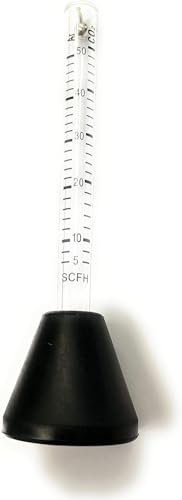
The Profax PX 50020 offers argon and CO2 flow rates up to 25 LPM (52 CFH), enabling measurement of actual shield gas flow at the torch. This can help reduce weld variations and gas usage in practical welding scenarios.
Best for: Shops seeking to quantify shielding gas delivery to reduce waste. Why selected: Direct torch-side measurement aligns with gas-efficiency goals.
Limitation: Lower maximum flow compared to some high-capacity regulators; verify compatibility with your workflow.
Buying Guide
What should you consider when choosing an inert gas flow meter for MIG/TIG welding?
- Gas compatibility: Ensure the regulator supports Argon, CO₂, Helium, or mixtures you use. CGA-580 inlets are common and should match your tanks.
- Flow range: Look for a model that covers your typical needs (often 0–60 CFH or 0–25 LPM). Some meters also function as testers for calibration.
- Reading clarity: A large, easy-to-read gauge and a clearly moving float improve control during critical welds.
- Inlet and outlet connections: Check that the unit fits your hose sizes and tank ports (9/16″ x 18 nut, 5/8″ x 18, barbed fittings).
- Durability: Brass bodies and robust seals help withstand workshop conditions and gas pressures.
- Maintenance: Some meters include filters or relief valves; consider devices with components easy to service.
- Portability and testing capability: If you need field checks, a compact tester like a peashooter-style device can be valuable.
- Warranty and support: A reliable vendor with straightforward replacement parts helps maintain continuous use.
FAQ
- What is an inert gas flow meter used for in welding? It standardizes shielding gas delivery to the torch, improving weld consistency and reducing gas waste.
- Can I use any flow meter with MIG and TIG welding? Most models that specify Argon, CO₂, or inert gas compatibility will work, but verify tank connections and flow ranges.
- What is CGA-580? It is a common inlet connector standard for inert gas regulators; ensure your regulator and tanks share this interface.
- Why would I choose a tester versus a regulator? A tester helps verify actual flow at the nozzle, while a regulator controls ongoing gas delivery.
- How important is accuracy in shielding gas flow? High accuracy minimizes porosity and weld defects by maintaining stable gas coverage.
- How do I prevent gas waste? Use the lowest practical flow for your process and regularly check for leaks, misreads, or improper connections.