Best Live Roller Conveyor Systems for Efficient Material Handling
Choosing the right live (gravity) roller conveyor can streamline production lines, assembly tasks, and shipping operations. This guide highlights five practical options from Ultimation and related brands, focusing on capacities, dimensions, and versatility for warehouses, workshops, and DIY projects. The following product summaries include clickable links to Amazon for quick reference and a buying guide to help compare features like width, roller diameter, load capacity, and stand options.
| Product | ||||
|---|---|---|---|---|
| Light-Duty Gravity Conveyor — 12″ Wide | 12″ | 3′ | 1.5″ | 180 lbs per linear foot; 540 lbs total |
| Light-Duty Gravity Conveyor — 18″ Wide | 18″ | 3′ | 1.5″ | 106 lbs per linear foot; 318 lbs total |
| Roller Table Set — 18″ Wide, 5′ Long | 18″ | 5′ | 1.9″ | 265 lbs per roller |
| Light-Duty Gravity Conveyor — 18″ Wide, 5′ Long | 18″ | 5′ | 1.5″ | 530 lbs total |
| Conveyor Replacement Rollers — 1.9″ Dia | Variable | 21″ | 1.9″ | 267-lb per roller (rated) |
Light-Duty Gravity Conveyor — 12″ Wide

Features focus on practical versatility: a 12″ overall width with 6″ roller centers supports a wide range of projects from inventory transport to woodworking and DIY table saw feeds. The 3′ length makes it suitable for short-distance transfers in warehouses or assembly lines. The 1.5″ diameter galvanized steel rollers offer robust durability, with a total load capacity up to 540 pounds when fully supported. The powder-coated steel frame provides weather-resistant strength for industrial, commercial, and carpentry settings.
Light-Duty Gravity Conveyor — 18″ Wide
This model expands workspace capacity with an 18″ width and 3′ length, ideal for larger SKU handling in distribution or assembly areas. The 1.5″ rollers share the same galvanized steel durability, supporting up to 318 pounds total under full support and around 106 pounds per linear foot. The 6″ roller centers enable smooth, steady movement for medium-duty loads, while the powder-coated frame adds long-term resilience in busy facilities.
Roller Table Set — 18″ Wide, 5′ Long
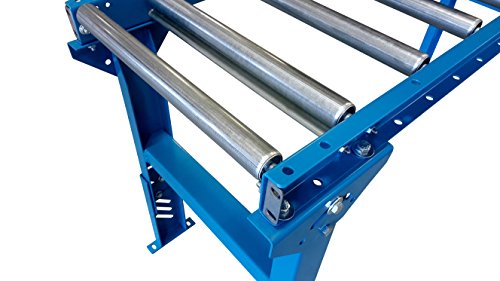
This set delivers a complete gravity conveyor solution with a 5-foot table and two adjustable supports, suitable as an unload or outfeed system for saw stands and woodworking stations. It uses 1.9″ diameter galvanized rollers spaced on 6″ centers, supported by a 16-gauge powder-coated frame. The height can be adjusted between roughly 22″ and 28″, enabling use as a standalone table or extension wing for larger materials or motorized runs. It supports up to 265 pounds per roller in typical applications.
Light-Duty Gravity Conveyor — 18″ Wide, 5′ Long
This longer 5-foot variant provides extended transport capability with an 18″ width and 6″ roller centers for smoother conveyance of mid-sized loads. The 1.5″ galvanized rollers deliver solid load capacity—up to 530 pounds when fully supported—making it a practical fit for warehouse bays, assembly lines, and shop floors. The durable powder-coated frame stands up to daily use in industrial or DIY environments.
Conveyor Replacement Rollers — 1.9″ Dia (5 Pack)

These 1.9″ diameter galvanized steel rollers come in a 5-pack, designed to fit gravity conveyors with compatible frame layouts. They feature a 21″ between-frames spacing and a 22-1/2″ axle length, allowing straightforward replacement and maintenance for existing systems. Bearings are crimped and oiled to provide smooth operation, with a rated load capacity around 267 pounds per roller, supporting consistent material handling across various applications.
Buying Guide: Key Purchase Considerations and Comparisons
When selecting a live roller conveyor system, consider these factors to match your workflow and space. First, assess width and length: wider conveyors accommodate larger parts and multipleSKU flows, while longer lengths reduce the need for manual transfers. Roller diameter and center spacing influence load distribution and speed; smaller centers offer more support for tiny parts, while larger centers work well for bulk goods. Load capacity is critical for safety and efficiency—verify both per-roller and total system capacity, especially for fully supported installations.
Frame material and finish affect durability in your environment. Powder-coated steel frames resist corrosion and wear in dusty or humid spaces, but stainless options may be preferable in food, chemical, or marine settings. Installation flexibility matters: adjustable-height stands and modular components can adapt to variable workloads or evolving layouts. For DIY projects, ensure compatibility with existing tools (e.g., saw stands or workstations) and confirm that the roller material is suitable for your loads and surface treatments.
Maintenance considerations include bearing protection, lubrication needs, and ease of roller replacement. Crimped and oiled bearings improve reliability, and standard roller dimensions (such as 1.5″ or 1.9″ diameters) support broad compatibility with common frames. Finally, factor total cost of ownership, including installation, replacement parts, and potential upgrades for higher-capacity models as your operation grows.