Best Load Cell Solutions for Precision Weighing
The market for load cells includes compact modules, breakout boards, and multi-sensor assemblies designed for precise force, weight, and torque measurements. This guide highlights five standout options that align with “load pin” style applications and general weighing needs. Each product section provides key features, usage notes, and practical considerations to help you pick a suitable sensor system for Arduino, Raspberry Pi, or standalone digital displays.
| Product | Brand | Approx. Load Range | Notes |
|---|---|---|---|
| WWZMDiB 1KG/5KG/10KG/20KG Load Cell Amplifier+HX711 (1KG) | WWZMDiB | 1kg / 5kg / 10kg / 20kg | HX711 ADC module included |
| ShangHJ 4 Sets Digital Load Cell With HX711 (5kg) | NC | 5kg per cell | Direct Arduino/RPi compatibility |
| 4pcs 50kg Load Cell Half Bridge + HX711 AD Module | NEXTION | 50kg per cell | Can form full-bridge configurations |
| Load Cell Amplifier With RS-485 4-20mA 0-5V 0-10V | QILICHUANGAN | Various configurable outputs | Modular weight-sensing display |
| Wishiot 2PCS Digital Load Cell Weight Sensor (1kg/5kg/10kg/20kg) | Wishiot | 1kg / 5kg / 10kg / 20kg | Multiple units available |
WWZMDiB 1KG/5KG/10KG/20KG Load Cell Amplifier

Designed to measure force, pressure, displacement, strain, torque, and acceleration, this module integrates a 24-bit HX711 ADC. It supports multiple load ranges including 1kg, 5kg, 10kg, and 20kg, making it flexible for small-scale projects or precise testing rigs. Operating voltage ranges from 2.6 to 5.5V, enabling use with standard microcontroller boards. The HX711’s high-resolution conversion supports detailed weight measurements for hobbyist and educational setups.
Consider this option when you need a compact, plug-and-play amplifier with an integrated ADC. It’s well-suited for DIY scales, force sensing experiments, or torque/acceleration studies where a reliable, low-cost sensor chain is required. Be mindful of wiring stability and calibration to ensure repeatable results across different loads and mounting configurations.
ShangHJ Digital Load Cell Kit With HX711

This kit includes four digital load cells rated at 5kg each, paired with HX711 modules for straightforward weight sensing. The system is designed for Arduino and Raspberry Pi projects and provides a direct output as voltage signals that reflect force changes. With a recommended drive voltage in the 5–10V range, the setup is practical for portable scales, kitchen devices, and compact force-measurement projects. It’s especially useful for educational kits and small lab experiments where multiple channels are beneficial.
As a multi-sensor approach, it enables quick prototyping of proportional load measurements and simple data logging. Ensure proper calibration, secure mounting, and consistent cabling to minimize cross-talk and drift when using multiple cells in tandem.
4Pcs 50kg Load Cell Half Bridge With HX711

This kit provides four 50kg load cells configured as half-bridges, suitable for forming full-bridge configurations for higher precision. You can pair two cells to achieve a 100kg range or combine with external resistors to tailor sensitivity. The half-bridge design offers flexibility in how you implement strain-gauge-based measurements with minimal wiring complexity. It’s a solid choice for projects needing robust load sensing across moderate weights, such as bench-scale testing rigs or consumer electronics integrations.
Key considerations include ensuring proper bridge balancing, matching temperature effects, and implementing careful calibration to reduce nonlinearity and offset drift. The versatile mounting options help secure sensors in various environments, aiding repeatable measurements in dynamic tests.
QILICHUANGAN Load Cell Amplifier With RS-485 4-20mA
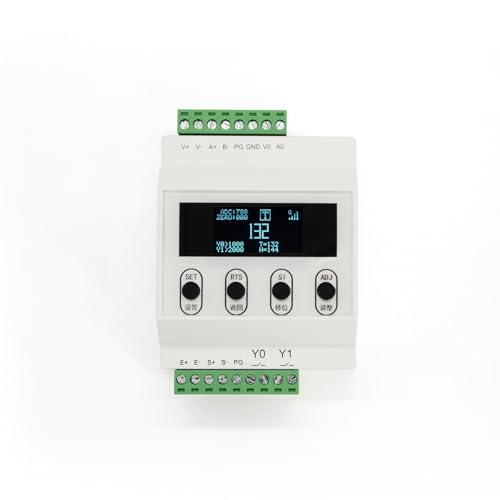
This device functions as a weighing transmitter with multiple output options, including RS-485, 4-20mA, 0-5V, and 0-10V. It features a digital display for direct readouts and a flexible interface ideal for industrial or lab setups needing longer-distance communication. With a stated accuracy around ±0.003% of full scale, it supports precise weight monitoring across various units (kg, g, ton, newtons). It’s a practical bridge between raw load cells and digital display systems or PLCs.
When considering this option, assess the compatibility with your existing data logger or control system, the required voltage supply, and whether you need isolated or non-isolated outputs. Calibration stability and environmental resilience (vibration, temperature) are additional factors to review.
Wishiot 2PCS Digital Load Cell Weight Sensor

This product offers two digital load cells with selectable ranges of 1kg, 5kg, 10kg, or 20kg. Each unit uses a four-wire connection (Red to E+, Black to E-, Green to A+, White to A-) and requires a drive voltage in the 5–10V range. The load signal is output as a voltage change, suitable for Arduino or Raspberry Pi projects and straightforward data capture. It is a compact choice for small-scale weighing tasks or portable scales where quick setup matters.
Consider pairing these with a stable breadboard or a small enclosure to reduce mechanical noise. Calibrate against known weights and check for repeatability under different mounting configurations to ensure reliable readings in real-world use.
Buying Guide: Key Considerations For Load Cell Purchases
- Measurement range and resolution: Choose a range that comfortably exceeds your maximum expected load, while ensuring the sensor’s sensitivity matches the precision you need.
- Bridge configuration: Half-bridge sensors require pairing for full-bridge accuracy; full-bridge kits typically offer better linearity and stability.
- Output and interface: Decide between analog outputs (mV/V), HX711-based digital readouts, RS-485, 4-20mA, or 0-5V/0-10V interfaces based on your controller and distance requirements.
- Power and voltage compatibility: Verify supply voltage requirements match your microcontroller or industrial controller, including any tolerance for 2.6–5.5V ranges.
- Calibration and drift: Plan for calibration routines using known weights, and consider temperature sensitivity and creep in your environment.
- Mechanical mounting: Look for appropriate mounting hardware and brackets to minimize slippage and friction, especially in dynamic measurements.
- Durability and materials: For industrial or outdoor use, prioritize sensors with robust housings and corrosion-resistant materials.
- Integration ecosystem: If you use a particular MCU or platform (Arduino, Raspberry Pi, ESP32), ensure there’s readily available libraries and example code for quick integration.