Best Mechanical Oil Flow Meter Options for Precise, Battery-Free Monitoring
Answering the needs of professionals and do-it-yourselfers seeking reliable oil flow measurement, this guide covers top mechanical and digital oil flow meters. These devices are best for measuring motor oil, lubricants, antifreeze, and other viscous liquids with high accuracy and minimal setup. Ideal buyers include shop technicians, fleet maintenance teams, and hobbyists who want robust, battery-free options or compact digital displays for quick readings. The table below highlights the five selected products and their key traits.
| Product | Type | Best For |
|---|---|---|
| GRYVOZE 1/2″ NPT Digital Gear Flow Meter | Digital gear flow meter | Low-flow, high-viscosity liquids like motor oil |
| GRYVOZE Mechanical Oil Control Valve Flow Meter Dispenser Nozzle | Mechanical oil metering gun | No-battery dispensing in harsh shop environments |
| GRYVOZE 1 Inch Mechanical Fuel Flow Meter | Mechanical fuel flow meter | High-volume fuel transfers in industrial settings |
| Lincoln 877 Mechanical Fluid Dispense Meter | Mechanical dispense meter | Petroleum and synthetic oils with totalizer |
| GRYVOZE 1/4″ NPT Digital Gear Flow Meter | Digital gear flow meter | Medium-flow, high-viscosity liquids |
GRYVOZE 1/2″ NPT Digital Gear Flow Meter

Best for low-flow, high-viscosity liquids, this digital gear flow meter offers three display modes and strong anti-electromagnetic interference resilience. It is ideal for motor oil, lubricants, antifreeze, and hydraulic fluids where precise instantaneous and total flow readings are valuable. Additionally, its multi-mode display helps operators read data quickly in dynamic environments.
- Three measuring modes: Instant Flow Rate, Single Measurement Flow, and Total Accumulated Flow.
- Designed for motor oil, lubricants, transmission fluid, antifreeze, and other viscous liquids.
- Anti-interference design supports stable operation near motors and welders.
Who this is best for: technicians focusing on accurate, quick readings with a digital interface in a workshop or service bay. Caution: digital meters can require a power source or battery-independent operation depending on model setup; verify your exact deployment needs before purchase.
GRYVOZE Mechanical Oil Control Valve Flow Meter Dispenser Nozzle
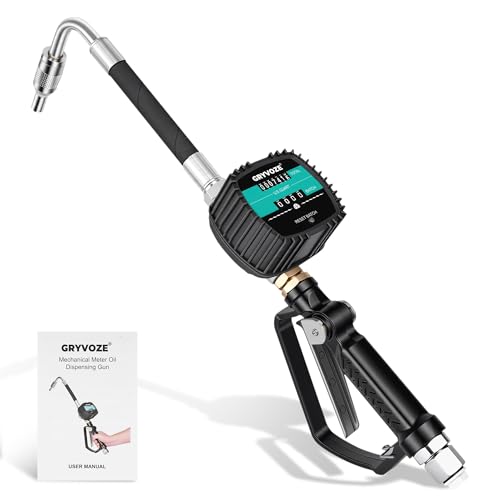
This mechanical oil metering gun is designed for simple, battery-free operation with high-accuracy dispensing. It features a fully mechanical structure, is water- and dustproof, and can withstand wide temperature ranges, making it suitable for tough shop environments. It displays total and batch quantities in quarts for precise tracking during operations.
- No batteries or setup required; ±0.5% accuracy over 0.26–9.25 GPM range.
- Fully mechanical, waterproof and dustproof, -10 °C to +50 °C allowed.
- Clear dial and mechanical reset for straightforward batch control.
Who this is best for: teams needing a rugged, gas- or oil-based dispensing gun that can operate without electricity. Limitation: may require regular calibration checks in extreme temperature or vibration conditions.
GRYVOZE 1 Inch Mechanical Fuel Flow Meter

With a nutating disc technology flow system, this mechanical fuel meter delivers up to ±0.5% accuracy for diesel, gasoline, and oil transfers. It is designed to minimize leakage and maintain stable sealing, even under demanding conditions. It operates without a battery, featuring a resettable batch reader and a totalizer for ongoing monitoring.
- Positive displacement measurement for repeatable accuracy.
- Battery-free design; resettable batch and totalizer.
- Sealed performance with precision gasket to prevent leakage.
Who this is best for: industrial fuel transfer operations requiring reliable mechanical measurement and no power source. Caution: not optimized for very low-viscosity liquids where precision is dominated by air or vapor lock concerns.
GRYVOZE 1/4″ NPT Digital Gear Flow Meter

Designed for low-flow, high-viscosity liquids, this meter provides three modes: Shift Cumulative Flow, Total Cumulative Flow, and Instantaneous Flow. Its anti-electromagnetic interference features help maintain stable performance near electrical equipment, making it suitable for motor oil, lubricants, and antifreeze.
- Wide application range including motor oil and lubricants.
- Three display modes for flexible data capture.
- Anti-interference design for near-power sources.
Who this is best for: operators needing compact digital measurement with flexible data display options. Limitation: smaller connection size may require adapters for some systems.
Buying Guide: Mechanical Oil Flow Meter Tech and How to Choose
Key questions to guide a purchase decision:
- What liquid will you measure? Consider viscosity, additives, and whether the liquid is oil-based or fuels when selecting flow meters.
- Do you prefer mechanical or digital? Mechanical meters excel in rugged environments without power, while digital meters offer instant readouts and easy data transfer.
- Is a totalizer or batch reading important? Totalizers help track cumulative usage, while batch readings support precise dispensing sessions.
- What flow range do you need? Ensure the meter’s accuracy range aligns with your typical flow rates to maintain ±0.5% or better.
- What environment will it operate in? Temperature, dust, water exposure, and proximity to high-frequency equipment influence meter choice.
- Do you require compatibility with existing hoses, connectors, or inlets? Check NPT sizes (1/2″ vs 1″) and thread types to ensure a proper fit.
Practical comparison tips
- Digital meters are best when quick readings and data logging are priorities; mechanical meters excel in no-power, harsh surroundings.
- For high-volume transfers, prioritize meters with higher flow capacity and robust sealing to prevent leaks.
- If you need precise batch measurements, select meters with explicit batch or totalizer features and easy reset functionality.
Quick maintenance and setup considerations
- Regularly inspect seals and gaskets for wear to prevent leaks.
- Keep sensors and dials clean and readable; dust and oil buildup can affect accuracy.
- Verify calibration periodically, especially when switching between liquids with different viscosities.
FAQ
- Q: Are mechanical oil flow meters accurate for all viscosities? A: They provide strong accuracy for a range of viscosities, but extreme thinning or thickening liquids can affect readings.
- Q: Do digital meters require batteries? A: Some models are battery-powered; others are battery-free. Check the specific product’s power requirements.
- Q: Can I use these meters for fuels and oils interchangeably? A: Many meters support multiple oil-based liquids, but verify compatibility with your exact liquid and viscosity.
- Q: What maintenance is essential? A: Inspect seals, reset counters as needed, and clean the display or dial to maintain readability.
- Q: Which meter is best for a high-vibration shop floor? A: Mechanical, rugged designs with sealed housings are typically better suited for vibration-prone environments.
- Q: How do I choose the right connection size? A: Match the meter’s inlet/outlet size (such as 1/2″ or 1″ NPT) to your existing piping or hoses for a leak-free fit.