Best Nitrous Oxide Flow Meter and Pressure Gauge Guide for 2026
Answering buyers who need reliable nitrous oxide flow measurement and pressure monitoring, this guide highlights five top options that balance accuracy, durability, and ease of use. Each product is suited to different uses—from street-friendly setups to high-performance racing environments. Read on to compare features, installation notes, and ideal buyers for each choice.
| Product | Best For | Why It Stands Out | Limitation |
|---|---|---|---|
| Auto Meter 3277 Nitrous/Fuel Restrictor | Street builds and damped readings | Restricts pressure spikes, stabilizes pointer movement for easier readability | Specific to restrictor needs, not a full gauge suite |
| Auto Meter 4328 Ultra-Lite Mechanical Nitrous Pressure Gauge | Simple, reliable mechanical gauge | No electrical system needed, traditional illumination | Mechanical readout may be slower to react than digital |
| Auto Meter 7574 Phantom II Electric Nitrous Pressure Gauge | High accuracy in harsh environments | LED dial lighting, solid-state transducer, digital precision | Requires electrical system integration |
| Nitrous Outlet Flowing Fuel Pressure Test Gauge Kit | Precision tuning and jets testing | 0-100 PSI digital gauge with 43 jets for tuning | Digital kit focus may be overkill for simple monitoring |
| Auto Meter 4374 Ultra-Lite Electric Nitrous Pressure Gauge | Night operation with robust readouts | Digital stepper motor, durable transducer | Requires electrical connection |
Auto Meter 3277 Nitrous/Fuel Restrictor

The 1/8 inch NPT male to -4AN male design helps manage pressure spikes in nitrous and fuel lines. This restrictor is best for builds where limiting fluctuations improves pointer stability and readability. It is ideal for street or strip cars where consistent nitrous flow is essential.
Best for: small to mid-size nitrous systems where spike dampening improves gauge readability. Better for riders who prioritize stable readings over maximum flow capacity. Caution: verify thread compatibility with your existing fittings to ensure a proper seal.
Auto Meter 4328 Ultra-Lite Mechanical Nitrous Pressure Gauge
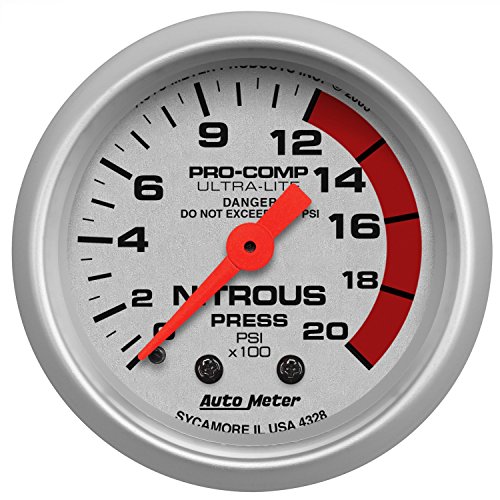
This traditional mechanical gauge uses incandescent illumination for perimeter glow and requires no electrical power to operate. It delivers trusted, race-proven accuracy and is easy to install, making it suitable for a broad range of street and race vehicles.
Best for: builders who want a straightforward, dependable mechanical gauge without wiring. Choose this for simple installations and proven durability. Caution: mechanical gauges can be slower to react than electric sensors under rapid pressure changes.
Auto Meter 7574 Phantom II Electric Nitrous Pressure Gauge

Featuring a data acquisition grade solid-state pressure transducer and a modern LED white dial, this gauge offers high-precision readings with durable performance in harsh environments. The electric system integrates with digital instrumentation, keeping hazardous fluids outside the vehicle interior.
Best for: racers and enthusiasts who need precise data logging and bright nighttime visibility. Better for complex builds with digital instrumentation. Caution: ensure compatible electrical connections and grounding in your dashboard setup.
NOS 6An Hi-Flo Nitrous Filter (Black)

This nitrous filter sits in the line to protect the system from debris and irregular flow. It is compatible with 12 and 16-volt electrical systems and is designed for a broad range of street and race cars. The kit includes installation hardware and bulb-like components for easy integration with existing lighting and indicators.
Best for: setups where added protection against particulate contamination is desired. Choose this when filtering and line integrity matter most. Caution: filter maintenance and replacement are necessary to maintain performance.
Buying Guide: Key Considerations for Nitrous Flow Meters and Gauges
What should you look for when selecting a nitrous flow meter or pressure gauge?
- Measurement type: Mechanical vs. electric gauges. Mechanical gauges work without power but may react slower; electric gauges offer faster response and data capabilities but require wiring.
- Pressure range: Ensure the gauge can cover your system’s expected nitrous pressure and any boost from fuel pressure tuning.
- Reading clarity: Incandescent, LED, or digital displays impact readability at night and in bright daylight.
- Durability and environment: Choose instruments designed for automotive use with resistant housings and sealed connections to handle racing environments.
- Installation: Consider the number of fittings, thread sizes, and whether a restrictor or filter is needed in your setup.
- Data capabilities: Some electric gauges include data acquisition and logging, which helps tuning over time.
- Safety and compliance: Ensure gauges are designed to minimize hazardous exposure and are compatible with vehicle regulations for your region.
Practical Tips for Setup and Tuning
- Match fittings: Confirm NPT and AN thread compatibility before purchasing or installing a restrictor or filter.
- Baseline testing: Start with conservative readings and gradually tune jets to prevent sudden pressure spikes.
- Maintenance: Regularly inspect filters and lines for wear, leaks, or clogging that could affect readings.
- Calibration checks: Periodically verify that mechanical gauges track accurately against known reference pressures.
Frequently Asked Questions
- Q: Are nitrous flow meters the same as nitrous pressure gauges? A: No. Flow meters indicate the rate of nitrous gas passing through a system, while pressure gauges measure the pressure within hoses and regulators.
- Q: Do I need an electric gauge for street use? A: Not necessarily. Mechanical gauges work without power, though electric gauges offer enhanced accuracy and data capabilities.
- Q: Can I install a nitrous filter in any car? A: It depends on the fuel and nitrous setup. Ensure compatibility with your line sizes and system design.
- Q: How do I know which gauge range to choose? A: Select a range that comfortably exceeds your normal operating pressure to avoid dials pegging or overflow errors.
- Q: Is a restrictor necessary? A: A restrictor helps dampen pressure spikes in some setups but won’t suit every system. Choose based on your tuning goals and readings.
- Q: What maintenance is required for these gauges? A: Regular inspection for leaks, calibration checks for mechanical units, and cleaning of any filters or jets in the line.