Best on Demand Air Compressor Solutions for Quick, Portable Air
Looking for an on demand air compressor that delivers reliable, fast inflation on the go? This guide highlights five top options designed for trucks, trailers, and heavy-duty use, with clear buyer targets and practical trade-offs. Whether you need fast tire inflation, air bag suspension control, or in-cab operation, these picks cover different power needs and installation styles. The following table summarizes the chosen products to simplify comparison.
| Product | Best For | |
|---|---|---|
| CNRAQR 150 PSI Air Compressor | Heavy duty trucks and trailers | 150 PSI, 1.6-gallon aluminum tank |
| RETRUE Onboard Air Compressor System | In-cab control for air bag suspension | 100 PSI with quick inflation |
| VIAIR 380C | Portable, plug-and-play inflating and tool use | Pre-wired, 200 PSI, 1.5 gallon tank |
| Medium Duty Onboard Kit 150 PSI | Train horns and multi-port setups | 2.5 gallon tank, multiple ports |
| maXpeedingrods On Board System | Air spring control while driving | 100 PSI max, single-path system |
CNRAQR 150 PSI Onboard Air Compressor

The CNRAQR kit is designed for easy installation with clear instructions and all necessary components. Best for heavy-duty use in trains, trucks, trailers, or autos, it offers a high working pressure of 150 PSI and intermittent capability up to 250 PSI. The included 1.6-gallon aluminum air tank emphasizes durability under stress. Choose this if you need a robust system that can handle demanding applications and frequent use, such as inflating large tires or powering air tools. A potential limitation is the weight and space required for the aluminum tank in tight install areas.
RETRUE Onboard Air Compressor System
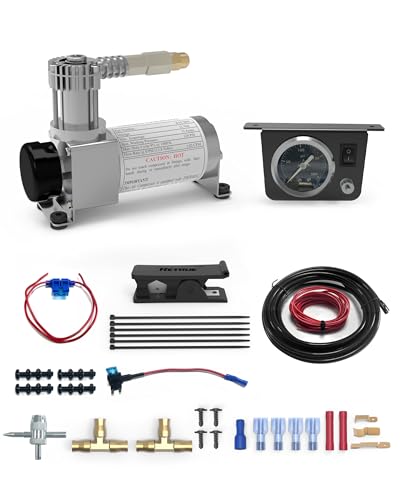
RETRUE emphasizes fast, in-cab control for air bag suspension. It inflates up to 100 PSI with quick timing—about 80 seconds to 50 PSI, 2 minutes 10 seconds to 70 PSI, and under 4 minutes fully inflated. Best for drivers who want to adjust ride height from the cab and avoid over-inflation with a press-and-hold control scheme. Limitations include relying on the gauge and potential issues with gauge accuracy; support is recommended if gauge trouble arises.
VIAIR 380C Plug-N-Play Compressor

The VIAIR 380C is a pre-wired, self-contained system with a 1.5-gallon tank and a 200 PSI rating. Its plug-and-play design and 12-volt power source suit mobile users who need portable inflating capability for tires and air tools. Best for users who want rapid setup and portability without separate air tanks, but note that the included space may limit long-term usage in tight vehicle compartments.
LLNSEAUTO Medium Duty Onboard Kit

This kit provides a 2.5-gallon tank with multiple ports, aiming at train or horn applications that require more ports and flexible plumbing. Best for those who need a stable, multi-connection platform and can manage a larger footprint. The kit includes essential mounting hardware and a heavy-duty pressure switch, but installation will be more involved due to port complexity.
maXpeedingrods On Board System (Low Pressure Sensor)
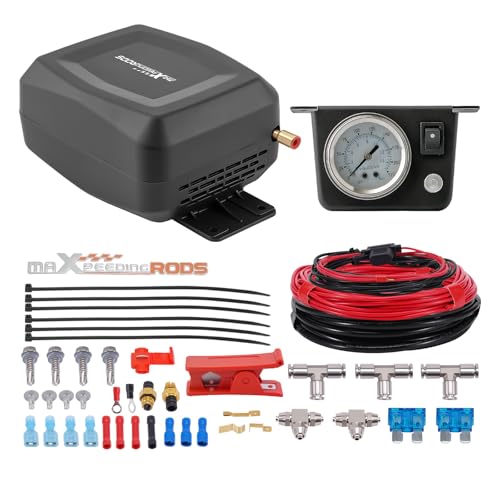
This single-path system focuses on easy air up with automatic pressure adjustments through a low-pressure sensor and an optional analog gauge. Best for drivers who want to inflate air springs without leaving the cab, and who prioritize simplified operation. A potential limitation is its 100 PSI maximum, which may be insufficient for some heavy-duty needs or larger air springs in extreme loads.
maXpeedingrods On Board System (Low Pressure Sensor, Analog Gauge)

This version expands with a low-pressure sensor and analog gauge, enhancing on-the-go adjustments for light- to medium-duty air springs. Best for fleets needing on-the-fly tuning without complex controls. The automatic sensor helps maintain safe pressure, but users should verify compatibility with specific air spring models to ensure accurate readings.
Lhfacc On Board Air Compressor System

Lhfacc focuses on a compact, integrated solution for air springs with a digital dual-path gauge and paddle valve. Best for installations where space is limited and users require separate control of two air springs from the cab. A limitation includes a need to drill multiple mounting holes and a longer installation time, roughly two hours depending on fitment.
Buying Guide: Key Considerations for On Demand Air Compressors
- How will you use the system? Consider tire inflation, air tools, or air bag suspension adjustments to select the right PSI range and tank size.
- Is in-cab control important? If yes, prioritize units with gauges, paddles, or remote controls for easier on-the-fly adjustments.
- What is the vehicle type and space for installation? Larger tanks require more mounting space; compact kits fit tighter installations.
- Power source compatibility matters. Most units run on 12V, but check if a dedicated power line or relay is needed for reliable operation.
- Number of ports and plumbing flexibility. Multilug ports enable more connections for trains, trailers, or multiple air bags.
- Durability and material. Aluminum tanks are lighter and rust-resistant, while steel may offer different mounting options.
Frequently Asked Questions
- What is “on demand” air compression? It means the compressor runs to refill air when a system needs pressure, rather than maintaining constant pressure continuously.
- Can these systems operate without an air tank? Some kits are tankless or have small tanks; review your model’s tank size to ensure it fits your needs.
- Do these kits require professional installation? Some are straightforward for DIY installation; others involve wiring and mounting hardware best handled by a pro or someone with basic auto-electrical skills.
- What PSI is typical for air bag suspension? Most systems operate in the 50–100 PSI range, but check your specific air spring requirements for optimal performance.
- Will these work with all vehicle types? Compatibility varies; verify fitment with your truck, trailer, or train application and any brand-specific requirements.
- Are there safety considerations for in-cab controls? Use the provided gauges and sensors, monitor hose routing, and avoid over-inflation to prevent damage.