Best Portable Multi-Gas Detectors for Safe Work Environments
Looking for a compact, reliable portable multi-gas detector to monitor ambient air for dangerous gases? This guide highlights five top options, explains who each device is best for, and explains why they stand out. Ideal buyers include workers in confined spaces, technicians performing field tests, and professionals needing quick, actionable gas readings. The following table summarizes the featured products to help you compare at a glance.
| Product | Best For | Key Benefit |
|---|---|---|
| TopTes Guard-101 | General industrial and home use | 4-gas monitoring with vibration, visual, and audible alarms |
| USA NIST Calibrated 4 Gas Monitor by Forensics | Calibration-focused operations | USB recharge and formal 4-gas monitoring |
| 4 Gas Monitor | Mini & Small | Compact, lightweight setups | Small form factor with USB recharge |
| TopTes Guard-863Pro | Worksites needing clear TFT display | Upgraded O2 sensor and data export |
| HAOKESITE 4 Gas Monitor | Budget-conscious buyers | Factory-calibrated with four alarm modes |
Note: All products listed focus on detecting O2, CO, H2S, and LEL/EX (explosive gas) to support safe decision-making in potentially hazardous environments.
TopTes Guard-101 Gas Detector

Product overview: The TopTes Guard-101 is a four-gas monitor designed for H2S, CO, LEL, and O2 detection. It includes vibration, visual, and audible alarms, with a long-lasting battery and explosion-proof safety rating. This device targets workers in general industrial settings who need reliable gas monitoring on the go. Best for quick, on-site gas checks and for environments where audible alarms must be complemented by tactile feedback.
Best for: Industrial maintenance crews, construction workers, and home users needing four-gas monitoring with robust alarms.
Why selected: It offers a balanced feature set with multi-alarms and a durable form factor suitable for everyday field use. The explosion-proof design adds a safety margin in harsh environments.
Limitations: Battery life is listed at 14 hours in some configurations; users in continuous 24/7 operation may require charging intervals or a spare unit.
USA NIST Calibrated 4 Gas Monitor by Forensics

Product overview: The Forensics 4-Gas Monitor provides USB recharge and a calibrated setup for four gases, including O2, CO, H2S, and LEL. This option appeals to professionals who require precise calibration data and straightforward USB-powered recharging for fieldwork. Best for calibration-conscious users and teams needing standardized gas readings.
Best for: Field technicians, safety officers, and labs requiring consistent calibration references.
Why selected: USB recharge and NIST-calibrated design emphasize reliability in routine checks and compliance workflows.
Limitations: Some users may prefer more compact form factors for tight spaces.
4 Gas Monitor | Mini & Small
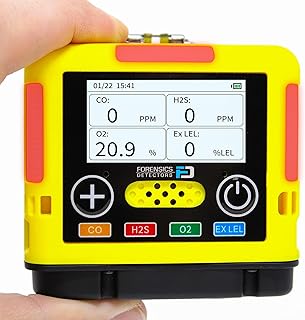
Product overview: The Mini 4-Gas Monitor offers a compact form factor with USB recharge. It targets users who need a lightweight detector for quick checks in tight spaces or on the move. Best for field technicians who value portability without sacrificing four-gas detection capabilities.
Best for: Inspectors, technicians, and contractors needing a small, easy-to-carry detector.
Why selected: Its small size makes it ideal for confined-space work or scenarios where bulkier units hinder access.
Limitations: Smaller devices may have fewer display options or longer-term battery life compared to larger units.
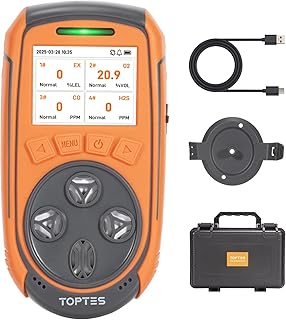
Product overview: The Guard-863Pro combines a TFT color screen with four-gas monitoring for H2S, CO, LEL, and O2. It adds an upgraded oxygen sensor and USB data export. This model suits workplaces needing clear data visualization and easy post-site analysis. Best for crews that require quick visual confirmation and reliable data export for compliance records.
Best for: Industrial teams and safety coordinators who prioritize a color display and data export capabilities.
Why selected: The higher-end O2 sensor lifespan and data export support improved long-term safety management.
Limitations: Higher feature set may come with a higher upfront cost; consider this in budget planning.
HAOKESITE 4 Gas Monitor
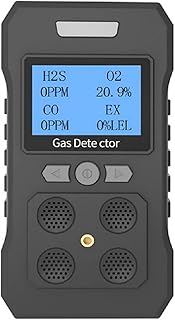
Product overview: The HAOKESITE 4 Gas Monitor is a budget-friendly portable detector with four alarm modes designed to alert via voice, loud alarm, vibration, and visual cues. It ships factory-calibrated and includes a calibration cap for improved gas concentration accuracy. Best for budget-conscious buyers who still need reliable four-gas detection.
Best for: Small contractors, DIY safety projects, and budget-first buyers seeking dependable four-gas monitoring.
Why selected: Factory calibration reduces setup complexity and provides immediate usability out of the box.
Limitations: The feature set may be more basic compared with premium TFT-display models, and battery life can vary with alarm usage.
Buying Guide
What to consider when choosing a portable multi-gas detector
Gas detectors protect workers by providing real-time readings of O2, CO, H2S, and LEL. When choosing, evaluate gas ranges, alarm types, battery life, display readability, calibration options, and data export capabilities. Consider whether you need factory calibration or regular field recalibration, and how the device’s size and weight fit your typical workflow.
Key features to compare
- Gas coverage: Ensure the detector reads all gases relevant to your worksite (O2, CO, H2S, LEL or EX).
- Alarms: Look for audible, visual, and vibrating alarms for immediate notice in noisy or visually obstructed environments.
- Display: TFT color screens can aid quick interpretation; simpler displays may suffice for basic readings.
- Power: Check battery life and charging method (USB recharge is common for field kits).
- Calibration: Factory-calibrated units provide ready-to-use convenience; recalibration needs may affect ongoing maintenance.
- Data export: USB or Bluetooth data export supports record-keeping and compliance reporting.
Choosing by use case
- Best for general field work: Models with robust alarms and long battery life.
- Better for data-heavy environments: Units with USB data export and clear displays.
- Choose this if confined-space work is frequent: Smaller, lighter detectors improve maneuverability.
- Avoid this if you operate in extremely bright sunlight: Some displays may be harder to read in direct sun; consider a TFT screen model with better visibility.
FAQ
- What gases does a portable multi-gas detector measure? It typically monitors O2, CO, H2S, and LEL or explosive gases.
- How do I know when to calibrate? Calibration intervals depend on the manufacturer and usage; factory calibration offers ready-to-use accuracy, while field re-calibration ensures ongoing reliability.
- Can I export detector data? Some models support USB data export or Bluetooth transfer for logs and compliance reports.
- What’s the best detector for confined spaces? A compact, four-gas detector with reliable alarms and easy readability is advantageous in tight areas.
- Is battery life enough for a full shift? Battery life varies by model and alarm activity; check manufacturer specifications and plan for charging steps or spare units.
- Do I need vibration alarms? Vibration alarms are helpful in loud environments where audible alarms might be missed.