Best Portable Gas Detectors for Quick Gas Sensing
For buyers searching for a portable gas detector, the goal is fast, reliable sensing in a compact device. This guide highlights five solid options that balance accuracy, durability, and ease of use. Ideal buyers: industrial workers needing constant monitoring, homeowners checking for leaks, and facility staff protecting staff in potentially hazardous environments. Below is a quick summary table of the chosen products to compare at a glance.
| Product | Best For | Key Benefit |
|---|---|---|
| TopTes Guard-101 | Worksites with multiple gas risks | Triple alarm with 14h battery |
| H2S Monitor Clip (HAOKESITE) | Hydrogen sulfide focused testing | High precision sensor, fast response |
| BW Clip BWC2-X | Easy daily wear with logging | Automatic event logging and bump test readiness |
| Forsensal 4 Gas Monitor (Pump) | Field service with pumped sampling | Rechargeable with calibration support |
| CHNADKS ADKS-4 | Rugged environments | Three alarms, durable ABS design |
TopTes Guard-101 Gas Detector
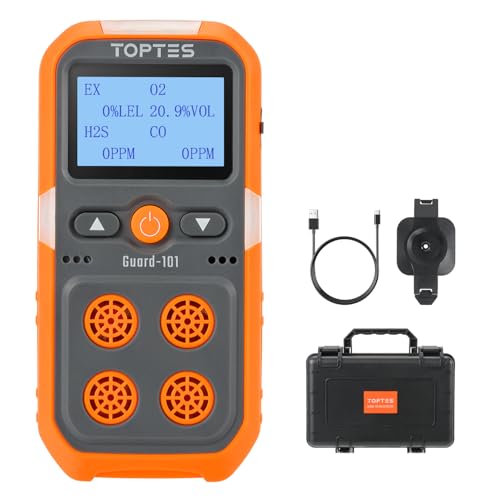
The TopTes Guard-101 is a 4-gas monitor for H2S, CO, LEL, and O2 with 14 hours of battery life. It features a waterproof, dustproof, and explosion-proof construction and a back clip for easy carry. It uses LED, vibration, and audible alarms with fast response (0.5 seconds) and stores alarm data for later review. This device is best for workers needing continuous multi-gas monitoring in industrial or home settings. A potential limitation is reliance on a password-protected start (initial password “69”) to prevent unintended operation, which may add a small setup step for new users.
H2S Monitor Clip Single Gas Detector (HAOKESITE)

This device focuses on hydrogen sulfide detection with a 0–100 ppm range and a high-precision sensor (±5%). It includes audible and red visual alarms to alert users immediately when H2S exceeds safe thresholds. Best for workers in confined spaces or industries with H2S exposure. Limitation: single-gas focus means it doesn’t monitor CO, LEL, or O2 simultaneously, which could require a separate detector in mixed-risk environments.
BW Technologies BW Clip BWC2-X

The BW Clip BWC2-X offers hibernation mode with optional case accessories and IntelliDoX integration. It automatically logs the most recent 35 gas events and bump test results, with user-configured high and low alarm set points before activation. This product is best for users who want continuous, low-maintenance monitoring with easy data access. Limitation: may require additional accessories or infrastructure to maximize data logging beyond the included features.
BW Technologies BW Clip BWC2-H H2S Monitor

This single-gas H2S monitor emphasizes hibernation mode, with logging for past 35 gas events and bump tests, and it allows configuration of alarm set points prior to activation. It is best for workers needing dedicated H2S monitoring with straightforward operation. Limitation: focuses on H2S; it does not monitor other gases, which could be a drawback in mixed-gas environments.
Forsensal Gas Detector with Pump

The Forsensal 4 Gas Monitor includes a pump, measures CO, O2, H2S, and EX, and ships with a calibration kit and a 3000 mAh rechargeable battery. It has a large LCD display for real-time gas concentrations and supports manual settings for alarms. Best for field service where pumped diffusion aids sample collection. Limitation: larger form factor and more advanced features may require more user familiarity and calibration care.
ADKS-4 Portable Gas Detector

The CHNADKS ADKS-4 is a four-gas detector for H2S, O2, CO, and LEL. It uses high-quality sensors and provides rapid responses with low error rates, and it is described as durable, with a triple alarm system (LED, sound, vibration). Best for industrial environments requiring a robust, all-around gas detector. Limitation: longer-term accuracy and calibration frequency should be managed according to use-case conditions.
Buying Guide: Key Purchase Considerations
- Number of gases: Decide whether you need single-gas simplicity or multi-gas coverage. Multi-gas units simplify monitoring when several hazards may be present.
- Power and run-time: Look for devices with long battery life and easy-to-replace batteries for continuous use on-site.
- Alarms and notifications: Choose devices with audible, visual (LED), and vibration alarms to accommodate noisy or dim environments.
- Durability and rating: For harsh environments, prefer explosion-proof, waterproof, and dustproof housings.
- Data recording: Some models log events or store alarm histories—useful for audits and post-incident reviews.
- Calibration and maintenance: Check calibration requirements and whether a kit or service is needed to keep readings accurate.
- Ease of use: Passwords, pre-set alarms, and clear displays help minimize human error in critical situations.
Frequently Asked Questions
- What is the best portable gas detector for H2S monitoring? Answer: For dedicated H2S monitoring, the HAOKESITE H2S Monitor Clip and similar single-gas detectors are well-suited due to their focused sensitivity and fast alert behavior.
- Do I need a pump in a gas detector? Answer: A pump helps draw air into the sensor from a distance, beneficial for testing confined spaces or hard-to-reach areas. It may not be necessary for general field use.
- Can these detectors log alarm events? Answer: Some models, like BW Clip series, offer automatic logging of recent gas events and bump tests, which is helpful for safety records.
- How do I choose between single-gas and multi-gas detectors? Answer: If your environment has one primary hazard (e.g., H2S), a single-gas device can be enough; for multiple potential hazards, a multi-gas detector reduces the need to carry multiple devices.
- What maintenance is required for accuracy? Answer: Regular calibration checks, battery monitoring, and following the manufacturer’s calibration certificates help maintain accuracy over time.
- Are these devices suitable for home use? Answer: Yes, portable gas detectors are useful for home gas leak detection (natural gas, propane) but verify the target gas types and sensor sensitivity for domestic needs.