Best Powder Coating Testing Equipment for Accurate Inspections
Answering buyers seeking reliable powder coating testing tools, this guide highlights five top options and who they suit best. From pencil hardness testers to digital thickness gauges, these devices help ensure consistent finishes, reduce defects, and support quality control in shops, labs, and auto-detailing. For quick reference, a buying table compares key strengths and suitability at a glance.
| Product | Best For | |
|---|---|---|
| Pencil Hardness Tester Kit | Coaters and inspectors needing portable scratch tests | All-in-one kit with calibrated weights and 45° angle for consistent results |
| Prismatic Digital Coating Thickness Gauge | Coaters and auto detailers | Ferrous/non-ferrous detection with real-time thickness readouts |
| Portable Paint Color Test Electrostatic Machine | On-site color testing | Electrostatic approach for test powder coating color matching |
| CM-205FN Paint Thickness Gauge | Auto shops and field techs | High-precision digital thickness with non-ferrous capability |
| LS226 Powder Coating Thickness Tester | Non-destructive coating measurements | Self-weighted, stable position, versatile substrate compatibility |
Pencil Hardness Tester Kit For Coatings

The Pencil Hardness Tester Kit provides a complete, ready-to-use solution for coating scratch testing. It includes a tester, 13 pencils (6B–6H), weights, a knife, eraser, and a case. This makes it ideal for shop floors and laboratories that need a portable, all-in-one hardness testing tool. Best for quality inspectors and technicians who require quick, repeatable scratch grade results (such as 2H or 3H) on painted wood, metal, or automotive coatings.
Best for: professionals needing a compact, field-ready hardness assessment that delivers precise pencil grades with calibrated weights and a fixed 45° angle. Choose this if you prefer an all-in-one kit that minimizes setup time and tool counting. Caution: bulkier kits may be heavier to transport than single-purpose testers.
Prismatic Powders Digital Coating Thickness Gauge
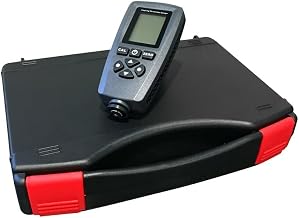
Prismatic Powders’ digital gauge automatically detects ferrous versus non-ferrous substrates and measures coating thickness with magnetic induction and eddy current technology. This makes it highly suitable for powder coaters and auto detailers who need uniform 2–3 mil finishes and real-time readings to prevent orange peel, runs, or drips. It stores up to 2000 readings and provides mean, max, min, and standard deviation for project-wide analysis.
Best for: professionals requiring automated substrate detection and robust data tracking to manage large coating programs. Better for: projects with mixed metals where substrate identification influences thickness interpretation. Limitation: advanced features may require some initial familiarization to leverage all data functions.
Portable Paint Color Test Electrostatic Machine

This electrostatic powder coating machine targets color testing and matching during the coating process. It is best for on-site color verification and quick adjustments to achieve color consistency across batches. Best for: shop floors that perform frequent color matching against standards or customer specs. Caution: data on color matching may require calibration against a reference standard for best accuracy.
CM-205FN Digital Coating Thickness Gauge

The CM-205FN digital thickness gauge for paints and coatings provides high-precision measurements with 0.1 μm resolution and a 0–1500 μm range. It supports auto-ferrous/non-ferrous detection and backlit display for easy reading in varied lighting. Best for: auto body shops and field technicians needing accurate, repeatable thickness readings without destructive testing. Caution: ensure proper calibration for non-ferrous materials to maintain accuracy.
LS226 Powder Coating Thickness Tester

LS226 is a non-destructive coating thickness tester designed for a range of metal substrates. It measures non-magnetic coatings and zinc on ferromagnetic metals like steel, as well as non-conductive coatings on non-magnetic metals and ceramics. It uses a self-weighted mechanism for stable positioning and reduced human error. Best for: technicians who need reliable thickness readings across diverse coating types with minimal setup. Limitation: compatibility varies with substrate material; verify substrate compatibility before use.
Buying Guide: Powder Coating Testing Equipment
- What to measure: Determine whether you need pencil hardness, coating thickness, or color/color-matching testing. Each tool targets a different failure mode (scratch resistance vs. film thickness vs. color consistency).
- Substrate compatibility: Ferrous vs. non-ferrous metal detection affects gauge choice. For mixed metals, devices with automatic substrate detection simplify interpretation.
- Measurement resolution: Look for units and resolution that match your quality standards (e.g., micrometers, mils, or pencil hardness grades).
- Data handling: For large projects, prefer devices with data storage, statistics, and export options to support report generation.
- Portability vs. bench use: Portable testers suit on-site work; benchtop models suit lab environments and repetitive testing.
- Calibration and maintenance: Check how easy it is to calibrate and service the instrument to maintain accuracy over time.
FAQ
What is the pencil hardness tester best used for?
It gauges scratch resistance of coatings by applying a defined pencil grade at a set angle and pressure to determine hardness levels.
How does a coating thickness gauge help with powder coating?
It measures the film thickness to ensure uniform coverage and prevent issues like orange peel or runs.
Are these devices suitable for on-site use?
Yes, several options are portable and designed for field testing, including pencil testers and handheld thickness gauges.
What should I consider when choosing a thickness gauge?
Consider substrate type, measurement range, resolution, data storage, and whether you need ferrous/non-ferrous detection.
Is non-destructive testing reliable for all coatings?
Non-destructive methods work well for most coatings but may require calibration or substrate verification for certain materials.
Do these tools require calibration?
Most devices require periodic calibration to maintain accuracy, with some offering automatic substrate detection for simplification.