Best Pressure Reducing Control Valve Options for Home and Commercial Plumbing
Answering the need for reliable water pressure management, these pressure reducing control valves help protect pipes, fixtures, and appliances from damaging high pressure. This guide highlights practical choices for residential, commercial, and multifamily installations, focusing on compact footprint, easy maintenance, and durability. Each product below targets a specific use case—tight spaces, high-use commercial settings, or DIY installations—so you can pick the right model for your scenario.
Summary of selected products
- Zurn Wilkins 34-NR3XLDU: Compact, cartridge-loaded design for easy repairs in tight spaces.
- Watts LF25AUB-Z3: NPT union connections with a wide pressure range, ideal for varied systems.
- Cash Acme EB45: Direct-access cartridge design with tamper-resistant features for safe, adjustable downstream pressure.
- Sprmith 1-NR3XLDU: 1″ valve suitable for residential or light commercial with up to 75 PSI adjustable setting.
- Orvexa LF25AUB-Z3: Factory preset 50 PSI, adjustable 25–75 PSI, with durable lead-free body.
Zurn Wilkins 34-NR3XLDU 3/4″ NR3XL Pressure Reducing Valve

Best for compact spaces where a shorter lay length is essential. The Zurn NR3XL cartridge-loaded design simplifies field repairs, reducing service time. Ideal for residential and light commercial lines where space is limited and easy maintenance matters most. The valve supports multiple tailpiece options for threaded, PEX, copper, or CPVC connections, enhancing installation flexibility.
Who it’s best for: homeowners and plumbers working in tight crawl spaces or utility closets. Why selected: its small footprint and cartridge-based repair approach minimize downtime and labor. Caution: ensure compatibility with your chosen tailpiece option to avoid installation delays.
Watts LF25AUB-Z3 Water Pressure Reducing Valve

Best for adaptable, wide-range pressure control in commercial, industrial, and residential systems. This model offers a broad inlet-to-outlet range and a standard 50 psi setting, with a lead-free copper silicon alloy body and a durable diaphragm. Its replaceable seat module and stainless steel strainer support longevity in more demanding environments.
Who it’s best for: facilities managers and builders handling mixed-use buildings where multiple fixtures benefit from consistent pressure. Why selected: flexibility in connection types and a robust diaphragm design make it a practical mid- to high-use solution. Caution: verify that 3/4 inch is the correct size for your supply line to avoid a mismatch.
Cash Acme EB45 Pressure Regulating Valve
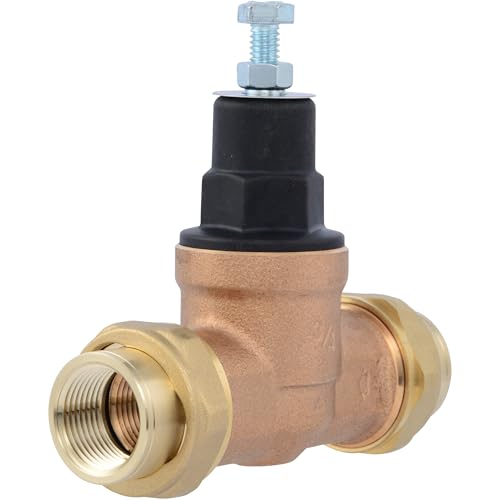
Best for tamper-resistant, lockable downstream pressure in commercial and residential settings. The EB45 uses a compact inline 3/4 in. NPTF double-union design and half-cartridge concept to offer direct access to the pressure-adjusting screw. This helps prevent accidental changes and provides stable, safe downstream pressure in potable water systems.
Who it’s best for: facility operators seeking a secure, easy-to-adjust regulator with straightforward maintenance. Why selected: the lockable design reduces the risk of accidental pressure changes, a valuable feature in shared building systems. Caution: 60 PSI is specified in the model name; verify the actual operating range for your installation to avoid under- or over-pressurization.
Sprmith 1-NR3XLDU 1″ NR3XL Pressure Reducing Valve

Best for medium to large residential or light commercial applications needing higher flow. The 1″ NR3XL provides a wide adjustable range (15–75 PSI) with a factory preset around 50 PSI, delivering potential water and energy savings. Brass construction with a stainless steel strainer offers wear resistance for varied water conditions.
Who it’s best for: homes or offices with higher water usage and a need for reliable pressure control across multiple fixtures. Why selected: the 1″ size balances flow and control, while the stainless steel screen adds dependable filtration. Caution: verify space for a 1″ valve and ensure correct piping orientation to avoid installation issues.
FASBET 3/4 Inch Water Pressure Regulator with Gauge

Best for visible pressure monitoring and DIY installations where a gauge is valued. This 3/4 inch regulator features a brass body and includes a gauge, wrench, and sealing tape in the package. It withstands up to 1.6 MPa and is suitable for many households, buildings, and factories.
Who it’s best for: homeowners performing their own plumbing work or facilities with a need to visibly track pressure. Why selected: the included gauge and complete packing kit simplify setup and ongoing monitoring. Caution: gauge accuracy and durability may vary; periodic checks are recommended.
Orvexa LF25AUB-Z3 Pressure Reducing Valve

Best for balanced household pressure with a preset 50 PSI and adjustable range. The LF25AUB-Z3 uses a lead-free alloy body with a polymer seat for durable sealing. It stabilizes incoming pressure to protect pipes and fixtures, supporting reliable performance in residential water systems.
Who it’s best for: homeowners seeking a straightforward, reliable regulator with a factory preset. Why selected: the combination of lead-free materials and adjustable 25–75 PSI range suits typical home plumbing. Caution: as with all regulators, verify your system’s baseline pressure to ensure the preset matches your needs.
Buying Guide: Key Considerations for Choosing a Pressure Reducing Valve
- Application scope: Choose based on residential, commercial, or mixed-use settings. Larger flow needs favor 1″ or higher, while compact spaces benefit from shorter lay lengths like the NR3XL models.
- Connection type: Union and FNPT options offer easier maintenance and replacement. Ensure the connection size matches your pipework (1/2″, 3/4″, 1″).
- Pressure range and preset: Common ranges are 25–75 psi. Factory presets (e.g., 50 psi) suit many homes, but adjustable models let you tailor downstream pressure to fixtures and appliances.
- Cartridge design vs. traditional diaphragms: Cartridge designs simplify servicing and replacement, often reducing labor time during repairs.
- Materials and durability: Brass bodies and corrosion-resistant components extend life in potable water systems. Lead-free options are preferred for drinking water safety.
- Tamper resistance and security: Some models offer lockable screws or tamper-resistant features to prevent accidental changes in shared facilities.
- Monitored vs. unmonitored: Gauges provide visible pressure readings useful for DIY setups and ongoing maintenance, while gauge-free units rely on downstream testing.
- Space and installation: In tight spaces, compact models save room and simplify routing. Consider the valve lay length and tailpiece options for your layout.
Frequently Asked Questions
- What is a pressure reducing valve (PRV) used for?
A PRV lowers incoming water pressure to protect plumbing, reduce water waste, and extend the life of fixtures and appliances.
- How do I know what size PRV I need?
Match the valve size to your supply line (e.g., 3/4″, 1″). Consider the desired downstream pressure and the load on your fixtures.
- Should I choose a gauge-equipped model?
A gauge helps monitor pressure, especially during installation or in systems with fluctuating supply pressures.
- Can PRVs be adjusted after installation?
Yes. Most models offer adjustable pressure ranges; use the manufacturer’s instructions to set and verify the desired downstream pressure.
- Are lead-free valves required for drinking water systems?
Yes. Lead-free bodies are recommended and often required to meet potable water regulations.
- What maintenance is typically needed for PRVs?
Regular inspection for leaks and flow consistency, plus periodic testing of downstream pressure and cleaning or replacing seals or seats as needed.