Best Rotating CIP Spray Ball Solutions for Your Tank Cleaning Needs
Finding the right rotating CIP spray ball depends on your tank size, inlet type, and required spray reach. This guide compares top options for American buyers, highlighting best uses and limitations. The picks focus on stainless steel 304 construction, 360° spray patterns, and compatibility with common tri-clamp and NPT connections. Suitable for small to medium dairy, beverage, and biotech setups seeking reliable automated cleaning performance.
| Product | Connection | Best For | Notes |
|---|---|---|---|
| Geife 1.5″ TC to 2″ TC | Tri Clamp | Compact, tight-tank cleaning | 7.9″ length; 6.26″ wall depth |
| DERNORD 1/2″ NPT | 1/2″ NPT Female | Small tanks with NPT ports | 360° spray; 38mm ball |
| Geife 1.5″ TC to 3″ TC | Tri Clamp | Medium tanks with longer reach | 7.9″ length; 6.26″ wall depth |
| DERNORD 1.5″ Tri Clamp | Tri Clamp | Standard CIP cleaning | 1.5″ x 1.5″ connection |
| VARMHUS 1/2″ NPT | 1/2″ NPT Female | Low-pressure, high-coverage cleaning | 0.3 MPa minimum; 360° |
Geife 1.5″ TC To 2″ TC Rotary CIP Ball

Features: Fully constructed by SS304 stainless steel. Polished and cleaned inside and outside. 7.9 inch overall length, 6.26 inch wall penetration into tank. Inlet-to-outlet configuration supports efficient wall-to-wall spray.
Best for: Small to mid-size tanks with 1.5″ to 2″ tri-clamp ports. Choose this if your system uses standard tri-clamp connections and you need good wall penetration without excessive length.
Caution: Ensure your tank wall opening can accommodate the 6.26″ penetration and 7.9″ overall length to avoid clearance issues.
DERNORD 360° Rotary Ball 1/2″ NPT
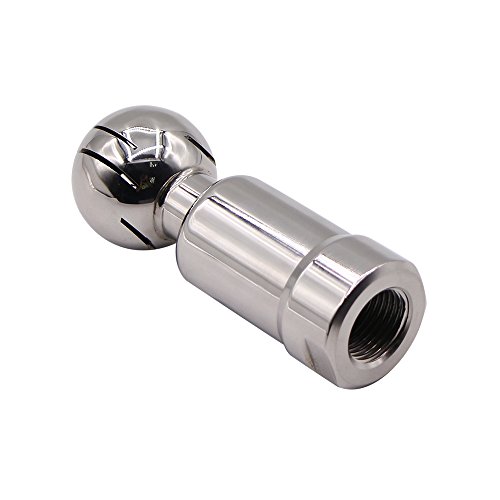
Features: Connection: 1/2″ NPT Female Thread; Ball Diameter: 38mm; Minimum working pressure: 0.3 MPa.
Best for: Small-bore piping systems or tanks with 1/2″ ports seeking precise, rounded spray coverage. Better for compact systems where larger spray balls wouldn’t fit.
Caution: Lower pressure may be insufficient for larger tanks or high-viscosity cleaning solutions; verify operating pressure before use.
Geife 1.5″ TC To 3″ TC Rotary CIP Ball

Features: Fully constructed by SS304 stainless steel. Polished and cleaned inside and outside. 7.9 inch overall length, 6.26 inch through-wall penetration into tank.
Best for: Medium tanks requiring longer reach with 1.5″ inlet to 3″ outlet configurations. Choose this when hardware space allows longer assemblies without sacrificing spray coverage.
Caution: The longer profile may limit installation in compact tanks; confirm clearance before ordering.
DERNORD 1.5″ Tri Clamp CIP Ball

Features: Connection Types: Tri Clamp; Connection Size: 1.5 inch x 1.5 inch; Made of stainless steel 304; durable and long service life.
Best for: Systems with Tri Clamp fittings needing a straightforward, reliable cleaning head. Better for standard CIP routines in moderate-sized tanks.
Caution: Ensure Tri Clamp compatibility with your existing piping to avoid mismatches during installation.
VARMHUS 304 Stainless Steel 1/2″ NPT Rotary Ball

Features: Efficient 360° coverage; 0.5–1.5 meter spray radius; SS304 with mirror-polished surfaces; low-pressure operation at 0.3 MPa; stabilization via double ball bearings.
Best for: Clean-in-place tasks in small to mid-sized tanks where low-pressure operation and full coverage matter. Choose this if your system prioritizes corrosion resistance and easy cleaning.
Caution: Lower flow regions may require additional spray heads for complex geometries; verify total cleaning coverage for your tank geometry.
Geife 1.5″ TC To 4″ TC Rotary CIP Ball

Features: Fully constructed by SS304 stainless steel. Polished and cleaned inside and outside. 7.9 inch overall length, 6.26 inch through-wall depth.
Best for: Tanks with larger 4″ tri-clamp clover connections needing robust cleaning performance and extended reach. Choose this when your process requires more aggressive spray coverage in bigger vessels.
Caution: The larger configuration may demand more space and careful mounting; confirm compatibility with your vessel’s ports.
Buying Guide: Key Considerations For Rotating CIP Spray Balls
- Connection Type: Ensure compatibility with your tank ports (Tri Clamp, NPT, or Clover). Inlet-to-tank compatibility affects flow and spray geometry.
- Ball Diameter and Spray Radius: Larger balls provide broader coverage but may require more clearance. Consider your tank diameter and internal obstacles.
- Material and Finish: SS304 stainless steel with mirror polish resists corrosion and eases cleaning. Verify passivation and sanitary finishes for food and pharma use.
- Operating Pressure: Most options specify a minimum working pressure; confirm your CIP pump capacity aligns with the ball’s required pressure for effective spray.
- Length And Penetration: Longer assemblies penetrate deeper into tanks, which is beneficial for deeper vessels but may limit mounting options near tank rims.
- Maintenance And Durability: Look for simple, robust designs with few seals. Stainless steel construction typically offers longer service life in CIP environments.
- Tank Geometry: Complex internal features, baffles, and tubes may require multiple spray heads or alternate spray patterns for complete cleanliness.
FAQ
- What is a CIP rotating spray ball best used for?
They provide 360° spray coverage to clean inner tank surfaces evenly, suitable for dairy, beverage, and biotech CIP processes.
- Which connection type is most versatile?
Tri Clamp connections are common in sanitary environments, offering easy assembly and disassembly.
- Do larger spray balls require more maintenance?
Generally, larger balls demand more space and careful mounting but typically offer broader coverage with fewer spray heads.
- Is 0.3 MPa the minimum operating pressure for these balls?
Yes, several models list 0.3 MPa as a minimum; verify your CIP pump pressure to ensure proper spray performance.
- Can I mix NPT and Tri Clamp spray balls in the same system?
Yes, as long as the system has appropriate adapters or fittings to match each connection type.
- Which model is best for a small 1/2″ port?
The 1/2″ NPT options are compact and suitable for smaller ports, delivering adequate spray without oversized hardware.