Best Scrap Cable Stripping Machines for Efficient Copper Recycling
Answering the need for fast, safe, and reliable wire stripping, these machines are best for hobbyists, small-scale recyclers, and professional electricians handling scrap copper. The top picks blend automatic and manual options to match different volumes and power preferences. This guide highlights five models, explains who they suit, and compares features to help you decide which is right for you.
Summary table of chosen products
| Product | Best For | Key Benefit | Notes |
|---|---|---|---|
| High-volume scrap wire | Fast, 5-hole feed for 0.06″–1″ wires | Automatic, 180W, steel blade | |
| Versatile and efficient | Eight feeds, all-copper motor, wide range | Best for mixed wire sizes | |
| Heavy-duty recycling | 370W, 11 channels, up to 0.06″–1.5″ | High speed, durable base | |
| Smaller batches, portable | Drill or hand crank, 0.06″–1″ | Two operation modes | |
| Portable, on-the-go stripping | Adjustable blade for multiple sizes | Compact and lightweight |
CREWORKS 180W Electric Wire Stripper Machine

The CREWORKS 180W electric stripper is designed for speed and efficiency. It strips insulation from wires up to 1 inch in diameter at speeds up to 98 ft/min, powered by a durable 180W motor. It features five feed holes covering 0.06″ to 1″ wires, enabling quick processing of common sizes. An adjustable blade height and an emergency stop provide safety and control for bulk scrap work. Best for higher-volume recycling and workshops with steady workloads. Caution: ensure proper sizing to avoid jams when feeding thicker wires.
CREWORKS Manual Wire Stripper Machine

The manual CREWORKS stripper relies on a hand crank, with an option to connect a drill for automatic cranking. It uses three feed holes to strip wires ranging from 0.06″ to 1″ (1.5–25 mm). Blade height is adjustable for precise stripping, and the hand-crank approach makes it suitable for smaller batches or where electricity use is a concern. Best for DIYers and small shops handling mixed gauge scraps. Limitation: slower than automatic models for large volumes.
CREWORKS Automatic Wire Stripper Machine (8 Channel)
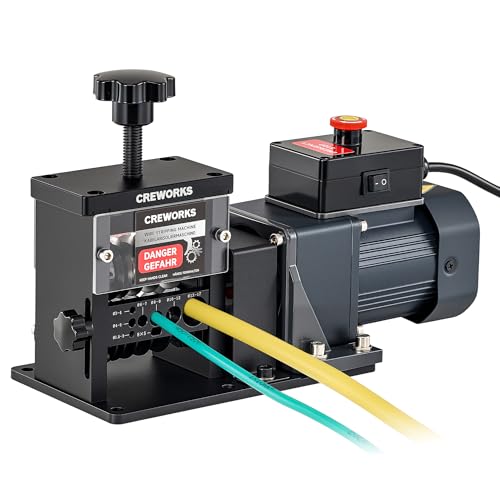
This automatic model offers eight feed channels and a 40W all-copper motor. It strips wires from 0.06″ to 0.67″ and uses five blades for clean, efficient cuts. Fine-tuning is possible through adjustable rollers, with vertical and horizontal adjustments to suit various sizes. Best for recyclers handling a variety of common wire gauges. Caution: setup accuracy matters to prevent blade wear on oversized wires.
Wayona Manual Wire Stripper Machine

The Wayona stripper supports two operation modes: hand crank and drill-powered. It covers wires from 0.06″ to 1″ (1.5–25 mm) and features adjustable blade-roller distance for precise stripping. Best for users who want flexibility between manual control and quick drill-assisted processing. Limitation: manual cranking can slow down very large batches unless a drill is used.
VEVOR Electric Wire Stripping Machine

The VEVOR model features a 370W motor and 11 channels, supporting wires from 0.06″ to 1.5″ with a stripping speed up to 98 ft/min. A transparent acrylic plate helps monitor operation, and the aluminum base aids portability. Best for heavy-duty recycling tasks where speed and durability are priorities. Caution: ensure the machine’s weight and base stability suit your workspace to avoid wobble during operation.
Buying Guide: Key Purchase Considerations
- Production volume: For high-volume scrap, choose automatic machines with multiple feed channels (e.g., 8-channel or 11-channel models) to maximize throughput.
- Wire size range: Confirm the machine supports your typical wire sizes (0.06″ to at least 1″ or more). Look for adjustable blade height and roller spacing for precision.
- Power source: Decide between electric-only and dual-mode (manual plus drill-powered) options based on available space and electricity access.
- Blade durability: Machines use steel or carbide-like blades. Manganese steel and all-copper motors are good indicators of longevity and smoother cuts.
- Safety features: Emergency stops, blade guards, and adjustable blade height reduce the risk of accidents during use.
- Portability and stability: Heavier units with sturdy bases perform better in workshops; lighter models suit mobile setups or smaller spaces.
- Maintenance: Consider ease of blade replacement and cleaning to minimize downtime between batches.
- Price-to-value balance: Higher upfront cost can be justified by speed, multi-channel feeds, and long-term blade life for frequent users.
FAQ: Quick Answers for Buyers
- What is the best wire stripper for high-volume scrap?
Automatic machines with multiple channels (like 8-channel or 11-channel models) are best for high-volume scrap work because they process more wires with less manual effort. - Do manual wire strippers work well for large batches?
Manual or drill-assisted models are suitable for smaller batches or irregular jobs; for large batches, automatic or multi-channel machines perform better. - Can these machines strip all wire types?
Most are designed for copper wires within a specific gauge range. Check the specified diameter range and blade settings to ensure compatibility with your wires. - Is safety equipment necessary when using these machines?
Yes. Use eye protection, keep hands clear of blades during adjustment, and use emergency stop features when available. - Are there portable options for field work?
Yes, compact handheld or light manual/drill-powered models are designed for portability and on-site use. - How do I maximize scrap value with these tools?
Strip insulation efficiently and maintain wire purity; clean copper typically yields higher scrap value at recycling centers.