Best Second Stage Propane Regulators for Reliable LP Gas Control
Choosing the right second stage propane regulator ensures safe, consistent pressure to appliances while accommodating a first stage regulator at the tank. This article highlights top options, comparing compatibility, outlet pressures, and connection types to help American buyers select a regulator that fits their propane system and usage needs. The selections below prioritize durable construction, standard 9–13 inches water column (in WC) regulation, and clear labeling for easy field adjustments.
Summary at a glance: the following table outlines five regulators that align with common residential and light commercial propane setups, including inlet and outlet sizes, typical operating range, and mounting considerations. Use this quick reference to cross-check your existing first stage and hose connections.
| Product | Outlet Range | Inlet / Outlet | Mounting / Design |
|---|---|---|---|
| Marshall 1652-CFF Second Stage | 9–13 in WC | 1/2″ x 3/4″ NPT | Backmount |
| Marshall 1622-BCF Second Stage | 9–13 in WC | 1/2″ x 1/2″ NPT | Straight Through |
| Emerson-Fisher R622-DFF | 9–13 in WC | 3/4″ x 3/4″ NPT | Standard FNPT |
| Marshall 1642-DFF Generator Regulator | 9–13 in WC | 3/4″ x 3/4″ NPT | Side Output option |
| Emerson-Fisher R622-CFF | 9–13 in WC | 1/2″ x 3/4″ NPT | Standard FNPT |
These selections provide a variety of inlet/outlet configurations and mounting options to fit many installation scenarios, from backmount to inline paths. All listed units support the same general operating window of 9 to 13 inches of water column, making them suitable for typical residential and light commercial propane systems when used with a compatible first stage regulator at the tank. Each product is documented with its specific connection sizes and output behavior to simplify matching components.
Marshall 1652-CFF Second Stage Propane Regulator

The Marshall 1652-CFF features an 11″ water column output with a 1/2″ female NPT input and 3/4″ 90-degree female NPT output. This backmount design integrates with a first stage high pressure regulator at the tank, requiring roughly 10 PSI input. The unit offers adjustable output in the 9″ to 13″ water column range, supporting a stable propane supply for grills, heaters, and portable generators. Its configuration suits installations where a backmounted regulator is preferred for accessibility and space efficiency, especially on RV or trailer systems compatible with standard LP lines.
Marshall 1622-BCF Second Stage Propane Regulator

The Marshall 1622-BCF provides an 11″ WC output with a 1/2″ input and 1/2″ output in a straight-through design. This model is designed for easy inline installation and a compact footprint, still requiring a first stage regulator at the tank for the correct pressure feed. Output adjustment remains in the 9″–13″ WC range, enabling precise appliance performance for grills and appliances that require steady propane flow with minimal fluctuations during operation. Its straight-through layout helps conserve space in tighter installations.
Emerson-Fisher LP-Gas R622-DFF Second Stage
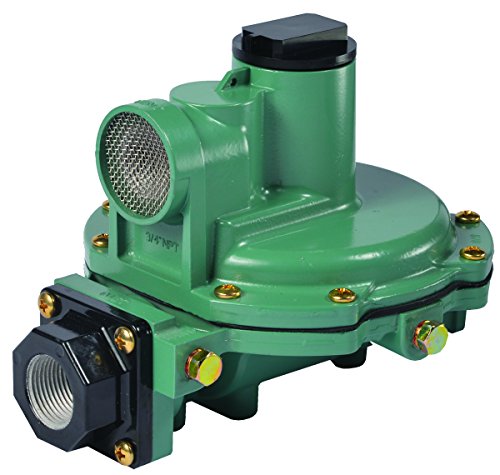
The R622-DFF from Emerson-Fisher offers a 9–13″ WC outlet range with a 3/4″ x 3/4″ NPT inlet/outlet. This regulator supports 10 psi maximum inlet pressure and an emergency inlet pressure at 50 psi, designed to operate with a compatible first stage regulator at the tank. The unit’s robust construction and standard FNPT sizing make it a common choice for mid-size propane systems used in homes and small commercial setups. The 9–13″ WC window provides reliable, predictable gas pressure across appliances that depend on consistent regulator performance.
Marshall 1642-DFF Generator Propane Regulator

This Marshall regulator is labeled 1642-DFF for generator use, with an 11″ WC output and a 3/4″ side outlet. Like the others, it requires a 10 psi first stage at the tank and offers adjustable output from 9″ to 13″ WC. The side output feature adds installation flexibility for configurations where a side tap is preferred. This model emphasizes a secure connection pathway and steady pressure suitable for backup power setups or off-grid applications that rely on LP gas for essential equipment.
Emerson-Fisher R632A-CFF Integral 2-Stage Regulator

The R632A-CFF is an integral 2-stage regulator with a 9–13″ WC output range and a 1/4″ x 3/4″ NPT inlet/outlet. It supports high-pressure readiness up to 250 psig in certain configurations, though its typical operational use centers on standard 10 psig feed with a suitable first stage. The integrally designed unit is a compact choice for installations where space is at a premium or where a combined two-stage regulation approach is desired for precise appliance performance in space-constrained enclosures.
Emerson-Fisher R622-CFF 2nd Stage
The R622-CFF is another Emerson-Fisher option offering a 9–13″ WC range with 1/2″ x 3/4″ NPT connections. It supports a 10 psi inlet in typical use with a distinct emergency inlet at 50 psi for safety. Known for durable construction and consistent regulation, this unit is suitable for a wide array of propane-powered appliances where reliable secondary-stage regulation is essential for safe, steady operation.
Buying Guide: Second Stage Propane Regulators
Key purchase considerations include outlet pressure range, inlet/outlet sizing, and mounting style. Ensure the second stage regulator is compatible with your first stage regulator to achieve the correct pressure at the appliance. Material quality and corrosion resistance matter for outdoor installations. Look for regulators with standardized NPT threads and clear labeling of input and output connections to simplify installation and maintenance.
- Compatibility: Confirm that the regulator works with your first stage (typically around 10 psi at the tank).
- Pressure Range: Most residential regulators operate in the 9–13 in WC window; verify the required range for your appliances.
- Connection Size: Match inlet/outlet sizes (1/2″, 3/4″, etc.) to your piping and hoses.
- Mounting: Backmount, inline, or side-output configurations influence placement and accessibility.
- Durability: Choose regulators with robust seals and corrosion-resistant materials for longevity in varying climates.
These options provide reliable, compliant choices for second stage propane regulation across typical residential and light commercial contexts. By aligning regulator specifications with first-stage pressure and appliance needs, you can maintain steady gas flow, improve appliance performance, and uphold safety standards in your propane system.