Best Semi Automatic Horizontal Bandsaw Options for Metal Fabrication and Shop Use
If you’re evaluating semi-automatic horizontal bandsaws, you want reliable cutting power, precise hydraulic downfeed, and sturdy frames for repeated daily use. This guide highlights five strong choices from KAKA INDUSTRIAL, Baileigh, and VEVOR that fit classic shop workflows—from small fabrication benches to larger industrial setups. Each product is assessed for who benefits most, what makes it stand out, and any practical limits to consider.
| Product | Best For | Why It Stands Out |
|---|---|---|
| KAKA INDUSTRIAL TBK-11 | Metal fabrication shops needing solid 11″ capacity | Powerful 3 kW motor, three speed options, hydraulic downfeed, double-column stability |
| KAKA INDUSTRIAL TGK-14 | Industrial workshops with mid-range capacity | 2.2/2.8 kW motor, dual speeds, precise hydraulic control, strong stability |
| KAKA INDUSTRIAL TGK-16A | Heavy-duty production environments | 4.0 kW dual-speed motor, robust hydraulic control, high stability |
| Baileigh BS-260SA | Workshops needing versatile miters | Dual-mitering with quick-release head lock and angled cuts |
| VEVOR Metal Horizontal Band Saw | Budget-conscious shops needing versatility | 7×12 cutting capacity, adjustable angles, quick-lock clamp |
KAKA INDUSTRIAL TBK-11 — 11 Inch Capacity Semi-Auto Bandsaw

The TBK-11 uses a robust 3 kW motor with three blade speed options (28, 45, 59 m/min). This combination supports metals, plastics, composites, wood, and rubber, making it versatile for mixed-material shops. The hydraulic downfeed offers smooth blade descent and adjustable feed speeds, aiding clean, uniform cuts. The double-column frame plus vertical lifting enhances stability, reducing vibration for accurate results in industrial settings.
Best for: shops needing strong all-around performance with flexible cutting speeds for various materials. Better for: operations that prioritize smooth hydraulic control and high stability. Avoid: setups with extremely thick materials beyond its 11″ capacity without reconfiguring tooling.
Key benefits
- Three blade speeds enable optimized cutting for different materials.
- Hydraulic downfeed provides controlled, consistent cuts.
- Double-column design improves rigidity.
Important consideration
Keep in mind your typical material thickness to ensure 11″ capacity matches your workload.
KAKA TGK-14 — 13.8 Inch Capacity Double Column Bandsaw
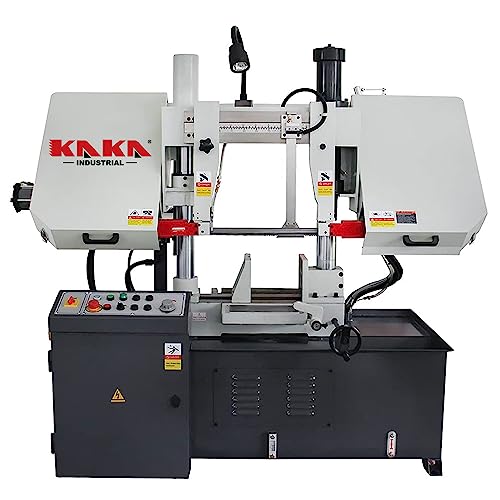
The TGK-14 blends a 2.2/2.8 kW dual-speed motor with a hydraulic system that enables precise, variable feed speeds. This yields smooth blades for different materials, enhancing cut quality and productivity. Its double-column structure with vertical lifting delivers high stability to minimize vibration during heavy-duty cutting, which is beneficial for frequent production cycles.
Best for: metal fabrication facilities requiring reliable dual-speed performance and precise feed control. Better for: operators who value consistent downfeed and stability. Caution: ensure the available floor space accommodates the taller lifting mechanism.
KAKA TGK-16A — 15.7 Inch Capacity Heavy-Duty Band Saw
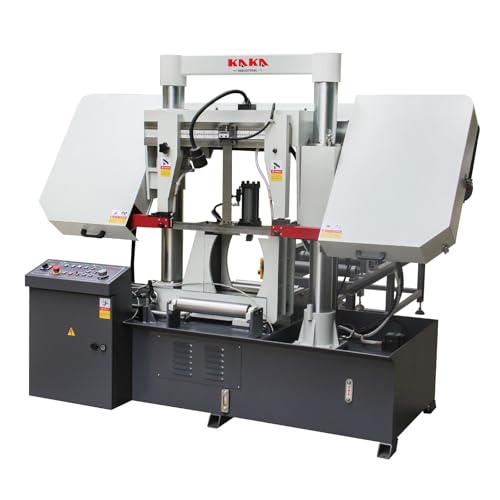
The TGK-16A upgrades to a 4.0 kW dual-speed motor with two blade speeds (141 and 220 ft/min). This provides robust cutting power for a wide range of materials, including metals and composites. The hydraulic control ensures smooth, accurate downfeed, while the rigid double-column structure and vertical lift support long-term durability in heavy-duty use.
Best for: production environments that require high power and reliable performance. Better for: operators who need faster cutting at higher blade speeds. Caution: higher power demands may require dedicated electrical supply and cooling in some shops.
Baileigh BS-260SA — 9″ Dual-Miter Semi-Auto Bandsaw

Baileigh’s BS-260SA focuses on miters, offering dual-miter head capability with a quick-release head lock for rapid angle changes up to 60 degrees right and 45 degrees left. This unit emphasizes ease of setup and repeatable angled cuts, making it well-suited for shops that regularly require precise miters for frame and bracket work. It features a compact footprint for small to mid-size shops.
Best for: fabricators prioritizing rapid, accurate miter cuts. Better for: setups needing frequent angle changes with minimal downtime. Limitation: the 9″ capacity is smaller than some larger industrial models, so consider material size requirements.
VEVOR 7×12 Horizontal Band Saw — Versatile Entry Model

The VEVOR model offers a 7 x 12 in cutting capacity with a 1.1 kW motor and selectable speeds across four ranges. It supports horizontal and vertical cutting modes, making it a flexible option for metal, wood, and plastic tasks. A quick-lock clamp helps hold materials steady, and a manual fine-tuning mechanism supports precise alignment for straight and angled cuts up to 45 degrees.
Best for: budget-minded shops needing a versatile, entry-level bandsaw. Better for: users who want both horizontal and vertical cutting capability in one machine. Caution: lower power may be less suitable for heavy-duty industrial metals or thick sections.
Buying Guide
How to choose the right semi-automatic horizontal bandsaw
Consider blade capacity (width and height) relative to your typical material sizes. Larger capacities enable thicker sections but require more floor space and power. Hydraulic downfeed improves cut consistency, especially on varied materials, but ensure the system’s responsiveness fits your workflow.
Power and speed considerations
Motors range from about 1.1 kW to 4.0 kW with single or dual-speed options. Higher power supports tougher materials and thicker sections, while dual-speed setups let you optimize for steel, aluminum, or nonmetals. Verify electrical requirements align with your shop’s electrical system.
Stability and frame design
Double-column frames with vertical lifting reduce vibration and improve accuracy during long runs. Stability is especially important for straight cuts and consistent tolerances. If your shop handles frequent, repetitive cycles, prioritize machines with rigid construction.
Versatility: miters and angles
Many semi-automatic bandsaws offer mitering heads or both horizontal and vertical cutting modes. If your work includes frames, brackets, or angled cuts, a model with quick-angle adjustments and solid stop points can save downtime and improve repeatability.
Maintenance and support considerations
Look for straightforward hydraulic systems, accessible blade tensioning, and durable blade wheels. Brands with established service networks typically provide easier parts replacement and service intervals, which minimizes downtime in busy shops.
FAQ
- What is a semi-automatic horizontal bandsaw? It is a bandsaw with automated downfeed and blade control, often including hydraulic or electric feed options, used for cutting metal and other materials.
- Which bandsaw has the best balance of capacity and power? Models like TGK-16A and TBK-11 offer strong power and decent capacities suitable for mid-to-heavy workloads.
- Is hydraulic downfeed necessary? It improves cut consistency and reduces operator fatigue, especially on harder materials, but some smaller models rely on manual feed.
- What should I consider besides capacity? Stability, ease of alignment, speed options, and compatibility with common cutting materials (steel, aluminum, plastics) are key.
- Can I use these machines for vertical cuts? Yes, several models support vertical cutting modes, offering flexibility for different part geometries.
- Do these saws require special electrical setups? Higher-powered units may require appropriate outlets or dedicated circuits; verify your shop’s electrical capacity before purchase.