Best Single Fork Pallet Jack for Warehouses and Retail
Choosing the right pallet jack improves efficiency, safety, and uptime in warehouses, factories, and retail environments. This guide highlights five highly capable single fork pallet jacks with 27″ x 48″ forks and strong load ratings, focusing on reliability, maneuverability, and ease of use. Each model below is evaluated for typical warehouse duties, including doorways, aisles, and loading docks. Use the quick reference table to compare core specs at a glance.
| Product | Brand | Capacity | Fork Size | Notable Feature |
|---|---|---|---|---|
| Global Industrial Industrial Duty Pallet Jack | Global Industrial | 5500 lb | 27″W x 48″L | Spring loaded loop handle |
| Global Industrial High Capacity Pallet Jack | Global Industrial | 6600 lb | 27″W x 48″L | 3-stage fingertip control |
| Global Industrial Standard Duty Pallet Jack | Global Industrial | 5500 lb | 27″W x 48″L | Red powder coat |
| Ezmhbro Standard Duty Pallet Jack | Generic | 5500 lb | 27″W x 48″L | Nylon wheels, leak-proof pump |
| Tory Carrier Manual Pallet Jack | T Tory Carrier | 6600 lb | 48″L x 27″W | Leak-proof hydraulic pump |
Below are five detailed product sections. Each entry includes a concise overview, key features, and practical guidance for selection and use in everyday operations. All information reflects typical configurations and factory specs as listed by manufacturers and marketplaces.
Global Industrial Industrial Duty Pallet Jack
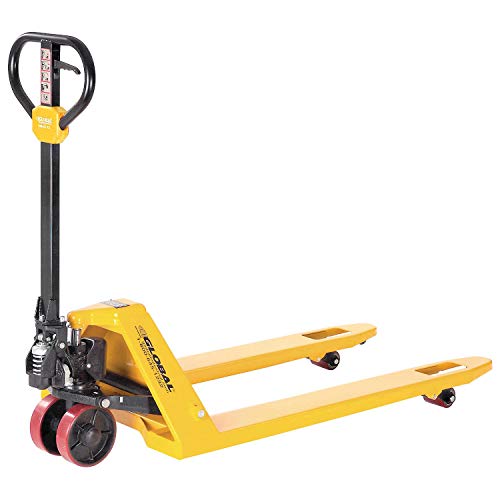
The Industrial Duty model offers a 5500 lb capacity with 27″ W by 48″ L forks. It features a spring-loaded loop handle that returns upright to reduce bending during retrieval, and a raised height of 7-3/4″ with a lowered height of 3″. A 3″ non-marring load roller plus 7″ polyurethane steer wheels enable a smooth, controlled ride and a broad steering arc of about 190 degrees. This setup suits general warehouse workloads where occasional high-stacking is common and doorways may be narrower than full pallet dimensions.
Key considerations include compatibility with standard pallets, ease of maintenance, and the balance between wheel durability and floor protection. The non-marring rollers help protect sensitive floors, while the wheel configuration supports decent maneuverability in tight spaces. For operations prioritizing upright handle retrieval and low-maintenance performance, this model provides a solid baseline option.
Global Industrial High Capacity Pallet Jack

This high-capacity pallet jack increases load limits to 6600 lb and uses a three-stage fingertip control along with a safety loop handle that springs back to the upright position. It uses 3″ polyurethane load wheels and 7″ polyurethane steer wheels, delivering a robust ride with a steering range of about 200 degrees. The design emphasizes ease of operation, reducing fatigue during repetitive lifts and moves in busy facilities.
Consider its higher capacity versus standard models when your operations frequently handle heavier pallets or bulkier loads. The fingertip controls simplify operation for operators who require precise, one-hand management of lift height, travel, and lowering. Durability and maintenance needs should be evaluated against daily throughput and floor conditions in your warehouse.
Global Industrial Standard Duty Pallet Jack

The Standard Duty model consolidates a 5500 lb capacity with a 27″ W by 48″ L fork arrangement. It emphasizes a narrower overall width that aids pallet access through doorways while maintaining reliable hydraulic control. Manual operation of the hydraulic system is straightforward, and the mobility design reduces maintenance frequency and eliminates the need for daily recharging in typical work shifts.
When selecting this option, assess door clearance and aisle width, ensuring the jack can navigate existing layouts. The red powder coat provides visibility and protection against corrosion in moderate industrial environments. This model is a balanced choice for facilities needing dependable performance without extra bulk or complexity.
Ezmhbro Standard Duty Pallet Jack

Ezmhbro’s model advertises a 5500 lb capacity with 27″ × 48″ forks and a leak-proof pump. It relies on nylon wheels for reduced rolling resistance and durability, paired with standard 7″ polyurethane steer wheels for smoother steering. The design claims robustness with a focus on a leak-proof hydraulic system and increased reliability in everyday usage, potentially offering lower maintenance needs over time.
Consider the trade-offs between wheel material and surface compatibility—nylon wheels can fare better on smooth concrete but may perform differently on rough or uneven floors compared to polyurethane wheels. Use cases with frequent wet or oily floors should investigate wheel type compatibility and maintenance schedules to prevent premature wear.
Tory Carrier Manual Pallet Jack 6600 Lb

This 6600 lb-capacity model features 48″ L × 27″ W forks, a max lifting height of 7.3″, and a fork lowered height of 3″. It includes tapered fork ends with guide rollers to facilitate pallet entry and a hand-operated hydraulic pump for lift control. The pump and steel construction emphasize durability for heavy-duty environments, with a focus on controlled lowering and reliable performance under high loads.
Picking this model makes sense when maximum capacity and dependable performance under frequent heavy lifts are priorities. Operators should evaluate the ergonomic aspects of the lever and control placement, as well as the stability of the jack during extended duty cycles. Ensure that floor surfaces and doorway widths support the chassis dimensions for smooth operation in busy facilities.
Buying Guide: Key Purchase Considerations And Comparisons
Product selection should balance capacity, fork dimensions, maneuverability, and maintenance needs. Here are practical criteria to guide your choice:
- Load capacity: Match the typical pallet weight to ensure safe margins. Overflow risk increases with heavier pallets or uneven loads.
- Fork dimensions: 27″ W x 48″ L forks fit most standard pallets, but verify compatibility with your pallet stock and any oversized skids.
- Lift height and lowering speed: Higher lift height aids stacking; controllable lowering enhances safety during placement and unloading.
- Handle and controls: Spring-loaded handles improve upright retrieval; fingertip control reduces operator fatigue on repetitive tasks.
- Wheels and floor compatibility: Polyurethane wheels offer smooth operation on concrete; nylon wheels may excel in certain conditions but can wear differently.
- Durability and maintenance: Leak-proof pumps and robust frames lower downtime; inspect for corrosion resistance and field service availability.
- Ease of storage and transport: Foldable forks and compact designs aid storage and mobility when space is limited.
- Operational safety: Look for features such as stability during lift, clear visibility of load, and intuitive lowering controls to mitigate accidents.
- Facility fit: Consider doorway widths, aisle spacing, dock accessibility, and the typical pallet pattern used in your operation.
All models presented offer solid baseline capability for standard pallet handling tasks in American warehouses, retail backrooms, and light manufacturing. For busy operations, prioritizing higher capacity and smoother steering can reduce operator fatigue and increase throughput, while for spaces with tighter aisles, a model with narrower overall width and a tight turning radius will pay dividends. Always pair a pallet jack with proper operator training, routine maintenance, and periodic inspection to maximize lifespan and safety.