Best Small Commercial Pressure Washer for Pro-Grade Cleaning
Answering the need for compact, capable power washers that fit on job sites and in small fleets, this guide highlights five small-commercial units suited for contractors and professional handymen. These units balance portability with high cleaning power, making them ideal for deck restoration, painting prep, siding cleaning, and light commercial tasks. The buyers who benefit most are contractors with multiple small projects, service fleets needing reliable cold-water options, and pros who value mobility without sacrificing power.
The following summary table helps compare key strengths at a glance. It focuses on intended user, best-use scenario, and notable drawbacks to weigh against your workflow.
| Product | Best For | Limitation |
|---|---|---|
| Simpson 4400 PSI Gas PS60843 | Contractors needing high PSI and durable mobility | Gas-fueled; requires fuel management |
| IvyBess 4200 PSI Gas | Homeowners and light commercial tasks | Multiple nozzles; weight |
| IvyBess 4200 PSI 4GPM with wheels | Professional on-site cleaning | Heavier setup |
| Westinghouse ePX3500 Electric | Electric-only sites; quiet environments | Lower PSI compared to gas |
| Steupoek 4200 PSI Gas | Deep cleaning on tough jobs | Gas engine, maintenance |
Simpson 4400 PSI Gas Pressure Washer PS60843

Best for contractors needing maximum cleaning power in a portable frame. This unit delivers 4400 PSI at 4.0 GPM with a PowerShot feature and a premium 420cc CRX engine for rapid deck cleaning, wood restoration, and paint prep. The welded steel frame with powder coating offers durability and corrosion resistance, while 13-inch pneumatic tires improve maneuverability across uneven ground. The unloaded thermal relief helps prevent overheating on long jobs.
Small to mid-sized contracting crews, property maintenance pros, and demanding job sites where high pressure is required for rapid surface prep.
Why chosen: Combines strong cleaning power with robust build quality and mobility for tough commercial workloads.
Caution: It is gas-powered, so ensure proper storage and ventilation and follow fueling guidelines to avoid startup delays on remote sites.
IvyBess Gas Powered Pressure Washer 4200 PSI
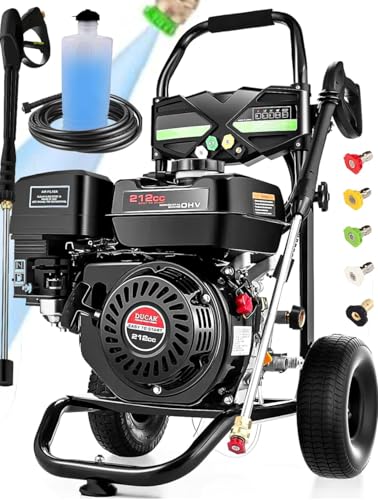
Best for homeowners and service pros who need strong cleaning power with flexible nozzle options. This unit generates up to 4200 PSI at 4.0 GPM using a 212cc gasoline engine paired with an axial cam pump. It includes five quick-connect nozzles and a 1 L soap tank for detergent applications, enabling versatile cleaning of siding, driveways, decks, and vehicles. The carb-compliant engine supports regulatory compliance in many regions.
Who it’s best for: On-site technicians, painters, and handymen who value a wide nozzle set and detergent capability for routine exterior cleaning.
Why chosen: The multiple nozzle options and soap capability expand cleaning versatility beyond basic scrubbing.
Caution: Heavier than electric units; plan for fuel handling and transport on job sites.
IvyBess Professional 4200 PSI Gas with 10″ Wheels

Best for on-site pro cleaning where mobility matters. This unit offers 4200 PSI at 4.0 GPM, a 10-inch wheel system for easy transport, and a 33-foot hose to extend reach. It uses a 212cc 7HP engine and includes five nozzles for a wide range of cleaning tasks, from driveways to fences to cars. The 33-foot hose length helps reduce repositioning during large areas.
Who it’s best for: Pros who frequently move between job sites and require a platform that’s easy to roll across varied terrain.
Why chosen: The wheel setup and hose reach improve job-site productivity and coverage area.
Caution: Heavier unit that may require more storage space and handling effort on steep sites.
Westinghouse ePX3500 Electric Pressure Washer

Best for quiet environments and electric-only sites. The Westinghouse ePX3500 delivers up to 2500 max PSI and 1.76 max GPM, with a compact 16.5-inch height and 19-pound weight. It features a pro-style 17.5-inch extendable wand, quick-connect nozzles, and a 25-foot hose. An onboard 20-ounce soap tank supports detergent cleaning for tougher jobs on decks, fences, and driveways.
Who it’s best for: Small businesses and contractors operating in noise-sensitive neighborhoods or indoor-outdoor studio setups.
Why chosen: Electric operation reduces emissions and noise while providing reliable cleaning power for light-to-moderate jobs.
Caution: PSI and GPM are lower than gas models, so consider this when tackling heavy-duty exterior tasks.
Steupoek 4200 PSI Gas Pressure Washer

Best for deep-cleaning tasks on patios, driveways, and vehicles. This machine reaches up to 4200 PSI at 4.0 GPM with a rugged 212cc engine. It includes five quick-connect nozzles and a 32-foot hose for extended reach. The 60º nozzle and 0º nozzle cover both broad and precise cleaning needs, while the 3L dual soap tank supports detergents for tougher cleaning cycles.
Who it’s best for: Pros handling stubborn grime on larger outdoor surfaces that require sustained, high-pressure cleaning.
Why chosen: The longer hose and varied nozzle set enable efficient cleaning across larger areas without frequent repositioning.
Buying Guide: Key Considerations For Your Small-Commercial Unit
Power source: Gas engines deliver high PSI and GPM, ideal for heavy-duty jobs and off-grid sites. Electric models are quieter, cleaner, and suitable for residential or noise-sensitive areas. Choose gas if you need mobility and maximum cleaning power; select electric for controlled environments and lower maintenance.
PSI and GPM balance: Higher PSI helps with surface prep and tough grime; GPM determines how quickly the area is cleaned. For decks and driveways, aim for at least 3000 PSI and 2.5–4 GPM. For more delicate surfaces, lower PSI with appropriate nozzles is safer.
Durability and portability: Look for welded frames, corrosion-resistant finishes, and sturdy wheels. If you operate on uneven terrain, prioritize larger wheels and a balanced layout to reduce operator fatigue.
Nozzle versatility: A multi-nozzle kit (0°, 15°, 25°, 40°, and soap/turbo) expands cleaning capabilities across surfaces from brick to siding. Ensure compatibility with quick-connect fittings for faster tool changes.
Hose length and reach: Longer hoses improve coverage, reduce repositioning, and help reach second-story windows or tall facades. Consider hose quality and kink resistance for reliability on busy job sites.
Detergent compatibility: Integrated soap tanks or compatible foam cannons simplify surface cleaning and paint prep. Verify the detergent type and dilution options for your typical workload.
FAQ: Quick Answers For Buyers
- What is the best choice for professional deck cleaning? – A high-PSI gas model with a PowerShot or similar feature is typically preferred for fast, aggressive cleaning on wood and paint prep tasks.
- Should I buy a gas or electric unit for a small business? – Gas models provide more power and mobility for on-site work; electric models are quieter and better for urban or noise-restricted environments.
- How important is nozzle variety? – Very important. Multiple nozzles allow safe cleansing of varied surfaces from siding to concrete without switching tools.
- Is a longer hose worth it? – Yes, it expands reach and reduces spurring around large properties, but it can add weight. Balance hose length with maneuverability.
- What maintenance should I expect with gas models? – Fuel management, regular oil checks, and air filter maintenance are typical; follow manufacturer guidelines for best results.
- Can these units remove graffiti or heavy grime? – Yes, with appropriate nozzle selection and technique, most models shown can handle exterior graffiti and heavy grime on durable surfaces.