Best Small High Pressure Vessels for Lab Use
When selecting small high pressure vessels, choose options that balance chemical compatibility, pressure ratings, and ease of sealing for reliable lab performance. This guide highlights five compact vessels ideal for research, synthesis, and closed-System experiments. Best for compact bench space, practical chemists, and educators needing predictable, maintenance-friendly vessels.
Summary table of selected products:
| Product | Volume | Material | Sealing | Best For |
|---|---|---|---|---|
| ALWSCI 75ml Heavy Wall Pressure Bottle | 75 ml | Borosilicate Glass 3.3 | 12 mm PTFE threaded plug | High-pressure reactions with accessible access |
| 50ml ALWSCI Heavy Wall Pressure Bottle | 50 ml | Borosilicate Glass 3.3 | 12 mm PTFE threaded plug | Workspace-efficient small-volume experiments |
| Deschem 200ml Glass High Pressure Bottle | 200 ml | Borosilicate Glass 3.3 | #15 PTFE threaded stopper | Moderate-to-large scale small-volume runs |
| Deschem 25ml PTFE Lined Hydrothermal Reactor | 25 ml | Stainless Steel with PTFE lining | PTFE-lined chamber | Rigid high-temperature/high-pressure reactions |
| BAOSHISHAN 25ml Hydrothermal Autoclave | 25 ml | 304 Stainless Steel | PTFE-lined chamber | Hermetic sealing for heating/cooling cycles |
ALWSCI 75ml Heavy Wall Pressure Bottle

Volume: 75 ml. Material: 3.3 borosilicate glass with high pressure resistance and low thermal expansion. Sealing: 12 mm PTFE thread plug with bushing and O-ring for secure, hand-tightened access while maintaining pressure integrity. Temperature and pressure range: rated for 60 psi at room temperature for the bottle and up to 150 psi at up to 120°C for the tubes. Best for: small-scale high-pressure reactions where precise access without tools is valued. Limitation: glass vessels are inherently brittle under rapid impact or thermal shock, so handle with care.
25ml Teflon Lined Hydrothermal Synthesis Autoclave Reactor
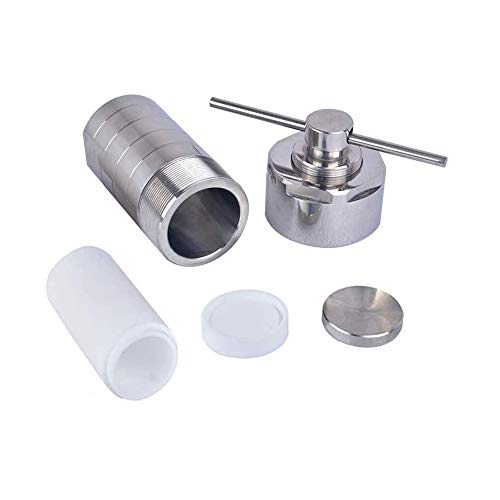
Volume: 25 ml. Material: 304 stainless steel with PTFE chamber lining. Delivers high-temperature, high-pressure capabilities suitable for hydrothermal reactions. Best for: researchers needing a corrosion-resistant steel vessel with a PTFE interior for inert reaction environments. Limitation: PTFE lining can be a wear point under aggressive mechanical manipulation; ensure gentle operation to preserve the seal.
Deschem 100ml Glass High Pressure Bottle

Volume: 100 ml. Material: Borosilicate glass 3.3 with clear graduations. Sealing: PTFE stopper type with threaded design. Best for: labs needing straightforward glass vessels with solid thermal stability and clear volume measurement. Limitation: glass vessels require careful handling to avoid impact and thermal shock.
Deschem 25ml PTFE Lined Hydrothermal Reactor

Volume: 25 ml. Material: Stainless steel chassis with PTFE lining. Sealing: PTFE-lined chamber designed to withstand high temperatures and pressures with corrosion resistance. Best for: bench-top, compact high-pressure synthesis with reliable PTFE containment. Limitation: smaller capacity; not ideal for larger reaction scales.
BAOSHISHAN 25ml Hydrothermal Autoclave

Volume: 25 ml. Material: 304 stainless steel with PTFE-lined chamber. Sealing: Hermetic PTFE sealing design with a precision locking mechanism for reliable sealing during heating. Best for: experiments requiring robust metal housing with a reliable PTFE seal. Limitation: assembly requires attention to locking mechanism to maintain a proper seal under pressure.
Deschem 200ml Glass High Pressure Bottle

Volume: 200 ml. Material: G3.3 borosilicate glass with an annealing point around 560℃ and a linear expansion coefficient of 32×10-7/℃. Sealing: PTFE thread stopper options. Best for: larger small-volume experiments needing more capacity while retaining glass chemical stability. Limitation: larger size reduces bench-space flexibility and increases handling effort.
Buying Guide: Key Purchase Considerations
- Volume requirements: Choose vessel size to balance reaction scale and workspace constraints. Small volumes (25–75 ml) suit rapid screening; larger volumes (100–200 ml) support larger batches.
- Material compatibility: Borosilicate glass (3.3) offers chemical stability and low thermal expansion for many reagents. Stainless steel with PTFE linings increases high-temperature resilience and corrosion resistance.
- Sealing integrity: PTFE thread seals and O-rings improve leak resistance. Verify thread size (12 mm, 18 mm, or 25 mm) and whether a bushing is included for easy hand-tightening.
- Pressure and temperature range: Ensure the vessel’s rated pressure and temperature meet your intended reactions, including any thermal cycling. Some bottles handle higher psi on stainless interfaces than pure glass.
- Chamber design: PTFE-lined chambers minimize chemical attack on metal, but liners may wear with aggressive reagents. Glass chambers provide inert environments but are fragile.
- Ease of use: Look for built-in graduations, access plugs, or quick-release locking mechanisms. Ergonomic features reduce wear on threads and improve sealing reliability.
FAQ
- What is the difference between glass and stainless steel high-pressure vessels?
Glass offers excellent chemical inertness and thermal stability for many reagents, but it is more fragile. Stainless steel with PTFE lining provides higher mechanical strength and corrosion resistance, suitable for more demanding conditions. - Which vessel is best for small-batch synthesis?
Vessels in the 25–75 ml range with PTFE sealing and accessible threaded plugs are ideal for small-batch experiments and quick access to the reaction port. - Are PTFE liners essential?
PTFE liners reduce chemical attack on metal housings and enhance corrosion resistance, especially in harsh chemical environments. They may wear over time with aggressive reagents. - Can these vessels handle heating and rapid cooling?
Most options are designed for controlled heating; check the max rate of temperature change and ensure compatible with your cooling method to avoid thermal shock, especially for glass vessels. - How should I maintain sealing components?
Regularly inspect O-rings, PTFE plugs, and thread seals for signs of wear. Replace damaged seals to maintain pressure integrity and prevent leaks. - Is there a risk with 3Mpa pressure in small vessels?
Working within the vessel’s rated pressure is essential. Do not exceed the manufacturer’s limits, and implement proper safety practices when operating at high pressure.