Best Small High Speed Motors for DIY Projects and RC Creations
Looking for a compact, high-speed motor to power RC cars, drones, model airplanes, or DIY gadgets? This guide highlights five top small high-speed motors, chosen for reliability, versatility, and ease of integration. Each option suits different project needs—from raw speed to controlled torque. Ideal buyers include hobbyists seeking quick replacements, model builders requiring compact form factors, and enthusiasts designing lightweight, high-rev devices.
Summary of selected products
| Product | Best For | Key Benefit | Voltage Range |
|---|---|---|---|
| AUTOTOOLHOME 12V DC Motor | RC cars, toy repairs | 2.3mm shaft for easy gear/pulley pairing | 6-12V |
| 6Pcs 280 Micro DC Motors | Multiple small projects | High speed up to 13500 RPM | 3-12V |
| ChgImposs HS390 12V Motor | Compact high-speed needs | Very high no-load speed | |
| 12V | |||
| MECCANIXITY Worm Gear Motor | Low-speed high-torque tasks | Self-locking, precise control | DC 12V |
| Coreless Motor 5 Pack | Model aircraft and micro toys | High speed, low current | 4.5V |
Autotoolhome 12V DC Motor — 6-12V Small Brushed Motor

This compact brushed DC motor runs on 6–12V and is designed for RC cars, toy repairs, and small hobby projects. It features a 2.3mm shaft, allowing straightforward compatibility with gears, pulleys, and couplers. The motor’s small size makes it a practical replacement in Traxxas or similar hobby vehicles, as long as the shaft diameter and wiring match the original part.
Best for: RC enthusiasts and DIYers needing a compact, versatile motor for lightweight vehicles and gadgets.
Why selected: The 2.3mm shaft and 6–12V operation cover a broad range of small assemblies, reducing adaptation work for common hobby parts.
Caution: Verify original motor size and wiring before ordering to ensure proper fit and electrical compatibility.
6Pcs 280 Micro DC Motors — 3V-12V, 13500RPM
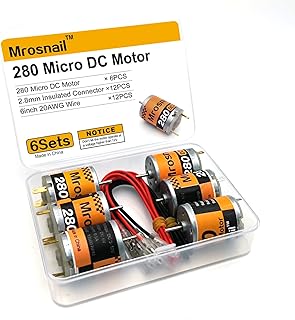
This set includes six micro DC motors with a broad 3–12V operating range, enabling multiple concurrent projects. At up to 13,500 RPM and 0.5A, these motors deliver high-speed performance suitable for RC boats, model airplanes, and other small toys. Efficient power usage helps extend battery life in compact designs.
Best for: Multi-project kits and enthusiasts building several small devices at once.
Why selected: The wide voltage range and high RPM provide flexibility for hobbyists experimenting with different toy or micro-robot ideas.
Caution: 0.5A current specification means verify your power supply can safely handle multiple motors simultaneously.
ChgImposs HS390 DC Motor — 12V, 22000RPM High Speed

The HS390 is a 12V micro motor delivering an impressive no-load speed of 22,000 RPM. It provides strong output power (~18W) while maintaining low noise and current draw. Its compact size makes it suitable for DIY toys, small appliances, or precise high-speed drives where space is limited.
Best for: Projects requiring very fast, compact power without bulky gearing.
Why selected: The high RPM at 12V offers ready-to-use speed for fast-moving micro devices, reducing gearing requirements.
Caution: High speed can demand robust mounting and vibration damping to avoid mechanical stress on the assembly.
MECCANIXITY DC12V Worm Gear Motor — 16RPM, Self-Locking

This worm gear motor combines a 12V DC motor with a gearbox to dramatically reduce speed while increasing torque. Its self-locking feature helps hold position when power is off, supporting applications that require stable, controlled movement. Overall dimensions are compact, making it suitable for automotive, home appliances, and robotics projects that need precise positioning at low speeds.
Best for: Projects needing high torque and stable holding power at low speeds.
Why selected: The self-locking mechanism simplifies motion control and safety in small automated devices or actuators.
Caution: Transmission adds mechanical complexity; ensure mounting matches the gearbox dimensions and shaft size.
Coreless Motor Pack — 5 High-Speed Micro Motors

This five-pack of micro coreless motors operates at 4.5V with a remarkable 32,250 RPM and low current draw. The small diameter (about 4 mm) and short height enable direct integration into micro aircraft, small toys, and vibration devices. Commonly used as replacements for damaged motors due to their compact form and efficiency.
Best for: Lightweight micro devices requiring very high speed in a small package.
Why selected: The high RPM and low current are ideal for compact, power-efficient models and toys.
Caution: Ensure the operating voltage matches your project’s power source to avoid overheating or reduced lifespan.
Buying Guide: Key Considerations For Small High-Speed Motors
- Voltage compatibility: Match motor voltage (often 3–12V or 4.5V) to your battery or power supply. Higher RPM often requires sufficient current capacity.
- Shaft size and mounting: Confirm shaft diameter (such as 2.3 mm) and mounting holes fit your gears, pulleys, and chassis.
- Torque vs. speed: High RPM motors are fast but may have lower stall torque. For lifting or moving-load tasks, consider gear motors offering higher torque at manageable speeds.
- Form factor: Evaluate motor dimensions, including length and diameter, to ensure fit within tight enclosures or small vehicles.
- Mechanical coupling: Gearboxes or worm gears add torque and holding power but increase size and complexity. Choose accordingly.
- Continuous vs. peak performance: Look for continuous operation ratings if the motor will run for extended periods; avoid excessive heat buildup by planning cooling or duty cycles.
- Application alignment: For RC toys, ensure compatibility with existing gear trains and battery capacity. For robotics, prioritize reliability and predictable speed control.
Frequently Asked Questions
- What motor is best for a lightweight RC car?
– A compact 6-12V brushed DC motor with an appropriate shaft size is often suitable, paired with a compatible gearbox if higher torque is needed. - Do high RPM motors require special power supplies?
– Yes. Some high-speed motors demand current within safe limits. Check the current draw and ensure your battery can supply peak current without voltage sag. - Can I use gears with any motor?
– Gears must match the shaft diameter and be compatible with the motor’s torque and speed. Verify gear pitch and bore before assembly. - Is a worm gear motor better than a plain DC motor?
– For applications needing high torque and self-locking capability, worm gear motors offer advantages, though they are typically slower and bulkier than direct-drive motors. - What maintenance is needed for micro motors?
– Keep motors clean, ensure secure mounting, and inspect wiring for wear. For brushed motors, occasional commutator cleaning can improve performance. - Are coreless motors more efficient than brushed motors?
– Coreless designs can offer higher efficiency and rapid response with lower inductance, which is beneficial for precise control and light weight, though availability varies by model.