Best Small Lab Vacuum Pumps for Quick, Clean Filtration
Small lab vacuum pumps are essential for rapid filtration, solvent handling, and sample preparation without introducing oil contamination. The following picks cover oil-free, portable models with quiet operation, reliable performance, and durable construction. Each option supports common lab tasks, from filtration of viscous liquids to generating steady negative pressure for precise experiments. Read on to compare features, reliability, and convenience across five top-rated units.
| Product | Brand | Key Feature |
|---|---|---|
| Oilless Vacuum Pump, 15L/Min With Dual Pressure | GOYOJO | Oil-free, dual ports, portable |
| LAB FISH Lab Vacuum Pump 10L/min | LAB FISH | Oil-free, anti-slip base, quick filtration |
| LACHOI Lab Vacuum Pump Portable | LACHOI | Oil-free, dual pressure, compact |
| ScitoLAB Vacuum Pump 50 L/Min | ScitoLAB | Oil-free, silenced, vacuum meter |
| WEST TUNE Lab Diaphragm Vacuum Pump | WEST TUNE | Oil-free, quiet operation, 10 L/min |
When choosing the right pump, consider filtration speed, cleanliness (oil-free operation), noise level, portability, and how easily the unit integrates with standard lab setups. The following sections profile five strong options, highlighting what makes each model suitable for small-scale lab workflows, education settings, and hobbyist applications that demand reliable, oil-free performance.
Oilless Vacuum Pump With Dual Pressure

This GOYOJO unit delivers oil-free operation with a diaphragm design, eliminating oil changes and reducing contamination risk in clean rooms and chemical labs. The pump achieves 10–15 L/min filtration speed, significantly cutting processing time versus gravity-based methods. Dual ports enable pumping and blow-back capabilities, and flow can be tuned to handle solvents or viscous liquids, offering versatile use in sample prep, epoxy curing, and silicone mold work. A compact frame and metal handle support easy transport between benches, while silicone pads and a quiet outlet minimize turbulence and noise.
What to consider: The oil-free diaphragm system promotes cleaner work environments, but users should confirm compatible tubing and fittings for their specific filtration setup. Temperature stability and reliability over extended runs are typical considerations for continuous filtration tasks. This model suits quick-turnaround projects where clean operation and flexibility matter more than extreme throughput.
LAB FISH Lab Vacuum Pump 10L/min

The LAB FISH model emphasizes fast filtration with an oil-free design, pulling 10 L/min to accelerate laboratory workflows that rely on rapid filtration. The diaphragm pump runs without oil changes, reducing maintenance and minimizing oil mist risk in sensitive experiments. A notable feature is the anti-slip base with four pads, ensuring stable operation on busy workbenches and quiet performance during filtration tasks. It is well-suited for essential oils, e-juice, home-brewing, and other applications where quick filtration and cleanliness matter.
Considerations for this unit include evaluation of overall noise in shared spaces and compatibility with existing hoses or filtration manifolds. Its compact size makes it a good fit for desktop lab setups or educational environments where hands-on demonstrations require reliable, oil-free vacuum without frequent upkeep.
LACHOI Lab Vacuum Pump Portable

This portable unit emphasizes cleanliness and portability with an oil-free design that protects high-cleanliness processes. The LACHOI model highlights stable operation across varied environments via an advanced control system and quality materials. Its two cooling holes design aids heat dissipation, while four rubber anti-slip feet reduce movement and vibration. The compact form and carrying handle facilitate easy transport between workstations, making it ideal for classrooms, field labs, or quick in-lab filtration tasks where consistent vacuum is essential.
Key points include assessing your required dual-pressure capability and how the unit integrates with your filtration flasks and tubing. Its emphasis on stability and quiet operation supports prolonged use in busy labs, though some users may prefer models with built-in vacuum gauges for real-time pressure monitoring.
ScitoLAB Vacuum Pump 50 L/Min

The ScitoLAB pump offers a higher throughput suitable for larger filtration tasks or busy lab environments where time matters. It features an oil-free design and a built-in vacuum meter, allowing real-time monitoring of vacuum levels. A newly upgraded silencer reduces noise, creating a quieter workspace while maintaining decent airflow at up to 50 L/min. The compact aluminum housing contributes to durability, and the unit’s maintenance-free operation aligns with labs prioritizing minimal downtime and clean operation.
Considerations include balancing filtration speed with noise tolerance and ensuring the vacuum meter is easy to read under ambient light conditions. For educational settings or research labs needing quick filtration across multiple samples, this model provides a reliable blend of performance and ease of use without the need for oil maintenance.
WEST TUNE Lab Diaphragm Vacuum Pump
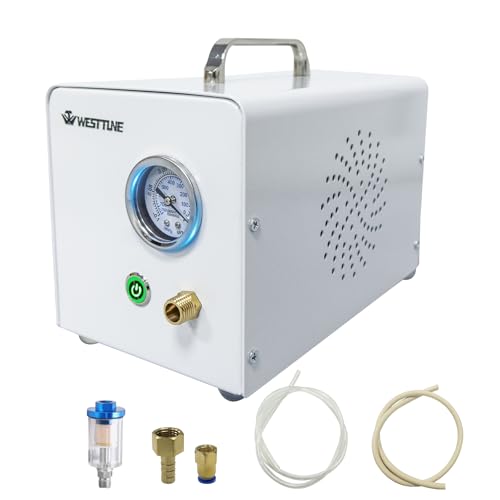
The WEST TUNE unit emphasizes oil-free operation with a stated 10 L/min capacity, designed to minimize maintenance burdens and keep the lab environment clean. The pump includes two rubber tube options and a noise-reduction device on the air outlet to lower operational noise while preserving stable performance. Its oil-free diaphragm setup makes it suitable for routine filtration, sample preparation, and other tasks where oil contamination must be avoided. The design focuses on reliability and quiet operation for long sessions at the workbench.
When evaluating this model, consider the availability of spare hoses and the compatibility of the tubing with existing filtration setups. Its 10 L/min rating aligns well with standard benchtop filtration tasks, offering a balance between speed and quiet operation for classrooms or small labs with modest throughput needs.
Buying Guide: Key Purchase Considerations
Oil-free operation tops the list for labs needing clean, contamination-free environments. When selecting a small lab vacuum pump, consider:
- Filtration speed and flow rate: Match your typical filtration volume and liquid viscosity to the pump’s L/min rating.
- Oil-free design and maintenance: Oil-free diaphragms reduce mess and downtime, but ensure compatibility with your solvents and lab safety standards.
- Noise level and vibrations: Silencers, anti-slip bases, and noise-reducing outlets improve comfort in shared spaces.
- Portability and footprint: Compact, lightweight models on wheels or with handles simplify bench-to-bench workflow.
- Dual-pressure capabilities and monitoring: Units with positive/negative pressure modes and real-time gauges support more complex workflows.
- Tubing and accessories: Verify included hoses, connectors, and filters. Check compatibility with standard filtration flasks and adapters.
- Durability and warranty: Look for solid housing materials, corrosion resistance, and manufacturer warranties for ongoing assurance.
In practice, choosing between higher throughput and quieter operation depends on your lab’s layout and the typical filtration tasks. For classrooms or shared cores, a quieter model with solid stability may be preferable even if it sacrifices a bit of speed. For busy research settings, a 40–50 L/min capacity with a robust silencer provides efficiency without excessive noise. Finally, confirm that the model’s maintenance-free design aligns with your safety practices and doesn’t introduce new risks for your specific samples.