Best Small Plastic Molding Machines for DIY Projects
Looking for a compact plastic molding solution that fits a small workshop or hobbyist setup? This guide highlights five small plastic molding machines and related forming devices that are practical for DIY projects, prototype work, or educational use. Each pick is evaluated for who it’s best for, key strengths, and practical limitations.
The following table provides quick buyer-aligned snapshots of the five selected products. Use it to compare core capabilities at a glance.
| Product | Best For | Key Strength | Notes |
|---|---|---|---|
| ICZW Vertical Injection Molding Machine Semi-Automatic Pneumatic Plastic Extruder 20g | Mini creators and hobbyists | Low-cost, simple mold replaceability | 0-15g per cycle; adjustable temp 0-350°C |
| ICZW Vertical Injection Molding Machine Manual Plastic Extruder with Bench Vise and Test Mold 110V | DIY enthusiasts and small makers | Low-pressure, compatible with 3D-printed molds | 0-10g per cycle; cost-saving design |
| 100g Vertical Injection Molding Machine Semi-Automatic Pneumatic Plastic Extruder for ABS PVC PP PC PET | Small production runs | Broader material range; precise temperature control | 100g capacity; automatic reset feature |
| Plastvac P7 110V Dental Vacuum Forming Machine | Dental labs, school labs, hobbyists | Vacuum forming with two-forming modes | Powerful 1400W motor; quick sheet handling |
| Gekufa Dental Vacuum Forming Machine 110V Molding Machine Lab | General vacuum forming | Built-in vacuum pump; low-noise operation | All-purpose thermoplastics support |
ICZW Vertical Injection Molding Machine Semi-Automatic 20g

Best for: hobbyists and small makers who want a compact, low-cost injection option with easy mold swapping. This unit uses a simple hand-disassembled mold approach to enable multiple uses of one machine, and allows temperature control up to 350°C to handle materials like PEPP, ABS, and PS. The theoretical 0-15g per cycle capacity makes it suitable for small prototypes and custom parts.
Why chosen: Its simplicity and replaceable mold capability provide a flexible entry into molded parts without large equipment or high maintenance. The adjustable temperature range supports experimenting with common thermoplastics used in home labs.
Limitations: The theoretical injection amount is modest, which limits larger parts. Pneumatic support is minimal in this model, so success hinges on precise manual operation and mold design. Best used for small, simple shapes rather than production runs.
ICZW Vertical Injection Molding Machine Manual 110V

Best for: DIYers focusing on hands-on control and budget-conscious projects. This manual extrusion model uses a simple hand-disassembled mold and supports replacement molds for diverse outputs. It’s particularly appealing for those who want to use 3D printed molds in their process, making it a practical choice for small-scale experimentation.
Why chosen: It’s explicitly designed for low-pressure operation and easy mold swapping, enabling rapid iteration. The temperature range mirrors common engineering plastics, making it adaptable for varied DIY plastics projects.
Limitations: Lower maximum injection (0-10g per time) constrains part size. The manual operation means less automation, so throughput is slower than semi-automatic systems.
100g Vertical Injection Molding Machine (LABFENG)

Best for: small production runs and businesses needing a broader material scope. This unit advertises a wide range of applicable materials and features precise temperature control on the control panel, aiding consistent results across batches. An automatic reset function saves time between cycles and reduces manual effort.
Why chosen: The combination of wide material compatibility and precise heating helps ensure uniform heating and better product quality. The automatic reset improves workflow efficiency for frequent cycle changes or testing runs.
Limitations: While more capable, it remains a small-scale device. It requires careful setup and ongoing monitoring to maintain uniform results across different plastics and molds.
Plastvac P7 110V Dental Vacuum Forming Machine

Best for: dental labs, schools, and hobbyists needing reliable vacuum forming with built-in sheet handling. The Plastvac P7 offers two plasticizing processes—Conventional and Rotary—and a powerful motor that automatically generates vacuum during molding, which can speed up workflows for forming sheets.
Why chosen: It’s quick and practical for forming dental or small plastic parts, with a focus on ease of use and efficient sheet handling. The dual forming modes provide flexibility for different part geometries.
Limitations: The model is specialized toward dental/thermoforming tasks; those seeking strictly general-purpose molding may find it over-featured for simple projects.
Gekufa Dental Vacuum Forming Machine 110V
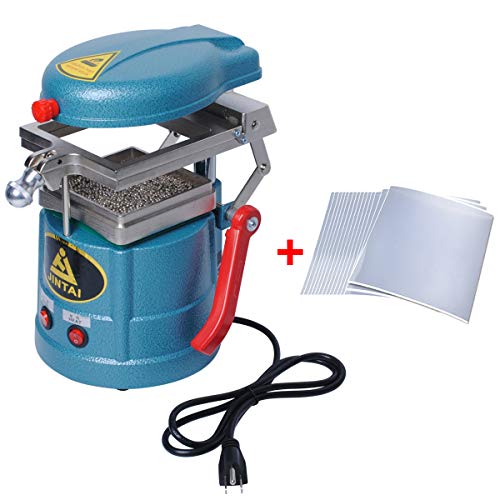
Best for: laboratories and hobbyists seeking a compact vacuum forming solution with built-in vacuum pump. This unit supports common dental thermoplastics and features a robust body with low-noise operation, making it suitable for small clinics or educational settings.
Why chosen: Built-in vacuum capability reduces the need for external compressors, simplifying setup. Uniform heat distribution and low noise are practical for classroom and clinic environments.
Limitations: Vacuum performance will depend on the compatible thermoplastics and sheet thickness. It’s best used where vacuum reliability and quiet operation are prioritized over large-format forming.
Buying Guide
What size should you pick?
Choose based on the largest part you intend to produce. Injection molding units in the 0-15g and 0-10g ranges are ideal for small prototypes and hobby parts. 100g machines suit small production runs or parts with higher material needs.
Which material range matters?
Look for machines with adjustable temperatures up to 350°C or higher to handle ABS, PE, PS, and PVC. If you plan to use 3D-printed molds, prioritize a setup that supports lower pressure and easy mold interchangeability.
What about automation and operation?
Semi-automatic models offer higher throughput, while manual variants emphasize control and low cost. If you want faster cycles and less manual exertion, favor units with automatic reset and pneumatic or motor-driven components.
Does forming vs. injection suit your needs?
For flat sheets and custom panels, vacuum forming is often quicker and cheaper per part. For precise, defined 3D shapes, injection molding with replaceable molds provides more consistency and repeatability for small runs.
What should you watch for in safety?
Ensure proper ventilation for heated plastics, use appropriate personal protective equipment, and follow manufacturer guidelines for electrical connections and nozzles. Small machines may still require stable mounting and clear workspaces to prevent accidents.
What about compatibility with DIY tools?
Some units support 3D-printed molds or DIY tooling; if you plan to prototype with custom molds, verify compatibility with your printer’s tolerances and the material’s molding requirements before purchasing.
Which choice balances price and capability?
Commonly, the lowest-cost options emphasize manual control and smaller outputs. If you expect ongoing prototyping or room to grow, a semi-automatic model with broader material support is often more economical in the long run.
Frequently asked questions
- What is the typical max output for small injection machines? The models shown range from about 0-15g per cycle to 100g per cycle, depending on the unit and mold design.
- Are these machines suitable for professional production? They are primarily intended for hobbyists, prototyping, or small-batch projects, not large-scale manufacturing.
- Can I use 3D-printed molds? Some units are designed to be compatible with 3D-printed molds, particularly in DIY and hobbyist scenarios.
- Do vacuum formers require an external compressor? Some models have built-in vacuum pumps; others may require additional equipment depending on the setup.
- What materials can I mold with these machines? The temperature ranges support common plastics such as ABS, PE, PS, PVC, and PET, among others, depending on the specific unit.
- Is maintenance easy? Most units are designed for straightforward operation and routine maintenance, but check mold alignment and temperature calibration regularly for consistent results.