Best Stepper Motor Linear Motion Solutions for Precise Automation
Direct answer: For reliable, ready-to-use stepper motor linear motion, consider compact, high-precision stages from VEVOR, RATTMMOTOR, FUYU, QINIZX, and Befenybay. These options cover a range of stroke lengths, load capacities, and mounting styles, making them suitable for engraving machines, CNC routers, laser systems, and DIY automation. The top picks target hobbyists to small shops needing stable, repeatable motion with straightforward integration. The following sections break down each product’s strengths and ideal buyers, plus a quick comparison to help decide which is best for your project.
| Product | Best For | Stroke / Travel | Key Benefit |
|---|---|---|---|
| VEVOR Linear Guide | Engraving and mini CNC builds | 1000 mm | Built-in NEMA 23 motor, high load capacity |
| RATTMMOTOR ZBX80 | Mid-size CNC and 3D printer beds | 100 mm | Strong aluminum rail, robust load rating |
| QINIZX DC 5V-9V | DIY laser engraving and light-duty motion | 3.1″ stroke | Compact, easy wiring, versatile drive |
| FUYU FSL40 Version 2.0 200 mm | Medium-range CNC and milling | 200 mm | All-aluminum, low-noise, good speed |
| Befenybay 100 mm | DIY CNC routers and positioning | 100 mm | Compact, straightforward Z/X/Y stage |
VEVOR Linear Guide With Ball Screw And NEMA 23 Motor

The VEVOR unit integrates a ball screw, a 16 mm diameter screw, and a built-in NEMA 23 stepper motor. It provides a 1000 mm effective stroke suitable for long-travel CNC and engraving rails. The design supports horizontal and vertical movement with a high load capacity of up to 10 kg horizontally and 5 kg vertically, making it a practical choice for mid-sized tooling and automation rigs. The anti-corrosion coating (≥10 μm electroplated) adds rust resistance for humid or basements environments, contributing to long-term reliability.
Best for: shops needing a long-travel, motorized stage with strong load handling and corrosion protection. Choose this if your project requires a single, integrated, motorized linear guide for engraving, milling, or 3D printing setups where space allows a larger footprint. Caution: the 1000 mm stroke may require careful alignment and mounting space; ensure your frame can accommodate the length during operation.
RATTMMOTOR ZBX80 100mm Stroke Linear Stage

The ZBX80 stage combines a 100 mm stroke with a robust aluminum alloy rail system. It supports horizontal loads up to 80 kg and vertical loads up to 20 kg, making it a strong choice for gantry-style setups or multi-axis configurations in CNC and automation projects. Its total length around 330 mm, including the motor, keeps the footprint compact for desktop CNC machines and placement where space is limited. The high-precision ballscrew and chrome-plated surfaces are designed to improve load-bearing performance.
Best for: users needing a compact, heavy-load capable linear stage for X/Y/Z axis applications or an upgrade to a small CNC router. Better for: users who prioritize load capacity and compactness over ultra-long travel. Caution: check the base plate dimensions and ensure compatibility with your mounting pattern and motor driver requirements.
QINIZX 5V-12V Stepper Motor Linear Rail
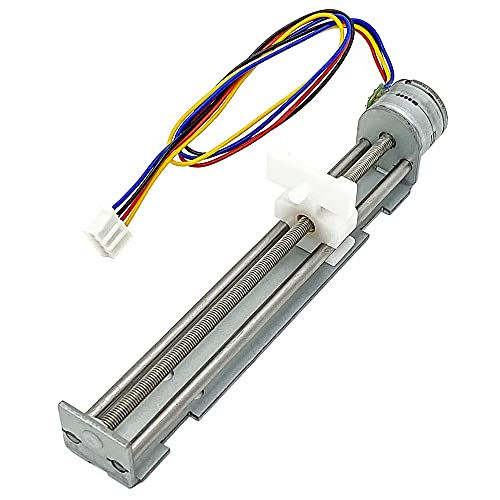
This compact kit runs on 5V-12V DC with a 2-phase, 4-wire stepper motor, offering a 18-degree step angle and a 3.1″ effective stroke. It is suitable for small DIY projects like laser engraving machines where a lightweight, simple drive is preferred. The design relies on an external stepper driver board, which gives flexibility for hobbyists who want to tailor step resolution and torque. Stated slider dimensions provide a simple sense of fit for small enclosures.
Best for: DIY enthusiasts building compact laser engravers or small desktop routers. Choose this if you want a small, affordable motorized rail and are prepared to pair with a separate driver board. Caution: this module requires an appropriate driver and control electronics; it is not a standalone motor driver solution.
FUYU FSL40 Version 2.0 Linear Guide With 200 mm Stroke

The FSL40 family uses a fully aluminum linear rail with a G1610 ballscrew, designed to resist rust and provide stable motion. This version lists an accuracy of ±0.02 mm and horizontal loading up to 25 kg, vertical up to 20 kg, with low noise during operation. The unit ships with a NEMA 23 stepper motor (5756 standard). It supports speeds up to 1200 rpm and a max theoretical speeds of 255 mm/s with no load, tapering under load. If faster speeds are needed, a 400W servo option is suggested by the vendor.
Best for: mid-range CNC or engraving projects needing a balance of speed, accuracy, and travel. Better for: users who want an all-aluminum module with integrated motor compatibility and relatively low-noise operation. Caution: performance figures are max values; actual speed depends on load and control electronics.
FUYU FSL40 Version 2.0 Long-Travel 600 mm
This 600 mm stroke option extends long-travel capabilities in a compact module with similar construction to the 200 mm version. It uses a G1610 ball screw and aluminum rail for strength and rust resistance, with comparable speed and acceleration figures under load. The NEMA 23 motor integration helps simplify integration into existing machinery. It is well-suited for larger engraving beds, milling add-ons, or multi-axis platforms that require more reach.
Best for: projects needing extended travel while staying within a modular, motorized rail system. Choose this if you require longer stroke without adding separate linear rails. Caution: longer travel increases the chance of deflection under load; ensure proper mounting rigidity for highest precision.
Befenybay 100 mm Mini Linear Rail With NEMA11 Motor

The Befenybay kit targets compact DIY projects with a 100 mm stroke and a NEMA11 stepper motor. It offers a 2.5 kg maximum horizontal load and 1 kg vertical load, providing straightforward motion for light-duty positioning tasks in small CNC routers or lab automation. The unit emphasizes repeatable positioning with a stated accuracy of ±0.05 mm and a speed envelope suitable for hobbyist projects. It remains a cost-effective choice for basic linear motion needs.
Best for: hobbyists and light-load desktop machines needing a compact, low-cost motorized stage. Caution: the lower load capacity means it’s less suitable for heavier tooling or aggressive milling operations.
Buying Guide: How To Choose Your Stepper Motor Linear Motion System
- Stroke length and travel needs: Match stroke to your machine’s work envelope. Longer travel adds reach but may require stronger mounting to minimize deflection.
- Load capacity: Consider horizontal vs. vertical loads. Heavier tooling demands higher capacity; calculate the worst-case loads during operation.
- Motor integration: Some units include a built-in NEMA motor; others require a separate driver. Ensure driver compatibility with your controller and electronics.
- Material and finish: Aluminum rails resist corrosion and balance weight with rigidity. Look for anti-corrosion coatings if humidity is present in your workspace.
- Precision and speed: Look for stated accuracy (in mm) and max speeds under no-load and loaded conditions. Real-world results depend on control software, drive current, and mechanical backlash.
- Mounting and footprint: Check base plate dimensions, mounting hole patterns, and overall footprint to ensure compatibility with your frame or gantry.
- Noise and vibration: Aluminum rails with ball screws generally offer smoother motion but may require dampening in noisy environments or precise finishing tasks.
- Upgrade path: If you expect future expansion, verify whether the same family offers longer strokes or higher load variants to avoid a full replacement later.
Frequently Asked Questions
- What is a stepper motor linear motion system best used for? It’s ideal for precise positioning tasks in CNC, engraving, laser-cutting, and small-scale automation where repeatable motion is required.
- Do I need a driver board with these modules? Some come with integrated motors; others require a separate driver board. Verify compatibility with your control system.
- Is a longer stroke always better? Not necessarily. Longer strokes require stable mounting and can increase system stiffness requirements. Choose based on usable work envelope and rigidity needs.
- What maintenance does a ball screw system require? Regular lubrication and periodic inspection of nut and screw surfaces help maintain accuracy and reduce wear.
- Which material is most durable for linear rails? Aluminum rails are common and offer good strength-to-weight ratios; stainless coatings add corrosion resistance in harsh environments.
- Can these systems be retrofitted to existing machines? Yes, many kits are modular and can be adapted to fit as upgrade components, provided mounting and electrical interfaces align.