Best Temperature Dry Block Calibrators for Accurate Calibration
Choosing the right temperature dry block calibrator is essential for maintaining the accuracy of thermocouples, resistance temperature detectors, and other temperature sensors. This guide highlights five top handheld and portable dry-well options from trusted brands, emphasizing range, portability, and durability. Each entry summarizes key features and suitability, helping you compare performance and application fit for precision calibration tasks.
| Product | Brand |
|---|---|
| CEM Dry Block Calibration BX150 | CEM |
| Fluke Calibration 9100S-D-156 HDRC | Fluke |
| Fluke Calibration 9100S-A-156 | Fluke |
| Fluke Calibration 9009-B-156 | Fluke |
| Fluke Calibration 9100S-C-156 HDRC | Fluke |
The table above identifies five relevant options for temperature dry block calibration. The selections balance high-temperature capability, portability, and rugged design, suitable for fieldwork or lab use. The following sections present each product with structured details to facilitate side‑by‑side evaluation.
CEM Dry Block Calibration BX150
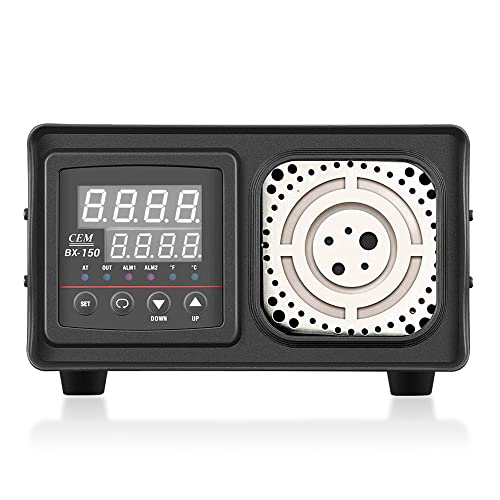
The CEM BX150 is a handheld dry-well calibrator designed for high-temperature operation. It covers a broad range from 33°C to 300°C (91.4°F to 572°F), enabling calibration across common industrial sensor classes. The device is positioned for portability while maintaining robust temperature stability for field use. Users should observe safety precautions, including handling probes and inserts only on heatproof surfaces and ensuring proper cooling before storage. The model emphasizes dry-well operation with strict guidelines against liquid exposure in the blocks.
Key considerations:
- Wide high-temperature range suitable for many calibration tasks
- Handheld design supports fieldwork and on-site calibration
- Safety guidance focused on hot components and heat management
Fluke Calibration 9100S-D-156 HDRC

The Fluke 9100S-D-156 HDRC features a compact, handheld dry-well system with a 35 to 375°C range, suitable for a variety of industrial and laboratory calibrations. It includes a RS-232 interface via the 9930 Interface-it v3.81 software, which supports data logging and calibration traceability. Fluke emphasizes portability and a US-origin build, aligning with reliability standards for critical calibration tasks. The HDRC designation implies high-density, rugged construction for demanding environments.
Key considerations:
- Compact, portable design ideal for on-site calibration
- 32-bit software and interface options enable data capture
- Wide 35–375°C range supports many sensor types
Fluke 9100S-A-156 Dry-Well
The Fluke 9100S-A-156 emphasizes portability as one of the world’s smallest and lightest dry-wells. This makes it particularly suitable for technicians who need a reliable calibration tool on the go. It’s described as a US-built device, with compact dimensions that facilitate easy transport between sites or within a workspace. The model’s focus on convenience does not sacrifice performance, providing dependable dry-well calibration for a range of high-temperature applications.
Key considerations:
- Ultra-portable design for field technicians
- American manufacturing provenance supports domestic serviceability
- Compact dimensions imply simple setup and quick measurements
Fluke Calibration 9009-B-156

The 9009-B-156 is a dual-block thermometer dry-well calibrator featuring two wells within a single block for simultaneous calibration tasks. It supports temperatures from –15 °C to 350 °C, enabling comparative calibration and cross-checks, which can improve efficiency in quality control environments. The unit is described as rugged, lightweight, and water-resistant, making it well-suited for challenging shop floors or field settings where durability matters.
Key considerations:
- Dual-well capability supports parallel calibrations
- Broad temperature span suitable for many sensors
- Rugged enclosure enhances durability in tough environments
Fluke Calibration 9100S-C-156 HDRC
The 9100S-C-156 HDRC is another slim, portable dry-well option with a 35 to 375°C range and a focus on reducing size while maintaining calibration accuracy. It features an RS-232 interface with 9930 Interface-it v3.81 software, enabling efficient data management and traceability. This model is positioned for professionals who require a compact yet capable device for precise calibration across a range of sensors and applications.
Key considerations:
- Smallest, lightest form factor among comparable models
- Integrated software support for calibration data handling
- High-temperature range supports diverse calibration needs
Buying Guide
- Temperature range: Consider the sensors you calibrate. If you work with many high-temperature probes, prioritize models with 300°C+ ranges and stable temperature control.
- Portability vs. capacity: Handheld dry-wells offer on-site flexibility, while larger units may provide more simultaneous wells or extended stability for batch calibrations.
- Number of wells: Dual-well or multi-well configurations enable simultaneous calibrations, increasing efficiency in production environments.
- Software and data logging: RS-232 interfaces and supported software help capture calibration data, ensuring traceability and compliance.
- Durability and form factor: For field use, rugged enclosures and heat-resistant surfaces reduce the risk of damage and improve reliability on-site.
- Brand and support: Reputable brands with US-based manufacturing often provide longer service life and easier access to support and parts.
- Safety considerations: Dry-well operation requires proper handling of hot inserts and careful cooling procedures to prevent injury.
- Calibration compatibility: Ensure the calibrator’s probe sizes and insert types are compatible with your thermometers and reference sensors.
When selecting, map your primary use case to the factors above. For field technicians, portability and quick setup may outweigh some advanced features. For labs performing frequent, high-volume calibrations, a multi-well or higher-precision unit with robust software support can deliver clearer returns on investment. Always verify the availability of spare parts, warranty terms, and service options in your region to maintain ongoing calibration capability.