Best TIG Welding Practice Kit Options for Beginners and Hobbyists
Direct answer: For new welders focusing on TIG practice, choose kits that offer consistently sized plates, robust mild steel, and a variety of shapes to practice precise bead control. The selected products below emphasize clean-cut edges, easy-to-handle material, and practical shapes that help you learn joints, angles, and multi-pass welding. Best for beginners seeking structured practice, best for progressive skill builders, and best for creative projects all surface in these picks.
| Product | Material/Thickness | What It’s Best For | Why It Stands Out |
|---|---|---|---|
| 40 PCS Welding Coupons, Hugbow | 11 Gauge Mild Steel | Structured beginner practice, basic cubes and boxes | Mixed plate sizes, included welding magnet for angle accuracy |
| 18 PCS Welding Coupons, Hugbow | 17 Gauge Mild Steel | Progressive skill development with multiple shapes | Thinner plates add challenge; varied shapes support technique depth |
| WelderElite 12-Piece, 11 Gauge | 11 Gauge Cold-Rolled Steel | Education and hobbyist practice | Laser-cut precision for clean edges and repeatable joints |
| ARCCAPTAIN 6-Piece | 201 Stainless Steel | MIG, TIG, Stick practice with box assembly | Uniform size, clean edges; box welding for joint alignment practice |
| Larbeti 49 Pieces with Magnets | 17 Gauge Carbon Steel | Comprehensive shapes including dice, cubes, cuboids | Large set; versatile frames with magnetic clamping |
40 PCS Welding Coupons Kit By Hugbow
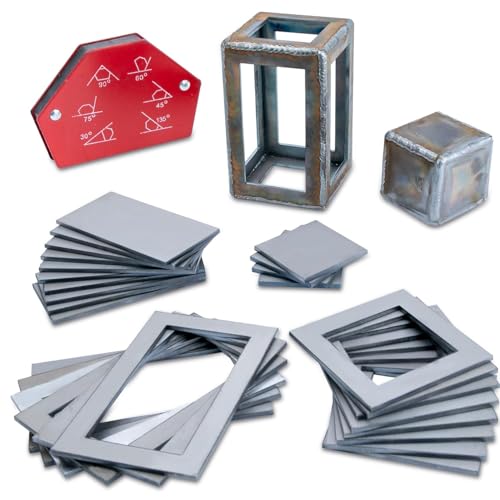
Best for: Beginners seeking a large, varied starter kit. Why: It combines multiple plate sizes (3×3, 2×2, 5×3, 4×2 inches) to allow basic cube and box builds, with 11-gauge mild steel for durability. The included welding magnet helps secure angles for consistent practice. Caution: Larger kits may overwhelm absolute beginners who prefer fewer options at first.
18 PCS Welding Coupons By Hugbow
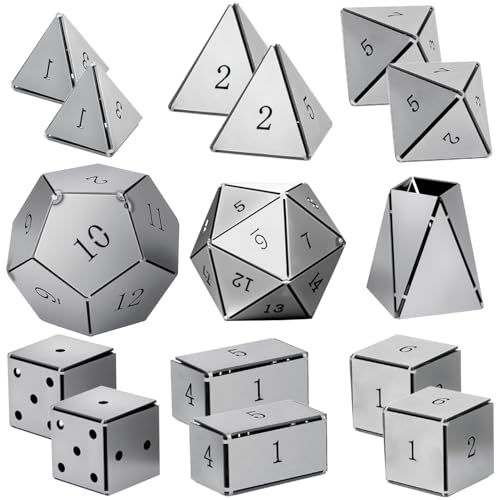
Best for: Intermediate welders expanding practice variety. Why: Made from 17-gauge mild steel, these plates are thinner, easing bend and shaping, with nine shapes offering progression from simple to moderately complex. Limitation: Thinner material can warp with aggressive heat if not controlled.
WelderElite 12-Piece Welding Coupons

Best for: Students and hobbyists focusing on precise sheet-metal practice. Why: The set uses 17-gauge cold-rolled steel for edge quality and accurate dimensions, making it suitable for controlled bead placement and learning sharp corners. Caution: Not all projects require 17-gauge; some users may want heavier or lighter stock for different weld techniques.
ARCCAPTAIN 6-Piece Welding Coupons

Best for: Welders who want structured, small-scale practice with box-style joints. Why: Made of 201 stainless steel, these plates can support consistent TIG, MIG, and arc practice while allowing box-building exercises that improve fit-up. Caution: Stainless stock behaves differently than mild steel—adjust heat and filler accordingly for best results.
Larbeti 49 Pieces Welding Practice Kit

Best for: Welders seeking a broad set with magnets for stable positioning. Why: Includes 48 coupons plus magnets and multiple frame shapes (dice, cubes, cuboids), enabling a wide range of practice scenarios. Caution: The larger set may require more storage space and organization to maximize learning efficiency.
Buying Guide
What material should you choose for TIG practice?
For TIG practice, mild steel is common due to its welding characteristics and cost. 11- to 17-gauge options provide a balance between ease of handling and realistic welding scenarios. Thinner stock (e.g., 17 gauge) can be easier for beginners but may warp with heat if heat input is not controlled.
How important are plate shapes and sizes?
Varied shapes (dice, cubes, boxes, and cuboids) help simulate real-world joints. A mix of small and larger plates supports both bead control practice and joint fit-up exercises. A built-in magnet can aid in holding plates at desired angles, improving repeatability.
What about stainless vs mild steel?
Stainless stock (such as Type 201) provides different heat behavior and corrosion resistance. It’s useful for learning how different metals react to heat, but beginners should first master mild steel before moving to stainless to avoid confusing material responses.
What is the best way to use these kits?
Start with basic square and butt joints on simple shapes, then progress to multi-pass welds on more complex boxes. Use the magnets to hold consistent angles, practice bead placement along straight and curved edges, and gradually increase joint complexity as confidence grows.
Safety and setup considerations
Work in a well-ventilated area with appropriate PPE. Maintain a stable workbench, clamp pieces securely, and keep the work area clean to minimize hazards. Follow machine-specific safety guidelines for heat, fumes, and arc exposure.
FAQ
- Q: Are these kits suitable for TIG-specific practice? A: Yes, they are designed for basic to intermediate TIG, MIG, and arc practice using mild steel or stainless samples.
- Q: Do these kits include magnets for angle accuracy? A: Several kits include welding magnets to help hold pieces at precise angles during practice.
- Q: Which gauge is best for beginners? A: 17-gauge gives a manageable thickness for beginners, while 11-gauge is more representative of real-world practice and improves skill transfer as you advance.
- Q: Can I use these for box and frame practice? A: Yes, many sets include pieces that can be welded into boxes, cubes, and cuboids to simulate real joints.
- Q: Do these kits require a special welder setup? A: They are compatible with standard TIG, MIG, and arc setups using common filler materials; always follow your welder’s instructions for materials and settings.
- Q: Is stainless steel necessary for TIG practice? A: It’s optional for variety; start with mild steel to build control, then introduce stainless to learn different heat responses.