Best Weighing and Bagging Machines for Small-Scale Packaging
Finding an accurate and efficient weighing and bagging machine helps smaller operations scale up with consistent fill weights. This guide highlights five reliable options, each suited for different materials and workflows. It’s ideal for bakers, spice makers, tea blenders, coffee roasters, and small manufacturers who need precise portions, hands-free operation, and compact footprints.
Summary of selected products:
- Hanchen Powder Filling Machine — Intelligent, high-precision powder filling with infrared discharge and foot pedal control.
- TREESNAIL 2-200g — Wide application for powders and granules with fast 8–16 packs/min and adjustable weight.
- MooKuQi Particle Filling Machine — Large 10–999g range, dual vibration for smooth flow, hands-free with foot pedal.
- ZERNEIL Particle Filling Machine — Copper inner core, dual vibration, adjustable weight and bag port options.
- Lumicasaler Automatic Weighing Filling Machine — 10–999g accuracy with 2g precision and mobility on wheels.
Hanchen Powder Filling Machine 1-20g

The Hanchen model uses intelligent weighing with a high-precision chip, a dedicated motherboard, and a vibrating disc to control fill cycles. It features infrared induction discharge, three speed levels, and a decimal-place accurate weight setting. Best for small-batch powders and granules that require careful handling, such as tea powders or spice blends.
Best for: small-batch operations that need accurate, adjustable dosing in grams and easy operation. Limitations: may require regular calibration to maintain precision across different materials.
TREESNAIL 2-200g Powder Filling Machine

Designed for dry powders and granules, this model emphasizes versatility in home and small business contexts. It offers 8–16 packs per minute, with accuracy around ±1–2% depending on material. A robust vibration system minimizes residue and supports stable filling for spices, coffee powder, flour, and similar items.
Best for: users needing a mid-range, high-throughput option for multiple powder types. Choose this if you want higher packing speeds without heavy industrial cost. Caution: not ideal for loose tea bags or irregular-shaped materials.
MooKuQi Particle Filling Machine

This unit covers 10–999 g with a dual-vibration design to improve material flow and accuracy. It uses a stainless steel build for durability and a large hopper to reduce refills. A foot pedal enables hands-free operation, making one operator able to manage the process efficiently in small-scale packaging lines.
Best for: operations needing a broad weight range and a robust, sanitary build. Limitation: some users may require longer setup to dial in for diverse materials.
ZERNEIL Particle Filling Machine
The ZERNEIL model highlights a copper inner core for stable performance under heavy use. It features smart control with adjustable weight and speed, plus dual vibration to reduce residue. With multiple bag outlet hopper sizes, it accommodates different bag styles and widths. Best for: producers needing precise control across varying bag formats. Caution: ensure compatible bag port size for your packaging needs.
Lumicasaler Automatic Weighing Filling Machine
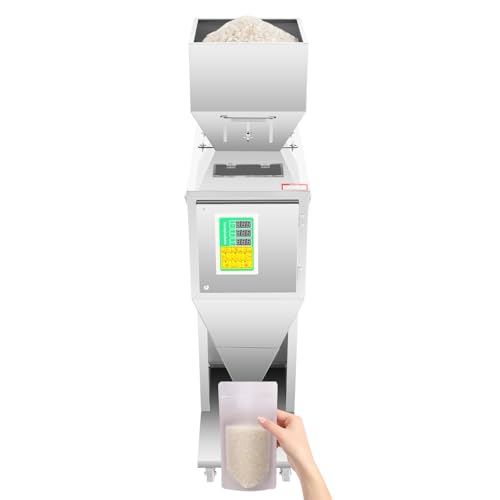
Lumicasaler delivers precise 2 g accuracy over a 10–999 g range with three speed settings and a production rate of 8–15 bags per minute. The unit uses stainless steel construction and four ABS wheels for mobility, making it suitable for temporary stations or flexible production layouts. Best for: teams needing reliable performance with easy mobility in a small factory or kitchen-ette setup. Caution: ensure your bags can fit the outlet spacing and weight range.
Buying Guide: Key Considerations For Picking The Right Machine
- Material compatibility: Are you packaging powders, granules, seeds, or coffee beans? Some machines handle only powders, while others support granules or mixed materials.
- Weight range and accuracy: Choose a machine whose weighing range covers your typical fill weight and offers the needed precision (for example, 2 g vs. ±1–2% depending on material).
- Throughput needs: How many bags per minute do you require? Higher speeds suit small businesses with steady demand, while lower speeds fit artisan or hobby-scale operations.
- Foot-operated vs. hands-free: Foot pedals enable single-operator control but consider safety and fatigue for longer shifts.
- Construction and cleaning: Stainless steel components and accessible cleaning paths reduce cross-contamination and simplify maintenance.
- Bag compatibility: Ensure the machine’s hopper outlets and bag widths match your packaging format.
- Portability and setup: Wheels and light frames help reposition equipment between workstations or storage; weigh the total footprint.
Comparative At-a-Glance
| Product | Best For | Weights | Throughput |
|---|---|---|---|
| Hanchen Powder Filling Machine | Small powders and granules | 1–20 g | Low to moderate |
| TREESNAIL 2-200g | Powders & granules, small business | 0.0044–0.44 lb (approx. 2–200 g) | Medium |
| MooKuQi | Broader weight range, versatile | 10–999 g | Moderate |
| ZERNEIL | Flexible bag formats | 10–999 g | Moderate |
| Lumicasaler | Mobility with precision | 10–999 g | Moderate |
Frequently Asked Questions
- What is the typical weigh range for these machines? Most options cover 10 g to 999 g, with several starting at 1–20 g for small powders.
- Are these machines suitable for powders and granules? Yes, many models specify compatibility with both powders and small granules, though some are optimized for uniform powders only.
- Do these devices require special tools for setup? Most units rely on a digital control panel and foot pedal; basic assembly typically involves hopper alignment and outlet configuration.
- Can these machines handle different bag sizes? Several models provide adjustable hopper outlets or multiple bag ports to fit varying bag widths.
- Is stainless steel construction important? Stainless steel improves durability, corrosion resistance, and ease of cleaning for contact with dry edible materials.
- What is the advantage of dual vibration systems? Dual vibration reduces material residue and promotes smoother, more consistent fills across materials with varying flow properties.